Opposition Leader Stephen Harper on Government Ethics

“The real issue is the systematic and systemic erosion of the public interest in favour of the narrow partisan interests of the [governing political party] and its friends. The ethical question is the mixing of the public interest with those narrow partisan interests and the use of the spending power of ministers and ultimately the prime minister…

“As I have said, on this and several other issues, the real scary part of the government is that it has lowered our expectations of what we should get from public officials. The difference between now and 1993 is that in 1993 people were outraged about what went on. Now people expect it. There is no difference. That is what we are really fighting against…

“When most people use the term corruption, they mean the abuse of power, as in power corrupts and absolute power corrupts absolutely. The system maintained by the government is one where power is centralized in Ottawa and the power in Ottawa is centralized in the cabinet and in the Prime Minister’s Office. It is a system that invites corruption….

“The (government) sees it as normal to flood their own constituencies with pork grants and contracts, not just as a matter of favourable legislation but even if such friends and such constituencies do not qualify under the government’s own rules, it will happen just the same…

“Most important, Canada needs a government that understands right from wrong, one that understands that the meaning of conflict of interest and corruption go beyond the letter of the criminal code and the written rules of conduct and into the spirit of good judgment, honesty, benevolence and integrity that all Canadians expect and deserve from their government.”

The author of those stirring words? Stephen Harper, circa 2002.

Don Braid: Harper cushions his campaign against Alberta-style surprise

Don Braid: Harper cushions his campaign against Alberta-style surprise

Prime Minister Stephen Harper and Alberta's NDP Premier Rachel Notley

THE CANADIAN PRESS/Jeff McIntoshPrime Minister Stephen Harper and Alberta’s NDP Premier Rachel Notley

Prime Minister Stephen Harper has decreed an election period as long as Pinocchio’s nose. Besides handing the Conservatives a severe money advantage, this makes it easier for Harper to switch campaign tactics if Alberta politics start breaking out all over Canada.

Alberta has an NDP government partly because of timing. The four-week campaign that ended May 5 was just long enough for Albertans to work themselves into a fine fury at Premier Jim Prentice’s Progressive Conservatives.

Prentice would surely have loved another two weeks to yank his wildly misguided campaign back into reality.

Complete Story

The Guardian view on Canada’s elections: is the Stephen Harper era over?

 – The October elections offer Canada a chance to return to the country’s best traditions
Tuesday 4 August 2015

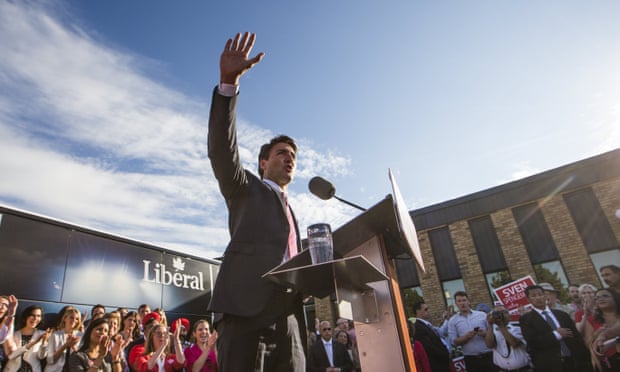
Canadian Liberal leader Justin Trudeau on the campaign trail

Justin Trudeau, the Canadian Liberal leader, campaigning in Mississauga on Tuesday. ‘Mean-spirited negative campaigning’ on behalf of Stephen Harper ‘is zeroing in on the youth and good looks of Trudeau.’ Photograph: Mark Blinch/Reuters

It is the second biggest country in the world, yet sometimes it seems almost invisible. Often ignored by its powerful neighbour, regarded with only distant affection by the two European countries from which its settlers came, and taken for granted by many nations who should be more grateful than they are for its help and mediation in the past, Canada ploughs a lonely furrow. Now it is heading toward an election that will determine whether it will continue along the predictable rightward course set by Stephen Harper as prime minister over the past decade or whether it can recover some of the verve and originality that once marked its politics, not least under Pierre Trudeau, whose son Justin is one of the contenders.

Under Mr Harper, Canada has not only moved to the right in almost every area of policy but has entered an era of highly calibrated, money-driven negative campaigning at odds with the courtesy that is one of the most attractive of Canadian qualities. So the result matters, obviously for Canada itself, but also for a world that has long been missing the special role it used to play on the international scene.

Money, its uses and its abuses, runs like a thread through Mr Harper’s time in power. At the very beginning, a scandal over the diversion of government funds under the then Liberal government helped him into office in 2006. Ironically, it then turned out that his Conservative party had itself been breaking electoral laws on spending during that campaign. Forming another minority government after the 2008 election, he began dismantling Canada’s system of political party subsidies, a policy that benefits the Conservatives, who have the largest base of wealthy donors, and puts other parties, particularly the Liberals, at a financial disadvantage.
Canada election 2015: a guide to the parties, polls and electoral system
Read more
A strategy aimed at spending his opponents into the ground seems to be once again behind his launching of the campaign for the next general election well ahead of it being formally called this week. Much of the money goes on mean-spirited negative campaigning of the kind that saw off the Liberal leader Michael Ignatieff in the 2011 election with gibes about his years away from Canada. Now it is zeroing in on the youth and good looks of Justin Trudeau, the new Liberal leader, suggesting he is too wet behind the ears to be prime minister.

Money came to Mr Harper’s rescue in a different way during the international fiscal crisis, because Canada’s prudent and well-regulated banking system and its stable housing market insulated it from the worst effects. None of this was Mr Harper’s doing – his own instincts are antiregulatory – but he got some of the credit. Money, in the shape of profits from tar sands, also influenced the notorious decision to withdraw from the Kyoto protocol, and Canada’s pledges ahead of the next international environmental conference in Paris are the weakest of any major industrial country. In spite of what Thomas Mulcair, leader of the New Democratic party, calls this “rip it and ship it” philosophy, Canada’s economy has faltered in recent years, and Canada is near, or perhaps already in, recession. The fall in oil prices is partly to blame, but his critics say that Mr Harper’s emphasis on a balanced budget at a time when the economy needs stimulus, not constraint, as well as giving tax breaks to the better-off, has made things worse.

Advertisement

Domestically Mr Harper has tried to move Canada away from its social democratic tradition, reducing government spending and services, privatising government agencies, cutting public health. He has gagged government scientists and civil servants, is bringing in new internal security laws, and made Canada a less open society. Internationally he has made the Canada that begged to differ (with Britain on Suez, on Vietnam with America, for example) and the Canada that was a pillar of peacekeeping and the United Nations a distant memory. And his particularly passionate identification with Israel has lost Canada the “honest broker” status that it arguably enjoyed in the Middle East in the past.

The political contest in Canada this time is particularly difficult to predict since the three big parties each have about 30% in popular support. Any of the three could end up in government, alone or in coalition. But we may be permitted to hope there is now a chance that something of the old Canada, committed to moderation and multiculturalism at home and to multilateralism and cooperation abroad, will re-emerge from the fray.

Original Story

 

#HarperBlamesAlbertans Takes Off After Harper Calls Alberta NDP Government A ‘Disaster’

CP

Stephen Harper took an online lashing from Albertans after making a dig at the province’s NDP government this week.

During a campaign stop in Laval, Que., the Conservative leader addressed an audience in French and criticized the Alberta government’s decision to delay the release of its provincial budget until October.

“We have an experiment like this going on in Alberta right now,” Harper said.

“The Alberta government, the new NDP government, in their first action they are incapable of presenting a budget. They raised taxes … the result is a disaster. It’s a disaster and (it’s) rejected by the population.”

Harper did not acknowledge his own government’s decision to delay tabling itsfederal budget earlier this year. Joe Oliver had cited the need for more time to assess the impact of plunging oil prices amid “market instability.”

Twitter users took advantage of the discrepancy between the Conservative leader’s remarks and its own government actions, by having some fun with the hashtag#HarperBlamesAlbertans:

Best of #HarperBlamesAlbertans

Mary Linville
When Harper delays a budget it is fiscal prudence, when Notley delays a budget it is “a disaster”. All righty then.

Mary Linville
Everett Coldwell
Let me get this straight. for throwing out a government that overspent, lacked vision, and took orders from business.

Marty Chan
Between spats with Premiers Wynne & Notley, Harper looks like the drunk at bar trying to pick fight with door.

Melissa Hills
Whoa Steve, you do NOT want to take on Notley. You should see what happened to the last guy

Peggy Blair
You Albertans stupidly chose to vote for a disaster but I won’t offend you directly, I’ll say it in French. Wow.
Marty Chan
Harper is huddled in closet & muttering, “As god as my witness, I didn’t think Albertans spoke French.

Jay Gamble
Wait, wait, wait. Did Harper just go?. Maybe he should hire Navigator for guidance.

Stephanie Ferguson
Go ahead and tell Alberta voters they screwed up Harper, it worked for Prentice – oh, wait…

Tynan Phillips
I knew this would be a long , I didn’t expect it to be so pathetic: Harper lies/misleads in his speech then

Brandon Tozzo
I’m not sure of the wisdom of insulting the voters that are your base of support. Didn’t work well for Kim Campbell.

B D Hone
You remember what happened the last time a leader called an early elxn & blamed Albertans right?
When Harper delays a budget it is fiscal prudence, when Notley delays a budget it is “a disaster”. All righty then.
 “Wait, wait, wait. Did Harper just go full Prentice?” asked one Twitter user in reference to an infamous comment made by ousted former Premier Jim Prentice in March.

The hashtag is a rip off of #PrenticeBlamesAlbertans, after the ex-Progressive Conservative premier told voters during the provincial election campaign that they need to “only look in the mirror” to see who’s to blame for billions in lost oil revenue.

Prentice would go on to lose the election — by a landslide — to the NDP’s Rachel Notley.

On Tuesday, Notley hit back at Harper and issued a statement, asserting her government has taken action to buck a “fiscal shortfall” inherited from “years of Conservative mismanagement” and the oil price drop.

“Protecting the jobs and incomes of regular working families rather than that of wealthy Conservative friends and insiders is the best way to put our province on the path to the economic recovery,” she said.

With files from the Canadian Press

Original Story


Early election call shows Stephen Harper’s hubris

Harper’s early writ drop was a cynical political ploy — one that might backfire badly.

Prime Minister Stephen Harper's hubris led him to “game the system” by calling for an extra-long, massively expensive election campaign, and to offer an insulting defence for his decision, writes Robin V. Sears.

STEVE RUSSELL / TORONTO STAR Order this photo

Prime Minister Stephen Harper’s hubris led him to “game the system” by calling for an extra-long, massively expensive election campaign, and to offer an insulting defence for his decision, writes Robin V. Sears.

“Those whom the gods would destroy, they first make proud.” — Sophocles

Canadians are a tolerant breed when it comes to indulging their political class. We permit them to tell tall political tales usually without retribution. We allow them to claim laughable political virtues, and only snicker occasionally. We even allow them to fling buckets of our money at us, and usually say, “Thank you.”

But there are lines you should not cross.

Conservative Leader Stephen Harper may just have crossed one. We do not often reward politicians who call unnecessary, sneaky or excessively short or long elections. Our “fair play” instincts kick in. As Jean-Pierre Kingsley, the former Elections Canada commissioner pointed out, Harper is “gaming the system.” Calling an election on a long weekend in midsummer is simply rubbing salt in an irritated Canadian vacationer’s wound.

Complete Story

Stephen Harper adds premiers to his list of electoral opponents: Tim Harper

The Conservative leader’s campaign offers a hint of scorched earth as he goes after Kathleen Wynne and Rachel Notley.

Now that he's campaigning against premiers like Alberta's Rachel Notley, Stephen Harper has added another chapter in the saga of the outsider, giving the early days of his 2015 re-election bid a hint of scorched earth, writes Tim Harper.

ANDREW VAUGHAN / THE CANADIAN PRESS FILE PHOTO

Now that he’s campaigning against premiers like Alberta’s Rachel Notley, Stephen Harper has added another chapter in the saga of the outsider, giving the early days of his 2015 re-election bid a hint of scorched earth, writes Tim Harper.

Stephen Harper has always seemed most comfortable as a self-styled “outsider,” no matter how oxymoronic that might sound from someone who lives at 24 Sussex Drive.

Depending on his needs, he can find elites in courtrooms or newsrooms to rally his troops and he likes to tell us he avoids the trappings of office, from power lunches to black tie soirees.

But now that he is campaigning against provincial premiers, Harper has added another chapter in the saga of the outsider, giving the early days of his 2015 re-election bid a hint of scorched earth.

It’s starting to look like Harper against the world and he appears to like it this way.

But it also reveals a glaring blind spot for this man—his inability to accommodate anyone who does not share his ideological bent.

Complete Story

Premier Notley unloads on Harper after his remarks badmouthing the Alberta NDP government

rick-bell

BY , CALGARY SUN

FIRST POSTED: | UPDATED:

TCP_JMC117284286Alberta Premier Rachel Notley, left, meets with Prime Minister Stephen Harper in Calgary, Alta., on Monday, July 6, 2015.THE CANADIAN PRESS/Jeff McIntosh

Stephen Harper throws down the gauntlet. Premier Notley picks it up.

Harper fires a missile Notley’s way though it’s clearly meant for federal NDP leader Thomas Mulcair.

The Conservative leader takes aim at the provincial NDP for being “incapable of producing a budget” while raising taxes — a corporate tax hike and a progressive income tax scheme where tax rates go up on yearly taxable income over $125,000.

The Conservative leader calls the result a “disaster” and says it’s been rejected by Albertans.

On Tuesday, Notley returns fire. The premier says she is “protecting the jobs and incomes of regular working families rather than that of wealthy Conservative friends and insiders.”

Ouch.

Notley says her NDP government replaced “regressive taxes with better ones.”

She says they threw out the health care tax proposed by the Prentice PCs.

The premier says Alberta now has “normal corporate taxes” and a “normal progressive income tax system” like other provinces in Canada.

Notley adds Albertans still have the lowest provincial tax load in the country.

Joe Ceci enters the fray, fresh from a meeting at the Calgary Chamber of Commerce, not exactly an NDP crowd.

Ceci is the Alberta NDP budget boss and brought in the tax measures.

“He’s electioneering,” says Ceci, accusing Harper of whipping things up.

“Everybody understands what elections are all about. They’re for saying things that get the attention of the populace. While they may not be accurate they do get people’s attention.

“In many ways there have been lots of people pleased with what’s happened in Alberta. I listen more to that than I do some other things.”

As in, what Harper says.

Conservative website promotes Stephen Harper with taxpayer-funded ’24/Seven’ videos

AUGUST 05, 2015 by

On Sunday, Stephen Harper explained that the reason he was calling the longest election in Canadian history since 1872 was that he feels the money for this election should “come from the parties themselves, not from the government resources, parliamentary resources or taxpayers’ resources.”

Well, guess what?

Not even a week later, the Conservative Party of Canada is actually promoting Harper using his 24/Seven vanity videos – which are taxpayer-funded and produced out of the Privy Council Office – on their own official website. Check it out:

conservativeca-24seven.jpg

The screenshot above, which appears at the URL http://www.conservative.ca/pm-harper/ is current as of 12:30 pm August 5, 2015.

Complete Story


Child-care benefit could be a potential $43,160 bonanza for B.C. polygamist with 133 children

Do the arithmetic of 20 children under seven and 78 between the ages of seven and 18 and it adds up to a $43,160 payday for Bountiful, B.C. polygamist Winston Blackmore, shown in 2012 leaving a Vancouver court, and his wives.

Jason Payne / PNGDo the arithmetic of 20 children under seven and 78 between the ages of seven and 18 and it adds up to a $43,160 payday for Bountiful, B.C. polygamist Winston Blackmore, shown in 2012 leaving a Vancouver court, and his wives.

There was no bigger winner than Bountiful, B.C., polygamist Winston Blackmore last month when the Canadian government sent out cheques for the expanded Universal Child Care Benefit.

Blackmore, who is awaiting trial on a single criminal charge of polygamy, has 133 children ranging in age from babies to adults.

For every child under the age of six, Canadian parents received $520, and for every child aged seven to 18, they received $420, with no restrictions on how the money could be spent.

Using the best information available from several sources, the 58-year-old fundamentalist Mormon leader has as many as 98 children who are 18 or younger, and as many as 20 of those are seven and younger.

Complete Story