Category Archives: Constitution

Somebody Finally Stood Up to RFK Jr. A federal judge’s ruling highlights the ways Kennedy’s anti-vax agenda is putting public health at risk.

Somebody Finally Stood Up to RFK Jr.
A federal judge’s ruling highlights the ways Kennedy’s anti-vax agenda is putting public health at risk.

Jonathan Cohn (The Bulwark)
Mar 18

WELL, WELL, WELL. The brainworm may finally have turned.

Robert F. Kennedy Jr. has spent the past year systematically dismantling federal support for vaccines. From his perch atop the Department of Health and Human Services, he has canceled funding for vaccine research, published misinformation about supposed vaccine dangers, forced out or fired respected scientists who might resist his agenda, and withdrawn federal recommendations for a half dozen childhood vaccines.

Until recently, Kennedy had run into little resistance. Donald Trump, who gave Kennedy all this power, has lauded Kennedy and amplified his attacks on vaccines. Bill Cassidy, the high-profile Senate Republican and Louisiana physician, has—despite some angry statements—refused to use his chairmanship of the Health, Education, Labor, and Pensions Committee to demand changes or even explanations for Kennedy’s actions.

But this week Kennedy suffered a major setback. And it came at the hands of the judiciary.

On Monday, a federal judge in Boston blocked several of Kennedy’s most consequential policy changes, arguing that he had violated legal rules for how the HHS secretary is supposed to make key decisions. The 45-page ruling was a big win for the plaintiffs—a group of medical organizations and affected individuals led by the American Academy of Pediatrics—who have been protesting Kennedy’s actions from the get-go.

“There is a method to how these decisions historically have been made—a method scientific in nature and codified into law through procedural requirements,” Judge Brian Murphy wrote in his opinion. “Unfortunately, the government has disregarded those methods and thereby undermined the integrity of its actions.”

Murphy’s order “stays” several key actions taken by Kennedy’s department—meaning that they are not fully prohibited, but rather they are put on hold as the legal proceedings fully play out. Judges in higher courts may not see things the same way; they could reverse some or all of Murphy’s ruling if the Trump administration appeals, as officials are already promising to do.

“HHS looks forward to this judge’s decision being overturned just like his other attempts to keep the Trump administration from governing,” HHS spokesman Andrew Nixon told reporters after the ruling. ¹

The underlying legal issues here include genuinely complex questions about which powers the HHS secretary really has and the extent to which judges can or should determine what qualifies as an expert. It also involves questions over who has legal “standing” to bring a lawsuit like this. Murphy is a Joe Biden appointee with a reputation as a liberal. It’s not at all hard to imagine conservative judges—including Trump’s appointees on the Supreme Court, if the case gets that far—ruling differently.

But Murphy’s order will help keep vaccines in the news. And that alone has important consequences, given how the politics around the issue seem to be shifting.

In just the last few weeks, the White House has taken a series of steps to get a tighter grip on operations at HHS and to tamp down on some of the anti-vaccine rhetoric coming from Kennedy and his camp. It’s not clear whether Trump is having second thoughts about his full-throated endorsements of Kennedy. What is clear is that people around the president have gotten nervous that the anti-vaccine agenda is alienating the majority of voters who support vaccination strongly.

In short, Team Trump would prefer to change the subject. Murphy’s ruling makes that harder.

Which, perhaps, is appropriate. The debate here isn’t simply about whether Kennedy is making decisions in ways that comply with the law. It’s also about whether he is making decisions in ways that are good for public health. And this case highlights multiple ways in which he is not.

Saying No to the Toddler Resisting consistently is the key

Saying No to the Toddler
Resisting consistently is the key

Mary L Trump
Mar 18

As you may have heard, despite declaring the war over, Donald has been desperately seeking help from U.S. allies to reopen the Strait of Hormuz. I have bad news for him. His delusions aside, every single country he has asked so far has said no. What we’re now seeing play out on the world stage is something long overdue: a toddler finally being told no.

Our allies’ united refusal is not the only thing rattling Donald right now. I think the latest phase of his unraveling began earlier this year when his corrupt, illegitimate supermajority of the Supreme Court that has bent over backwards to enable him nearly every step of the way finally drew a line when it declared his tariffs were unconstitutional and must be undone. How did Donald respond?

He attacked the justices who had, up to that point, given him almost everything he could hope for, including near-total presidential immunity. These justices have bent the law and broken the Constitution in ways that continue to protect him while expanding his power. The one time they told him something he did not want to hear, he lashed out; he insulted them; he called them traitors. And then he refused to comply with their decision anyway.

That’s right, instead of following the court’s ruling, he doubled down and imposed another 15% tariff across the board.

After all, who’s going to stop him? Donald continues to do what he’s always done: push the envelope to see what he can get away with. If nobody stops him (which they almost always never do), he pushes further and gets away with more. On those rare occasions when he’s thwarted, he doesn’t course correct like a mature human being; he doesn’t come up with a different strategy. He doubles down.

When the person engaging in this kind of behavior has the power to bring the world to the brink of economic chaos and a war nobody but him wants, we should all be on our guard. But it’s a long-established pattern: Most frequently, the person who stands up to him—after being threatened or blackmailed—eventually backs down. This gives him more room, more power, more oxygen. He becomes emboldened to do worse things, to take bigger risks, to inflict more pain, and to acquire more wealth and more power. Rarely has anybody stood up and said no in a way that sticks.

But that may finally be shifting.

Donald has dragged America into a war of his choosing without the permission of the U.S. government or the support of the American people. Nobody, with the exception of Donald and Israeli Prime Minister Benjamin Netanyahu, wanted this. It is a war that nobody, including Donald, can justify. And perhaps most telling of all, it is a war that nobody, including Donald, knows how to end.

For once, our allies are not falling in line behind him. Instead of humoring him, they’re standing up against him. They are finally, at long last, saying that very simple and powerful word: “no.” They are saying, “We do not want this. We did not ask for this. You did not consult us before starting this, and therefore we owe you nothing.”

And most importantly, they’re saying, “We will not risk our blood and treasure to help you wage an illegal and unconstitutional war that endangers us all.”

They will not participate in Donald’s war crimes; nor will they help him clean up the political disasters he has created for himself, both at home and abroad. Make no mistake, this situation is already costing him politically. His reckless and ill-considered actions have helped drive massive spikes in oil prices and the kind of economic shock that reverberates quickly across the globe.

Our allies are beginning to understand something that people inside the U.S. government often pretend not to understand: weakening Donald politically is actually good for the United States, and it is good for the rest of the world.

I suspect that many of our allies are quietly relieved to see Donald’s position weakening, because a diminished Trump regime means a more secure international coalition, fewer reckless decisions, fewer unilateral acts of aggression, and fewer moments during which the entire world has to hold its breath hoping that American leadership doesn’t plunge all of us further into chaos.

In this context, it’s particularly revealing who Donald has not asked for help—that embarrassing gaggle of failing democracies and autocracies that make up his so-called Board of Peace, countries like Israel, Saudi Arabia, Egypt, Turkey, and Hungary. Donald created that group as a way to convince people, erroneously, that he has global support when, in reality, he does not. The “Board of Peace” is also a very effective mechanism through which to steal more money from the American people. On February 26, Donald pledged $10 billion American dollars, funds over which he, as permanent chair, has discretion.

Donald, instead, has turned to China to help him out of the geopolitical mess he created. This serves to empower China further (it’s important to keep in mind that this entire fiasco benefits China and Russia—two of our greatest adversaries—at least until Donald gets back into the Oval Office in 2025. And it benefits them at the expense of American influence and security. And yet even China said, “No.”

Everyone is saying no to him. These refusals, though, will only matter if they are unwavering.

Over the past few days, we’ve seen signs that Donald is losing control to a degree that we may not have seen before. His behavior toward reporters has become even more volatile and inappropriate. Journalists asking basic, legitimate questions about the war he started, questions any president should be prepared to answer, are being met with insults and temper tantrums.

When a female reporter asked a straightforward question:

Can you explain why you are sending 5,000 additional Marines and sailors?

Donald shushed her and said,

You’re a very obnoxious person.

He then turned to a male reporter who, without missing a beat, asked another question without any concern for how his colleague had been treated (a conversation for another time).

This is how Donald has always operated, but there’s an important difference between throwing temper tantrums during business negotiations, when you have all of the power and leverage, and doing it while managing multiple international crises, most of them of your own making.

Donald likes to claim that he is a master dealmaker—he is not now, nor has he ever been. Not even if we entertain that myth for a moment, the reality is that as a businessman, he always negotiated from a position of overwhelming advantage.

When he was at the Trump Organization, thanks to my grandfather, Donald had more money, more lawyers, more resources, and more leverage than the people he was dealing with. Every negotiation was structured in his favor from the very beginning, and by the time a deal was ready to be finalized, all Donald had to do to make sure he got his way was show up at the last minute, and if the other party did not give him everything he wanted, he’d throw a tantrum, and, if necessary, threaten to bury them in lawsuits if they didn’t comply with his wishes.

That’s not how negotiations work. That is how weak people without any moral compass behave when they are handed enormous, unfair advantages.

What we are witnessing now is something Donald has almost certainly never experienced in his life: he is negotiating from a position of increasing weakness, and he has absolutely no idea how to handle it.

For most of his life, Donald has been protected by wealth, by privilege, and by individuals and institutions that were reluctant to hold him accountable. Even when he failed, the consequences were mitigated by those who realized he was still of use to them. Even when he crossed lines, someone eventually stepped in to smooth things over for him.

But we are living in a very different moment, because this is not just about him and his business interests anymore, and we’re not just talking about the Republican Party anymore. We’re talking about the fact that, through his reckless and dangerous actions, Donald has put the entire world at risk without having secured the support of the American people, of Congress, or other world leaders.

In response, our allies are showing us something that has been missing for far too long: resolve.

To our allies around the world, if you care about the future of NATO and Western liberal democracy, and if you care about America and the survival of our democracy, which you should, keep doing exactly what you are doing.

Keep saying no.

Trump ridiculed for ‘sending out invitations to WWIII’ as he ‘pleads’ allies for Iran help

David McAfee
March 14, 2026 8:32PM ET (RAWSTORY)

President Donald J. Trump spurred a variety of alarmed reactions on Saturday after he asked other countries to help the U.S. with the Iran war amid escalating tensions in the Strait of Hormuz.

“The United States of America has beaten and completely decimated Iran, both Militarily, Economically, and in every other way,” Trump wrote, before shifting to call for international cooperation. He urged countries reliant on oil transit through the strait to “take care of that passage,” promising substantial U.S. assistance and coordination to ensure “everything goes quickly, smoothly, and well.” Trump framed the effort as a long-overdue “team” approach that would foster “Harmony, Security, and Everlasting Peace!”

The post drew immediate online backlash, with critics highlighting what they saw as a glaring contradiction: claiming total Iranian defeat while seeking help to secure the vital waterway through which roughly one-fifth of global oil flows.

Professor Phillips P. O’Brien, a noted historian and strategist, described the message as “a work of art” worthy of preservation. He pointed out the irony: if Iran’s military capability is “100% destroyed,” why plead with frequently insulted allies to intervene in the Gulf?

Online reactions spread rapidly. PatriotTakes, which monitors right-wing extremism, quipped that Trump was “sending out invitations to WWIII.”

MS NOW’s Chris Hayes called it an “instant classic.”

Detractors mocked the pivot as evidence of overreach in the ongoing U.S.-Iran conflict, where recent airstrikes—including on Kharg Island’s military targets—have disrupted shipping but not fully neutralized threats like mines or asymmetric attacks. Supporters, however, viewed it as pragmatic leadership, emphasizing U.S. dominance and the need for shared burdens in global security.

The statement also underscores broader challenges in Trump’s foreign policy approach: bold claims of triumph paired with appeals for multilateral support in a region where unilateral action has proven costly. As oil prices surge and tanker traffic remains vulnerable, the post highlights the delicate balance between projecting strength and acknowledging real-world limitations in securing critical chokepoints.


https://www.rawstory.com/trump-iran-2676118637/?u=119b60d179004daa4a11f0327e221740d541b54821cf8fbaf39e7e57f8b9f336&utm_source=Iterable&utm_medium=email&utm_campaign=Mar.15.2026_1.01pm

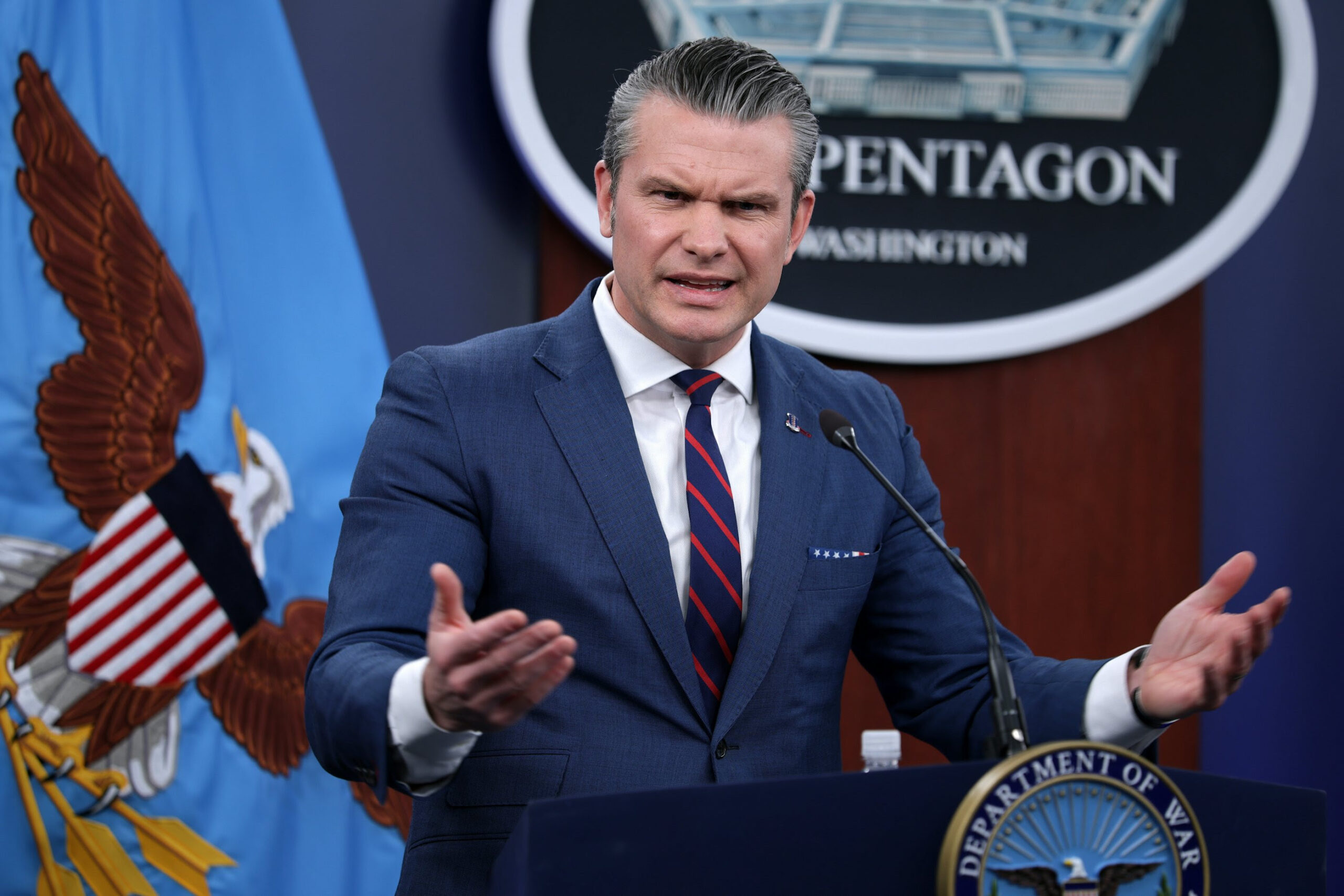
Raging at Media, Pete Hegseth Just Said the Quiet Part Out Loud

He wants “patriotic” coverage of the Iran war. He doesn’t understand: In a democracy, coverage that asks difficult questions of the government is itself “patriotic.”

By Greg Sargent (TNR)

Pete Hegseth wants to live in a world in which the American military can drop bombs on scores of schoolchildren and not face serious media scrutiny over it. And he just might get that world soon enough.

That’s the only way to understand the defense secretary’s extraordinary outburst on Friday morning. He lashed out at news organizations, criticizing headlines that aren’t sufficiently laudatory of American military successes in the Iran War.

“I know that everything is written intentionally,” Hegseth said of the media, referring to his own previous stint as a Fox News contributor, thus seemingly admitting that Fox, at least, does deliberately skew coverage. He faulted numerous headlines, insisting that rather than report things like “Mideast War Intensifies,” the press should instead be “patriotic” and write headlines like “Iran Increasingly Desperate.”

The visibly angry Hegseth also ridiculed a CNN story reporting that Trump’s war planners “underestimated the Iran war’s impact on the Strait of Hormuz.” He added: “The sooner David Ellison takes over that network, the better.”

That’s a direct reference to Paramount CEO David Ellison, who is acquiring CNN after taking over and creating a more Trump-friendly CBS. In short, Hegseth openly relishes future oligarchical control of the media to ensure more dutiful amplification of his propaganda.

Where to begin? First, Hegseth is playing games around that CNN story. He claimed it’s “patently ridiculous” because Iran “always” threatens to choke off shipping in the Strait of Hormuz. He fumed: “CNN doesn’t think we thought of that.”

But much of the CNN report details how officials underestimated Iran’s willingness to act on the threat of closure. It also details how Trump officials failed to sufficiently plan for the consequences of closing it, and why that insufficient planning took place. It’s obviously true that this happened. Media scrutiny of those failings is what Hegseth actually objects to.

Then there’s Hegseth’s claim that a “patriotic” press should primarily pump up American battlefield wins. This essentially demands that the media dispense with its adversarial role toward power. We don’t have to look far to see how malicious this demand truly is.

Take the reporting on the bombing of an Iranian elementary school with scores of children inside who have reportedly been killed—a central event in this conflict and potentially one of the worst atrocities in modern memory. On February 28, the day the war started, The New York Times painstakingly laid out evidence suggesting the United States was likely responsible. It followed up with more. Reuters disclosed that American investigators also concluded the U.S. role was likely. The Associated Press revealed that the bombing might have reflected faulty intelligence. All this reporting was careful and nuanced.

Hegseth is irritated with that scrutiny too. On Friday, he confirmed that an investigation of the bombing is underway but added this absurdity: “We’re not going to let reporting lead us or force our hand into indicating what happened.”

So let’s state this clearly: A key reason we want media scrutiny and fact-finding is precisely that it will, in fact, put pressure on official inquiries like this one. Hegseth suggested the military can do this itself. But remember, Trump blithely declared early on that Iran had bombed its own school. Then he admitted to reporters that he’d said this without knowing the facts. As Jennifer Rubin notes, it’s ironic that this admission too was shaken loose by more of the skillful media questioning that Hegseth disdains.

At the best of times, we can’t depend on government officials to hold themselves accountable. That’s the reason for innovations like independent inspectors general. Under Trump, there is even less reason to trust the government to do a good-faith accounting, given his boundless contempt for the truth.

But Hegseth wants a world in which a horror like this can unfold, and rather than the media digging in hard to ferret out known facts on a moment-to-moment basis, we all just sit back and let his handpicked investigator tell us what happened—at some point down the road.

The biggest scandals in U.S. history, such as Watergate, have played out in a cat-and-mouse way, with the press corps’ digging putting pressure on other institutional actors to do their part in ensuring that the truth wins out. During wars especially, we want to know if officials and combatants are adhering to rules, laws, and codes of conduct, given the awesome power of the U.S. military—and the tendency of war to produce unspeakable horrors.

Which brings us to the ultimate point here: Hegseth himself has declared open contempt for “rules of engagement.” Compounding the hall-of-mirrors effect, we don’t know what this has even meant in practice. As the Times’ Charlie Savage notes, there are many unanswered questions about the role Hegseth’s laxness played in the school. bombing:

What standards of certainty were imposed on planners for the strikes for vetting and validating potential targets? Does Mr. Hegseth’s repeated statement that he gave the military “maximum authority on the battlefield,” compared with the practice in past wars, mean the standards were formally lowered? Whatever the rules were on paper, did such comments contribute to a culture of moving faster and with less care—of “no hesitation,” in his words—among the planners, resulting in negligence or recklessness?

You can draw a direct line from Hegseth’s disdain for rules of engagement right to his contempt for the role of an adversarial press. He apparently doesn’t want those questions answered, either: Once CNN is taken over by Ellison (whose CBS is a network that Hegseth happens to like), there will be less scrutiny and more hagiography—by Hegseth’s own telling.

Hegseth is not disguising any of this. He wants the press to elevate American battlefield triumphs, something he chooses to call “patriotic.” But real patriotism requires demanding that the country live up to higher ideals. Hegseth’s conduct reveals exactly why we don’t want networks like CNN to fall into the hands of his preferred media masters, not why we do.

https://newrepublic.com/article/207760/pete-hegseth-iran-war-patriotic-media-coverage?utm_source=newsletter&utm_medium=email&utm_campaign=critical_mass

Defense Secretary Pete Hegseth in Arlington, Virginia, on March 2

Drain the Swamp — Kellyanne Conway Just Broke a Federal Ethics Law on National TV

In the middle of an interview, Kellyanne Conway did a spontaneous PR spot for Ivanka Trump to hawk her merchandise on live TV — a violation of federal law.

Trump’s top adviser was answering a question about the president when she deviated from the topic and started talking about Trump’s eldest daughter, Ivanka, and her experience of helping to run the Trump Organization while also developing a clothing and accessories line bearing her name. Then, after a minute-long buildup, and while Fox & Friends Host Steve Doocy was trying to interject to ask another question, Conway told viewers to “Go buy Ivanka’s stuff.”

Video

Conway appears to have violated a longtime ethics law in which federal employees are barred from using their office to endorse products. Office of Government Ethics (OGE) Director Walter Shaub posted a reminder of the rule to the OGE’s website shortly after Donald Trump tweeted his support for LL Bean as President-elect, encouraging his followers to buy their products. One of the planks of the rule is that executive branch employees are barred from “endorsing any product, service, or company.”

Continue reading Drain the Swamp — Kellyanne Conway Just Broke a Federal Ethics Law on National TV

Everything you need to know about the Trump travel ban

60,000 people have had visas cancelled under the ban

CBC News
Feb 06, 2017

A recent Reuters/Ipsos poll found that roughly one in two Americans support the travel ban.

A recent Reuters/Ipsos poll found that roughly one in two Americans support the travel ban. (Justin Sullivan/Getty Images)

U.S. President Donald Trump says a temporary suspension of a travel ban he introduced has put his country “in such peril” — an assertion currently being tested in the courts in what is shaping up to be his administration’s first major legal challenge.

The ban, which was issued as an executive order in the name of national security, caused confusion at airports and affected 60,000 foreigners. Here’s the latest on where the ban sits now and what lies ahead in the courts.


Is the ban being enforced right now?

People with valid visas from the seven Muslim-majority countries — Iraq, Syria, Iran, Libya, Somalia, Sudan and Yemen — can now enter the United States. Refugees who were destined for the U.S. before the order was signed will also now be granted entry.

The ban, which also suspended the Syrian refugee program indefinitely, was introduced as an executive order on Jan. 27.

Where does the ban stand now with the courts?

U.S. District Court Judge James Robart on Friday temporarily suspended parts of Trump’s executive order. The challenge was put forward by the attorneys general of Washington state and Minnesota.

Robart’s decision drew sharp criticism from the president.

The White House then filed an emergency request to resume the ban, but it was rejected by the 9th Circuit Court of Appeals, a federal appeals court based in San Francisco, on Sunday.

Lawyers for Washington State and Minnesota on Monday submitted a brief from former U.S. officials, including past secretaries of state John Kerry and Madeleine Albright.

They warned, “Blanket bans of certain countries or classes of people are beneath the dignity of the nation and constitution that we each took oaths to protect.”

Representatives from tech companies including Apple, Google and Uber also submitted briefs that argued the executive order would hurt their business operations. Hawaii’s attorney general has also filed a motion to join the lawsuit opposing the travel ban.

The Justice Department filed its appeal Monday afternoon. The appeals court will hear arguments in the case Tuesday in an hour-long telephone conference.

The three federal appeals court judges — Judge William C. Canby Jr.  (an appointee of Jimmy Carter), Judge Michelle T. Friedland (an appointee of Barack Obama), and Judge Richard R. Clifton (an appointee of George W. Bush), will then determine if the ban will be upheld or continue to be suspended. It’s unclear when a ruling will come.

What happens next?

Whichever way the federal appeals court rules, the case may ultimately proceed to the Supreme Court, given that both sides are likely to file an appeal. Five of the eight Supreme Court justices would need to agree to overturn Robart’s order, otherwise the appeals court’s ruling would stand. The court is currently split with four conservative and four liberal judges.

Is there actually support for the ban in the U.S.?

Support for the ban has been difficult to gauge. Immediately after the order was issued, demonstrators gathered in airports across the country to protest the ban. But a recent Reuters/Ipsos poll found that roughly one in two Americans support the ban while 31 per cent of respondents said it made them feel safer.

executive order

The Reuters/Ipsos poll was conducted online in English in all 50 states. It gathered poll responses from 1,201 people including 453 Democrats and 478 Republicans. A probabilistic sample of this size would yield a margin of error of +/- 3 percentage points, 19 times out of 20.

Has there been any fallout in Canada?

hi-nexus-852

Nexus memberships have been revoked from all Canadian permanent residents with citizenship in any one of the seven majority-Muslim countries affected by the U.S. travel ban.

Canadian residents with citizenship in one of the seven countries affected by the travel ban have had their Nexus memberships revoked, the Canada Border Services Agency said Friday.

Lawyers and law students have set up camp at airports in Montreal, Toronto and Vancouver to offer aid to those affected by the ban. Toronto-based Corey Shefman has joined with other lawyers to respond to the changing policies.

Shefman said the evolving situation is causing some confusion.

“We’ve been telling people and our American colleagues have been telling people, if you think you’re going to be affected by the travel ban, travel now and travel quick because we don’t know how long this stay is going to last,” he said referring to the temporary suspension.

Continue reading Everything you need to know about the Trump travel ban

Trump’s travel ban continues its legal journey

Judges will hear the government’s full argument by phone on Tuesday

The Associated Press Posted
Feb 06, 2017 

Demonstrators participate in a protest by the Yemeni community against U.S. President Donald Trump's travel ban in the Brooklyn borough of New York last week.

Demonstrators participate in a protest by the Yemeni community against U.S. President Donald Trump’s travel ban in the Brooklyn borough of New York last week. (Lucas Jackson/Reuters)

The fierce battle over U.S. President Donald Trump’s travel and refugee ban edged up the judicial escalator on Monday, headed for a possible final faceoff at the Supreme Court.

Travellers, temporarily unbound, tearfully reunited with loved ones at U.S. airports.

The Justice Department filed a new defence of Trump’s ban on travellers from seven predominantly Muslim nations as a federal appeals court weighs whether to restore the administration’s executive order.

The lawyers said the travel ban was a “lawful exercise” of the president’s authority to protect national security and said a judge’s order that put the policy on hold should be overruled.

The filing with the San Francisco-based 9th U.S. Circuit Court of Appeals was the latest salvo in a high-stakes legal fight surrounding Trump’s order, which was halted Friday by a federal judge in Washington state.

The judges are to hear arguments Tuesday by phone, though there’s no timeline for when a decision would be made or released.

The appeals court earlier refused to immediately reinstate the ban, and lawyers for Washington and Minnesota — two states challenging it — argued anew on Monday that any resumption would “unleash chaos again,” separating families and stranding university students.

APTOPIX Trump

Trump, seen with first lady Melania Trump at a Super Bowl party Sunday, blasted U.S. District Judge James Robart, who issued the temporary stay on Friday against Trump’s immigration ban. (Susan Walsh/Associated Press)

The Justice Department responded that the president has clear authority to “suspend the entry of any class of aliens” to the U.S. in the name of national security. It said the travel ban, which temporarily suspends the country’s refugee program and immigration from seven countries with terrorism concerns, was intended “to permit an orderly review and revision of screening procedures to ensure that adequate standards are in place to protect against terrorist attacks.”

The challengers of the ban, the Justice Department wrote, were asking “courts to take the extraordinary step of second-guessing a formal national security judgment made by the president himself pursuant to broad grants of statutory authority.”

Whatever the appeals court decides, either side could ask the Supreme Court to intervene.

It could prove difficult, though, to find the necessary five votes at the high court to undo a lower court order; the Supreme Court has been at less than full strength since Justice Antonin Scalia’s death a year ago. The last immigration case that reached the justices ended in a 4-4 tie.

The president’s executive order has faced legal uncertainty since Friday’s ruling by U.S. District Judge James Robart, which challenged both Trump’s authority and his ability to fulfil a campaign promise.

The State Department quickly said people from the seven countries — Iran, Iraq, Libya, Somalia, Sudan, Syria and Yemen — could travel to the U.S. if they had valid visas. The Homeland Security Department said it was no longer directing airlines to prevent affected visa holders from boarding U.S.-bound planes.

‘America is for everybody’

On Monday, a graduate student who had travelled to Libya with her one-year-old son to visit her sick mother and attend her father’s funeral was back in Fort Collins, Colo., after having been stopped in Jordan on her return trip. She was welcomed with flowers and balloons by her husband and other children.

Two Yemeni brothers whose family has sued over the travel ban, and who’d been turned away in the chaotic opening days of the order, arrived at Dulles International Airport in Virginia, where they were greeted by their father.

USA-TRUMP/IMMIGRATION-HONGKONG

Protesters in Hong Kong demonstrate against Trump’s executive order on immigration on Sunday. People protested the order all around in the world on the weekend. (Bobby Yip/Reuters)

“America is for everybody,” Aqel Aziz said after greeting his sons.

Syrian immigrant Mathyo Asali said he thought his life was “ruined” when he landed at Philadelphia International Airport on Jan. 28 only to be denied entry to the United States. Asali, who returned to Damascus, said he figured he’d be inducted into the Syrian military. He was back on U.S. soil on Monday.

“It’s really nice to know that there’s a lot of people supporting us,” Asali told Gov. Tom Wolf, who greeted the family at a relative’s house in Allentown, Pa.

Who has the power?

The legal fight involves two divergent views of the role of the executive branch and the court system.

The government has asserted that the president alone has the power to decide who can enter or stay in the United States, while Robart has said a judge’s job is to ensure that an action taken by the government “comports with our country’s laws.”

His Friday ruling triggered a Twitter rant by Trump, who dismissed Robart as a “so-called judge.” On Sunday, Trump tweeted, “Just cannot believe a judge would put our country in such peril. If something happens blame him and court system. People pouring in. Bad!”

The judge opens up our country to potential terrorists and others that do not have our best interests at heart. Bad people are very happy!

Just cannot believe a judge would put our country in such peril. If something happens blame him and court system. People pouring in. Bad!

States challenging the ban have been joined by technology companies, who have said it makes it more difficult to recruit employees. National security officials under former president Barack Obama have also come out against it.

A declaration filed by John Kerry and Madeleine Albright, former secretaries of state, and others said the ban would disrupt lives and cripple U.S. counterterrorism partnerships without making the nation safer.

“It will aid ISIS’s propaganda effort and serve its recruitment message by feeding into the narrative that the United States is at war with Islam,” they wrote.

How and when a case might get to the Supreme Court is unclear. The travel ban itself is to expire in 90 days, meaning it could run its course before a higher court takes up the issue. Or the administration could change it in any number of ways that would keep the issue alive.

The bench also could be full, with a new ninth justice on board, by the time the court is ready to hear arguments. If Judge Neil Gorsuch is confirmed this spring as Senate Republicans hope, chances of a tie vote would disappear.

Story Source

The President Has Much Power Over Immigration, but How Much?

By ADAM LIPTAKFEB. 5, 2017

Senator Cory Booker of New Jersey spoke against President Trump’s immigration order last Monday at the Supreme Court. Credit Gabriella Demczuk for The New York Times


WASHINGTON — President Trump’s executive order on immigration has prompted a constitutional showdown that could leave a mark on the law for generations and seems likely to end in a landmark Supreme Court decision.

A ruling by the court on Mr. Trump’s travel ban on seven predominantly Muslim countries could help answer some crucial legal questions: How much independent constitutional authority does the president have over immigration, and how much power has Congress given him?

The likely answer to both questions: a lot. But other parts of the Constitution may temper or defeat that power. Among them are the due process and equal protection clauses and the First Amendment’s ban on government establishment of religion.

Here is a look at the leading arguments in the case.

Continue Reading …