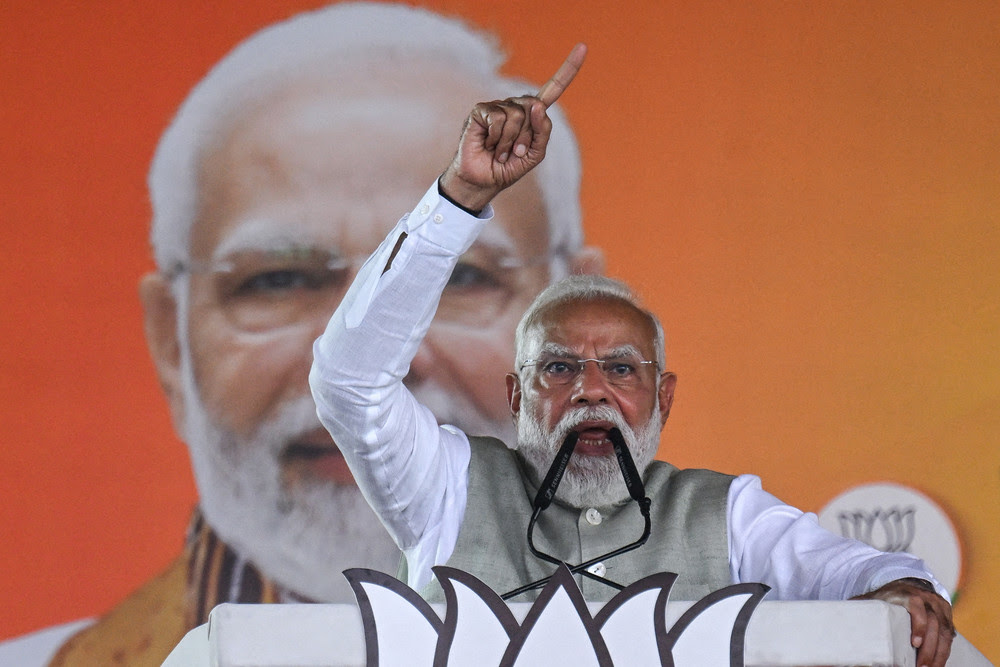
SINGAPORE — In late February, Narendra Modi embraced Prime Minister Benjamin Netanyahu in Israel, and the two sides vowed to strengthen military ties.
Politico Forecast – Brian Dabbs
Now, the Indian prime minister is beseeching the Iranian government for cooking fuel.
Three weeks into the conflict raging in the Middle East, New Delhi is walking a tightrope in the war—arguably more than any other capital globally. The Indian government is delicately balancing long-standing alliances with urgent economic needs. If Modi falters, a potential backlash awaits him at home.
In recent days, Tehran has let a handful of fuel-laden ships pass through the Strait of Hormuz, the narrow bottleneck between Iran and Oman that serves as a gateway to the globe for countless tankers and ocean liners. Meanwhile, U.S. and Israeli airstrikes continue to rain down on the Islamic Republic, and the Iranian military launches attacks on targets in Gulf states, Israel, and across the region.
Two shipments of liquefied petroleum gas, which is used as cooking and vehicle fuel, have reached India, and more are likely in the coming days, after Modi personally asked his Iranian counterpart to intervene.
For the Indian prime minister, the shipments are critical to the well-being of his people — and his party’s imminent prospects at the ballot box.
“The government of India will try all possible resources and all possible efforts to bring more and more ships so that this does not blow back in their face,” Shashwat Kumar, an India expert at the Centre for Strategic and International Studies, told Forecast.
Next month, Indians go to the polls in a number of states. Modi’s Bharatiya Janata Party is aiming to retain power in one and notch new wins in others, which would allow the BJP to boost its standing in the national parliament.
But a national shortage of LPG, which has hit Indian restaurants hard, could deprive BJP and its ruling alliance of votes. And as Iran proves it’s capable of choking the world economy by blocking exports through the Strait of Hormuz, many more India-destined gas shipments are stranded in the Persian Gulf.
“I think India is looking to negotiate safe transit of around 30 ships,” Martin Kelly, the United Arab Emirates-based head of advisory at EOS Risk Group, told Forecast. “But you have to put yourself in Iran’s position in the sense that they can’t let too much trade out of the Gulf, because it would defeat the whole object of closing the Strait of Hormuz.”
It’s not just LPG that’s in short supply on the global stage today.
After attacks on fossil fuel infrastructure in the region, global oil prices have surged well north of $100 a barrel—roughly doubling in just three months. Fertilizers and minerals are also blocked, threatening knock-on price spikes for food and consumer goods like electronics.
Along with the Indian LPG shipments that got the sign-off from Tehran, only a couple other shipments have passed the Strait.
So how did India manage to get Iranian support? Modi not only cozied up to Netanyahu; he sent out a series of social media messages in recent days condemning the attacks on Gulf states and urging “free navigation through the Strait of Hormuz.”
It’s a bit of an open question. This week, India sent medical aid to Iran, according to local media. And India has been one of Iran’s top trade partners in recent years.
“With Israel, India has very strong relations now. And historically, Iran and India have always had a good equation,” Kumar said. “So it does put India in a spot where it’s friends with both, and I think that’s also why there is an expectation that Prime Minister Modi will play a role in bringing this [conflict] around.”
But on top of popular discontent over LPG shortages, Modi may face trouble with an Indian population that’s proud of its history of non-alignment with global powers—a posture that some say Modi is jeopardizing by strengthening ties with Israel and, by extension, the U.S.
“U.S. military actions have never been received well in India,” Kumar said.