BREAKING: Trump Commits Thousands Of Troops To The Middle East—Iran Has Been Waiting For “US Boots On The Ground” For 47 Years.
Trump is gearing up to seize Kharg Island. The IRGC built their entire military doctrine around the day America tried.
Dean Blundell (Substack)
Mar 20
What’s Deployed, What’s Coming, And What The Numbers Actually Mean
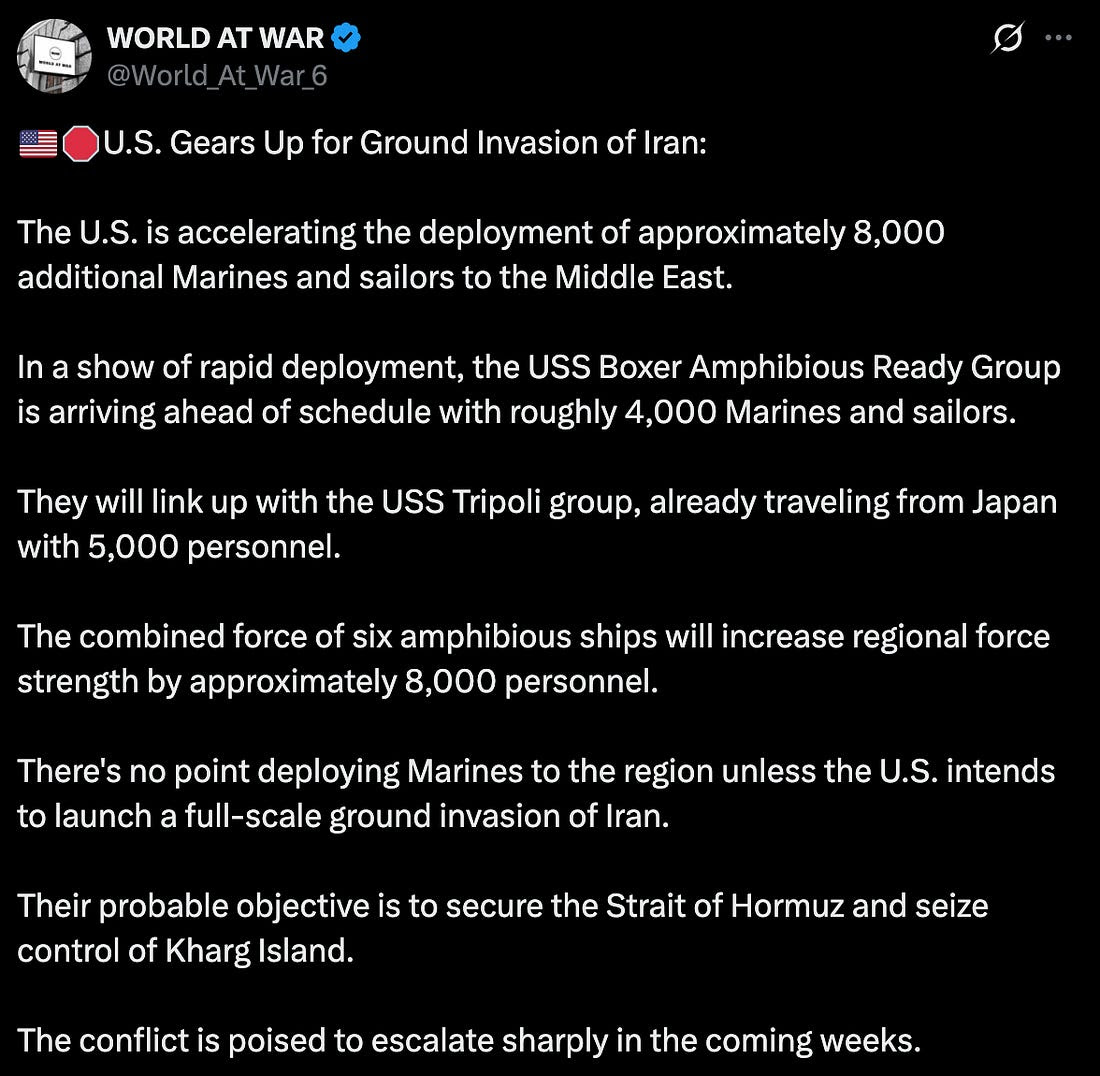
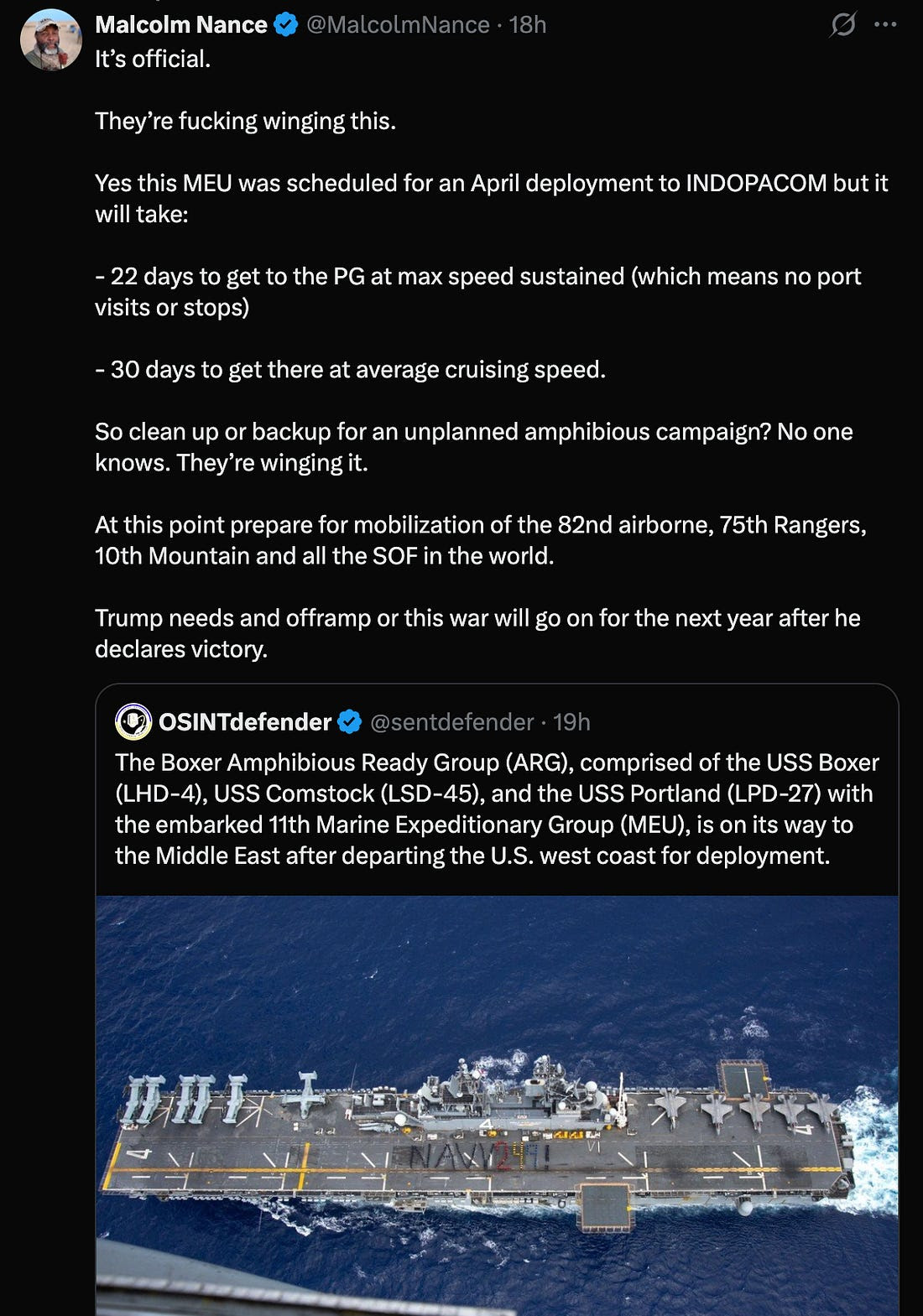
The USS Boxer Amphibious Ready Group—Boxer, USS Portland, and USS Comstock—departed San Diego on March 18, ahead of its originally scheduled deployment window. The Boxer ARG carries approximately 2,500 Marines from Camp Pendleton’s 11th Marine Expeditionary Unit, bringing total personnel, including sailors, to roughly 4,000 aboard those three ships.
They’re linking up with the USS Tripoli group, already transiting from Japan with the Okinawa-based 31st Marine Expeditionary Unit—approximately 2,200 Marines plus around 2,000 sailors, totaling 4,200 to 4,400 personnel. Once the two groups merge, six amphibious ships will have added roughly 8,000 service members to a region where 50,000 U.S. troops are already deployed.
The Boxer is a small aircraft carrier. F-35B stealth jets. V-22 Osprey tiltrotors. Hovercraft in the well deck. The 11th MEU can conduct amphibious landings. The 31st MEU is specifically trained for limited-scale raids and seizure of maritime platforms.
The Navy spokesperson told NBC San Diego this is “routine training that ensures the continued war-fighting readiness of Navy and Marine forces.” That’s the same Navy currently fighting a war with Iran.
The Target Is Already Named
This morning, Axios reported — citing four sources with direct knowledge — that the Trump administration is actively considering plans to occupy or blockade Iran’s Kharg Island to pressure Tehran into reopening the Strait of Hormuz.
“He wants Hormuz open. If he has to take Kharg Island to make it happen, that’s going to happen. If he decides to have a coastal invasion, that’s going to happen. But that decision hasn’t been made,” a senior administration official told Axios.
Kharg Island is a five-mile strip of coral in the Persian Gulf, 15 miles off Iran’s coast and 500 miles past the Strait of Hormuz. It processes roughly 90% of Iran’s crude oil exports. Destroy it or seize it, and you’ve grabbed Iran’s economy by the throat.
The U.S. already bombed it. On March 13, American forces conducted what Trump called “one of the most powerful bombing raids in the history of the Middle East,” targeting over 90 military sites on Kharg—naval mine storage, missile bunkers, IRGC naval bases, and the runway—while deliberately sparing the oil infrastructure. The message: We know where the off switch is, and we haven’t thrown it yet.
Trump told Fox News Radio the same day that if he were going to take Kharg Island, he certainly wouldn’t tell anyone about it. Then he spent the next week publicly threatening to bomb the oil pipelines. So.
White House thinking, per Axios sources: “We need about a month to weaken the Iranians more with strikes, take the island, and then get them by the balls and use it for negotiations.”
But Here’s What’s Waiting For Them
This is where the story gets complicated — and where the cheerleading from certain corners of Fox News needs to stop.
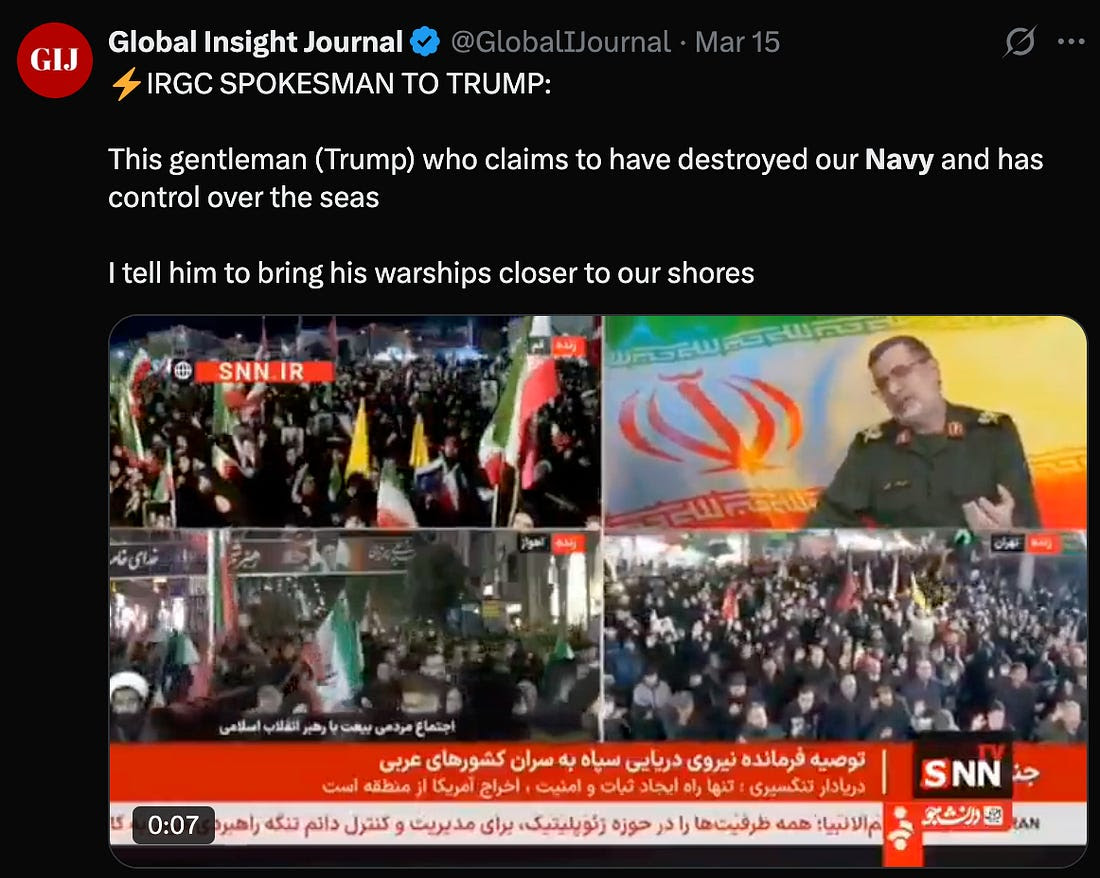
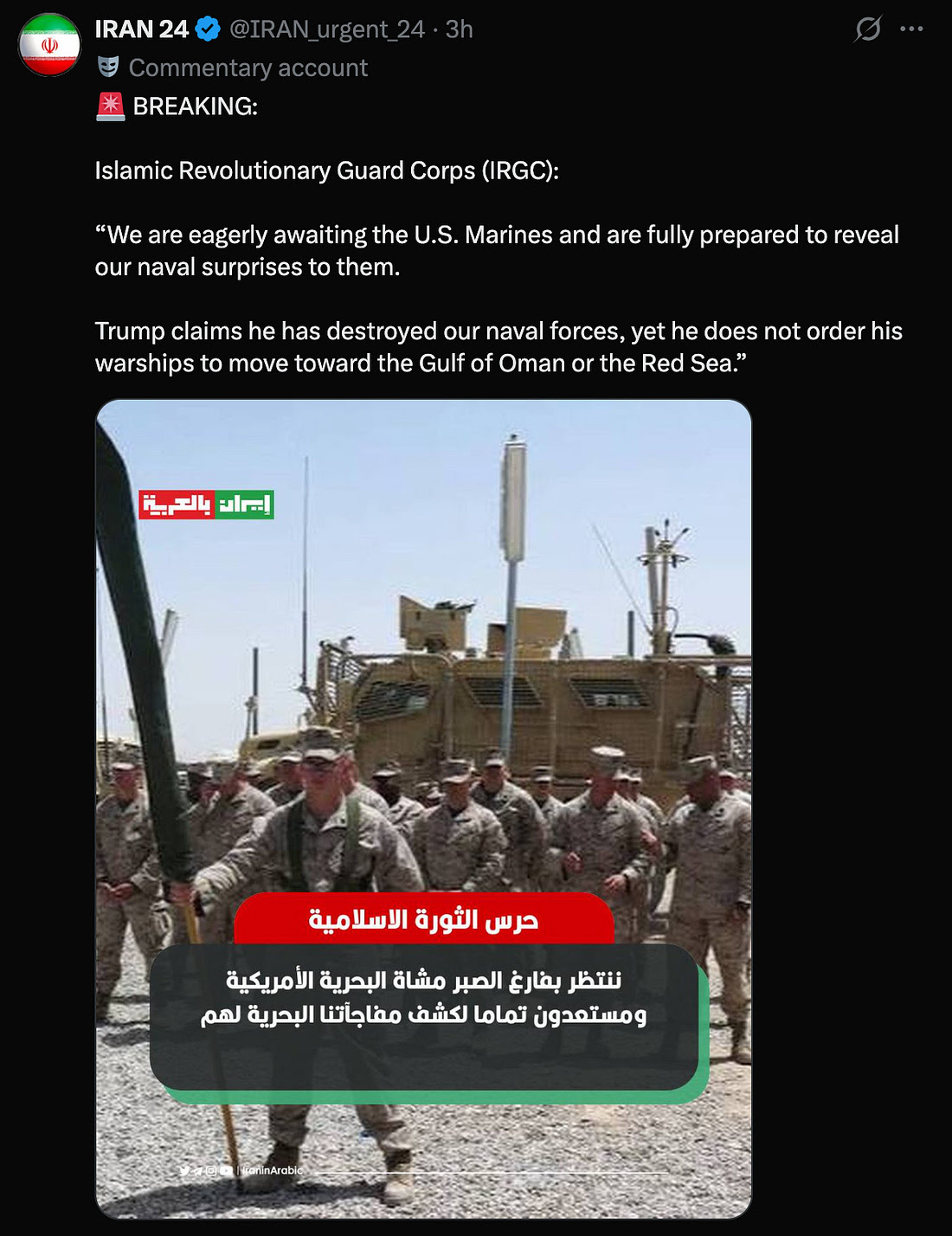
Iran has been preparing for this exact scenario since 1979. Not metaphorically. Literally. The entire military doctrine of the Islamic Revolutionary Guard Corps was built around the day America tried to come ashore in the Persian Gulf.
The lesson Iran learned in 1988 is the foundation of everything that followed. After the U.S. Navy sank roughly half of Iran’s conventional fleet in a single day during Operation Praying Mantis—retaliation for Iran mining a U.S. warship—Tehran reached an obvious conclusion: you cannot fight the U.S. Navy ship-for-ship and win. What followed was nearly four decades of building something else entirely.
The IRGC Navy isn’t a navy. It’s a guerrilla force at sea. Jane’s Defence—the gold standard for military analysis—recognizes it as the world’s most prominent practitioner of small boat swarm tactics: speed, mass, coordinated manoeuvre, low radar signature, and concealment. Iran is believed to possess around 3,000 fast-attack craft capable of these operations. Here’s how it works in practice: 10 to 20 boats swarm a single vessel from every direction simultaneously. They target the bridge to blind it and the engine room to kill it. Hidden in the chaos are unmanned suicide vessels — remote-controlled drone boats packed with explosives — steered directly into the hull. While the crew is overwhelmed, other boats drop tethered naval mines directly into the ships’ path. If the swarm doesn’t finish you, anti-ship missiles fired from mobile trucks that immediately retreat into fortified mountain caves will.
Then there are the mines. A former U.S. Navy admiral has stated publicly that Iran retains the capacity to mine the Strait of Hormuz in ways that would take many months to clear even without any hostile fire. A former British security analyst adds that Iran can deploy manned and unmanned submersible vehicles—small submarines, underwater drones—from concealed shore tunnels. You have to clear the strait before you can even reach Kharg. And you’re doing it under fire, in shallow water, in a channel 21 miles wide at its narrowest point.
Then there’s the “Mosaic Defence.” In 2005, the IRGC formalized what it calls a decentralized command-and-control doctrine—essentially a military designed from the ground up to absorb and survive decapitation strikes. Every regional IRGC unit operates semi-autonomously with its own intelligence, weapons stockpile, and command structure. You can kill the leadership — and the U.S. and Israel killed Supreme Leader Khamenei and dozens of senior IRGC commanders on day one of Operation Epic Fury — and the machine keeps running. Iran’s foreign minister announced this openly on February 28th: “Bombings in our capital have no impact on our ability to conduct war. Decentralized Mosaic Defence enables us to decide when — and how — war will end.”
Then there’s the cost math. A Shahed drone costs $20,000 to $50,000 to produce. A U.S. Patriot interceptor costs $4 million per shot. Iran has already forced the U.S. to burn through Tomahawk stockpiles and air defence interceptors at a pace that’s alarming Pentagon planners. This is the same playbook the Houthis ran in the Red Sea for months — low-cost attrition against expensive American systems — and Tehran has been watching and refining it the entire time.
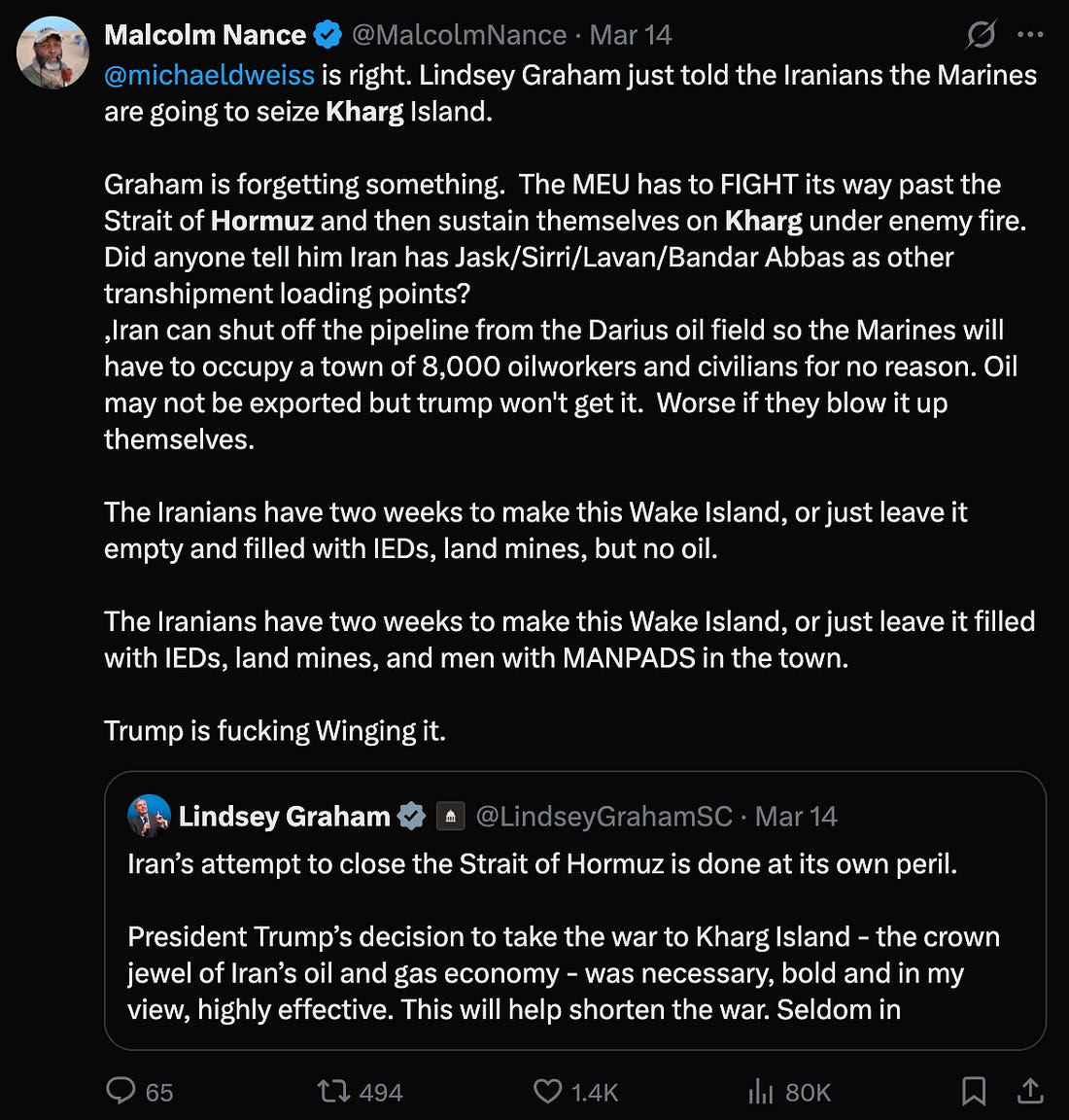
Then there’s the Strait of Hormuz. To take Kharg Island, you need to get through the Strait of Hormuz. NE is getting through the Strait of Hormuz without lighting up the Iranian coast and mountain ranges for DAYS with ammo the US simply does not have.
What The Experts Say About Actually Taking Kharg
Former U.S. Army intelligence analyst Harrison Mann, who resigned from the Defence Intelligence Agency over Biden’s Gaza policy and has no axe to grind for either side, put it plainly: any attempt to seize Kharg Island would be “close to a suicide mission.” The Marines would be 500 miles past the Strait of Hormuz — a chokepoint the U.S. Navy currently considers too dangerous to enter — 15 miles off the Iranian coast, within range of weapons the IRGC hasn’t even had the opportunity to deploy yet in this war. Artillery rockets. Short-range drones. Shore-based systems that have been waiting for exactly this moment.
A helicopter assault avoids anti-ship weapons but creates a different problem: the MEU’s Ospreys and helicopters would need at least three trips to insert the full Marine force. Those are three trips of predictable flight paths, landing zones, and sitting targets while Iranian forces calibrate their sights. Resupply and evacuation by sea means running the gauntlet again. Resupply by air means doing it indefinitely, under fire, on an island 15 miles from the Iranian mainland.
Responsible Statecraft’s assessment: for the troops who receive those orders, “the operation would land somewhere between a suicide mission and a self-imposed hostage crisis.”
There is a counter-argument. One analysis published this week argues the March 13 strikes degraded Kharg’s fixed defences severely enough—destroying SAM batteries, missile bunkers, and the IRGC naval base—that what’s left is a broken garrison of 200 to 500 personnel without command infrastructure or reinforcement capability. Under that scenario, 2,200 Marines against a destroyed garrison with total U.S. air superiority is an overwhelming force. The 82nd Airborne’s ready brigade has quietly cancelled scheduled exercises. Army battalions are already in Kuwait. Pentagon planning reportedly covers multiple island seizures simultaneously—Kharg, Hormuz, Qeshm, and Kish. If Rump keeps this Operation Epstein thing up, the US military is going to need all the help it can get, considering the USS Gerald Ford is on its way to Greece to have the shitters fixed and to start preparing it to be seaworthy enough to head back to the US after a mysterious 30-hour fire broke out on board.
That analysis assumes the intelligence assessment is right. The regime is too broken to mount a coherent response. Because Iran doesn’t have mobile capabilities, the bombing runs missed. That they don’t mine the waters around Kharg the moment the ships appear on radar.
If that assessment is correct, Kharg falls and the war ends on American terms.
If it’s wrong, the United States has Marines trapped on an island 15 miles from Iran with a hostile sea between them and resupply.
Iran has been building toward that second scenario for 47 years. The ships are sailing. The decision hasn’t been made. But the window is closing, and the math is brutal.