Trump Friend Got ICE to Arrest His Son’s Mother

Trump Friend Got ICE to Arrest His Son’s Mother

Trump’s FCC lets one company control 70% of local news; new footage shows Trump’s declining health; Trump may cave to Democrats’ key ICE demand

British Chris and Raw America
Mar 20

A friend of Trump is using ICE as his personal weapon. A new media merger is giving a right-wing billionaire control of almost all local news. New footage suggests Trump’s health is rapidly declining. And—in good news—Democrats may have forced Trump to unmask ICE agents.

MAGA oligarchs are buying up media outlets at a staggering pace, hollowing out newsrooms, and silencing all reporting they don’t like.

Trump Ally Asked ICE to Detain the Mother of His Child
Paolo Zampolli is the man who claims credit for introducing Donald Trump to Melania back in 1998 at a New York nightclub. Last June, Zampolli had a problem. His Brazilian ex-girlfriend, Amanda Ungaro, had been arrested in Miami on fraud charges. They were locked in a custody battle over their teenage son. And she was in the country on an expired visa.

So he picked up the phone.

According to records obtained by the New York Times, Zampolli reached out to a top ICE official named David Venturella. He explained that Ungaro was undocumented and suggested that getting her into ICE detention could help him win custody of his son.

Venturella then called the Miami ICE office to make sure agents would pick Ungaro up before she could be released on bail. He reportedly noted that the case mattered to someone close to the White House.

Ungaro was placed in ICE custody and eventually deported to Brazil.

DHS insists she was detained because of her expired visa and the fraud charges. And it’s possible she would’ve been deported regardless. But the speed with which a senior ICE official jumped into action for a minor Trump associate is quite a story.

This is what the abuse of power looks like. It doesn’t always come in the form of a presidential order. Sometimes it’s a phone call from a bloke who goes to the same parties as the first lady. Draw your own conclusions.

One Company Will Now Control Local News for Over 70% of US Households
As we mentioned this morning, Nexstar Media Group has just been cleared by the FCC and the Department of Justice to acquire Tegna, another major local broadcaster. Already the largest provider of local news in the country, Nexstar will now reach more than 70 percent of U.S. households with its local newscasts.

The FCC granted Nexstar a waiver of the rule that caps how many households a single broadcaster can reach. In other words, the rule that was supposed to prevent this kind of consolidation was just waved away.

Nexstar’s CEO praised President Trump and FCC Chair Brendan Carr by name for making it happen.

Eight state attorneys general had filed a lawsuit just the day before to block the deal, arguing it violates antitrust law and would put more broadcast news in fewer hands, gut local jobs, and remove accountability to the communities being covered. Those concerns were brushed aside.

New Footage Raises Serious Concerns About Trump’s Cognitive Health
A new Netflix documentary about the Murdoch family called “Dynasty: The Murdochs” also includes footage of Donald Trump spanning the past decade, and the contrast is striking.

The film includes clips of Trump from the first Republican primary debate of the 2016 election cycle, where he came across as coherent, sharp, and effective. Whatever one thinks of his politics, he was in command of himself.

Compare that to recent footage of the 79-year-old president, and the difference is difficult to ignore. Medical observers and Trump critics have for some time been pointing to rambling speech, verbal stumbles, and apparent difficulty concentrating during public appearances.

Trump himself dismissed questions about his cognitive health in January, saying his father had Alzheimer’s but that he does not.

He forgot the name of the disease mid-sentence while making that point.

Trump’s supporters argue the criticism is politically motivated. Medical professionals have noted the cumulative effects of age and stress. The documentary footage adds a visual dimension to a conversation that isn’t going away.

Trump May Be About to Cave to a Key Demand from Democrats
The partial government shutdown is still dragging on, with negotiations centred on funding for the Department of Homeland Security and reforms to ICE and Customs and Border Protection.

Border czar Tom Homan was expected to meet with Senate Democrats on Friday to continue talks.

According to NBC News correspondent Julie Tsirkin, the White House is open to compromising on some Democratic demands. One item is reportedly under discussion: agents unmasking, with restrictions. That means potentially limiting the ability of immigration enforcement agents to conceal their identities during operations.

Republican Senator Markwayne Mullin also agreed he’d use judicial warrants for home entries if he were named Homeland Security secretary.

Here’s the context that matters.

These negotiations are happening after federal agents killed two U.S. citizens in Minnesota: Renee Good and Alex Pretti. Two Americans are dead. That’s what it took to get any movement toward accountability measures.

The willingness to even discuss warrant requirements and agent transparency only appeared at the table after American lives were lost. That’s not reform. That’s damage control.


Internal Collapse Inside Trump’s White House Resignations looming, Miller rising, and a behind-the-scenes power struggle exploding.

Internal Collapse Inside Trump’s White House
Resignations looming, Miller rising, and a behind-the-scenes power struggle exploding.

Lev Parnas (Substack)
Mar 20

I’m going to be very direct with you.

What I’m hearing from my sources right now is serious — and if it plays out, it will send shockwaves through Washington.

Tulsi Gabbard is actively considering resigning as DNI.

This comes on the heels of Joe Kent’s resignation, where he made it clear there was no imminent threat from Iran, and what we are now seeing is not a coincidence.

It’s a fracture inside Trump’s intelligence and national security circle that is getting harder and harder to contain.

Let me explain what’s really going on.

Over the last two days, during her testimony before Congress, Gabbard made something very clear — without saying it outright.

She never once expressed support for Donald Trump’s decisions.

Instead, she carefully walked a legal line, repeatedly affirming that the president has the right to make decisions, while stopping short of saying she agrees with those decisions.

That’s not loyalty. That’s  distance.

At the same time, Joe Kent publicly undercut the administration’s position, saying there was no imminent threat — and then resigned.

When you have senior figures breaking from the same messaging—especially on something as sensitive as Iran—that’s not policy disagreement… that’s a rift.

Now here’s what I’m being told that the media is NOT reporting.

Trump is concerned. And he should be.

Because Tulsi Gabbard isn’t just another cabinet official.

She has been deeply involved behind the scenes in Trump’s election strategy infrastructure—working on so-called “election reform” initiatives in states like Georgia and Arizona and tied into broader efforts around foreign interference narratives, including Venezuela, that could be used as leverage politically.

That’s not a small role. That’s central to the operation.

And now she’s pulling away.

That’s why this is creating panic internally.

And it gets even more complicated.

Inside Trump’s inner circle right now, I’m hearing there are two camps forming:

Those who want Gabbard out immediately

And those who are trying to keep her in place at all costs

But let me be very clear here —

Trump and his inner circle are doing everything possible to keep her from leaving.

Because this isn’t just about optics.

This is about timing.

With the midterms approaching, the last thing Trump can afford is a high-profile fracture like this — especially from someone as deeply embedded in his national security and election infrastructure as Tulsi Gabbard.

They know if she walks now, it doesn’t just create headlines — it creates exposure.

And at the same time, the pressure is building from all sides.

The Tucker Carlson fractures, the Laura Loomer wing, and other voices inside the MAGA ecosystem are pulling in different directions—turning what was once a controlled operation into internal chaos.

That pressure is spilling directly into the White House.

And it’s becoming harder and harder to contain.

Because they also know what happens next if she leaves.

Tucker Carlson. Independent platforms. Uncontrolled conversations.

Places where she can speak freely — and where the narrative can’t be managed.

And that’s the real fear.

At the same time, there are major shifts happening inside the White House itself.

As I’ve been telling you:

Susie Wiles is on her way out

Stephen Miller is now effectively taking over, acting as chief of staff

And I’m hearing Alina Habba may be stepping into a larger role

This is a power struggle unfolding in real time — and nobody in mainstream media is connecting these dots for you.

But you’re hearing it here.

But here’s the bigger picture that should concern all of us.

While this internal chaos is unfolding:

Gas prices are climbing.

Wars are expanding.

Economic pressure is building on everyday Americans.

And where is the leadership?

Where is the Democratic Party calling this out clearly and consistently?

Where are the fighters explaining what’s actually happening behind the scenes?

They’re not there.

And that’s the problem.

This is exactly why I made the decision to run for Congress.

Florida’s 27th District is not just another race—it’s ground zero.

This is Trump’s backyard.

Marco Rubio is tied into it.

Susie Wiles operates out of it.

Pam Bondi and Donald Trump himself.

This is where power is concentrated — and where it must be challenged.


Federal judges have ruled more than 7,000 times in recent months that ICE has illegally locked people up without — at the very least — a chance to prove they can live safely in the community.

Federal judges have ruled more than 7,000 times in recent months that ICE has illegally locked people up without — at the very least — a chance to prove they can live safely in the community.

Politico West Wing Playbook
By Kyle Cheney, Ben Johansen and Sophia Cai

Most of the time, judges have simply rejected the administration’s legal claims that it can detain people under an expansive and unprecedented view of ICE’s power. Other times, the administration has dropped the ball — missing deadlines and failing to respond to emergency lawsuits brought by the people ICE has detained, leading judges to rule in the detainees’ favour.

Now, in a growing number of cases, the administration is simply raising the white flag.

DOJ offices across the country are inundated with emergency immigration cases, laboring to keep up with the pace and in constant triage mode. They have repeatedly told judges that they’ve struggled to get information from their ICE counterparts in order to defend detention decisions. And now, those struggles are leading to decisions to simply fold in court.

In those cases, the administration has simply agreed to provide a bond hearing, or even outright release, telling judges that officials “do not have an opposition argument to present” or saying they couldn’t cobble together enough information to mount a defence.

“Undersigned counsel was unable to obtain documentation … sufficient to provide factual support for a response,” a Justice Department attorney wrote in a March 13 response to a detainee’s lawsuit in Arizona. “Accordingly, [administration officials] do not oppose the Court ordering Petitioner to receive a bond hearing at this time.”

The phenomenon is the latest manifestation of the extraordinary strain that the administration’s deportation agenda — compounded by the mass detention of people who have lived for years without incident in the U.S. interior — has exacted on the justice system.

— On Jan. 23, Judge GARY KLAUSNER, a George W. Bush appointee in the Los Angeles area, ordered the release of a 70-year-old Iranian woman who was ordered deported in 1999 but whose deportation could not be effectuated at the time. She was detained by ICE in November, but when she filed a lawsuit seeking release, the administration did “not have an opposition argument to present.”

Klausner was floored: “It appears that Respondents arrested a chronically ill, 70-year-old woman, who came to this country to avoid religious persecution and applied for asylum, who has lived here peacefully for 26 years and complied with all check-in requirements and other conditions of release, who has no known criminal record and poses no threat to anyone … then kept her in detention for months without sufficient medical care — and they do not have any argument to offer to even try to justify these actions.”

— On Jan. 26, Judge KENLY KATO, a Biden appointee, ordered the release of another Iranian national who had been ordered deported after drug convictions in 2018 but whose deportation to Iran could not be arranged. ICE detained the man last June but has been unable to deport him since, so the man filed a lawsuit seeking release in January. The Trump administration’s response: “At this time, Respondents do not have an opposition argument to present.” A week later, for the same reason, Kato ordered the release of a man born in the Soviet Union, who was ordered deported to Russia in 2005 after a conviction but whose deportation could not be arranged.

— On Jan. 27, Judge DOLLY GEE, an Obama appointee, ordered the release of an Afghan man who had been detained for a year while the administration was unable to secure his deportation to the Taliban-led nation or an alternate “third country.” Once again, the administration had “no opposition argument” to his release from custody.

— On Feb. 17, a judge ordered the release of a Vietnamese man with paranoid schizophrenia who had been ordered deported after a 2000 burglary conviction but whose deportation could not be effectuated because of Vietnam’s longstanding reluctance to repatriate nationals who fled prior to 1995. The administration told Judge MARK SCARSI, a Trump appointee, it had “no opposition argument to present.”

The same pattern has played out in dozens of cases centred in California and Arizona, two states where ICE has housed thousands of detainees facing immigration and deportation proceedings. Justice Department and Department of Homeland Security officials declined to respond to requests for comment.

SINGAPORE — In late February, Narendra Modi embraced Prime Minister Benjamin Netanyahu in Israel, and the two sides vowed to strengthen military ties.

SINGAPORE — In late February, Narendra Modi embraced Prime Minister Benjamin Netanyahu in Israel, and the two sides vowed to strengthen military ties.

Politico Forecast – Brian Dabbs

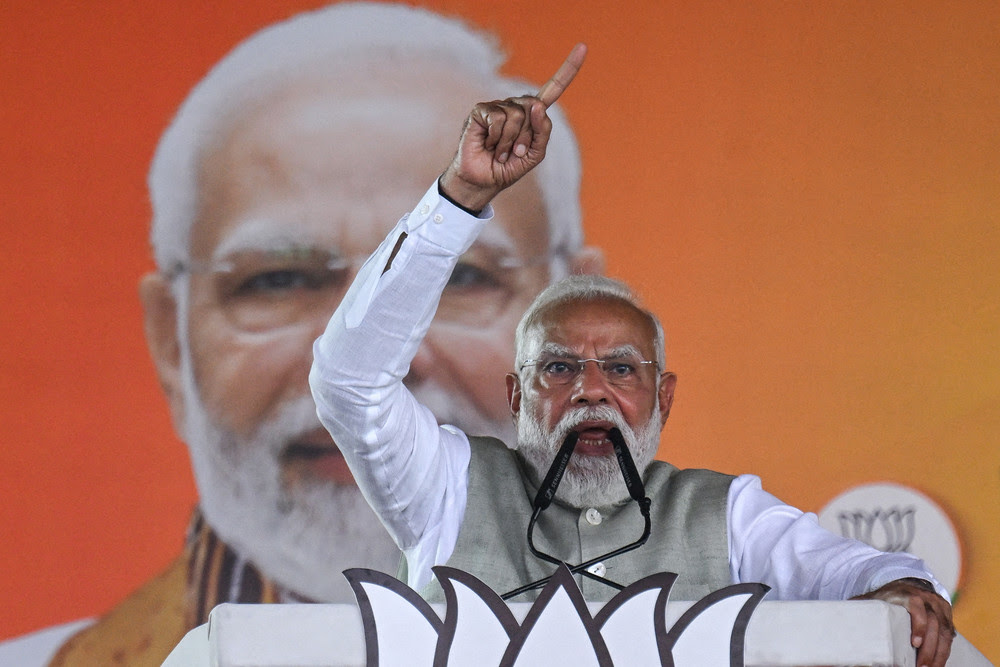
Now, the Indian prime minister is beseeching the Iranian government for cooking fuel.

Three weeks into the conflict raging in the Middle East, New Delhi is walking a tightrope in the war—arguably more than any other capital globally. The Indian government is delicately balancing long-standing alliances with urgent economic needs. If Modi falters, a potential backlash awaits him at home.

In recent days, Tehran has let a handful of fuel-laden ships pass through the Strait of Hormuz, the narrow bottleneck between Iran and Oman that serves as a gateway to the globe for countless tankers and ocean liners. Meanwhile, U.S. and Israeli airstrikes continue to rain down on the Islamic Republic, and the Iranian military launches attacks on targets in Gulf states, Israel, and across the region.

Two shipments of liquefied petroleum gas, which is used as cooking and vehicle fuel, have reached India, and more are likely in the coming days, after Modi personally asked his Iranian counterpart to intervene.

For the Indian prime minister, the shipments are critical to the well-being of his people — and his party’s imminent prospects at the ballot box.

“The government of India will try all possible resources and all possible efforts to bring more and more ships so that this does not blow back in their face,” Shashwat Kumar, an India expert at the Centre for Strategic and International Studies, told Forecast.

Next month, Indians go to the polls in a number of states. Modi’s Bharatiya Janata Party is aiming to retain power in one and notch new wins in others, which would allow the BJP to boost its standing in the national parliament.

But a national shortage of LPG, which has hit Indian restaurants hard, could deprive BJP and its ruling alliance of votes. And as Iran proves it’s capable of choking the world economy by blocking exports through the Strait of Hormuz, many more India-destined gas shipments are stranded in the Persian Gulf.

“I think India is looking to negotiate safe transit of around 30 ships,” Martin Kelly, the United Arab Emirates-based head of advisory at EOS Risk Group, told Forecast. “But you have to put yourself in Iran’s position in the sense that they can’t let too much trade out of the Gulf, because it would defeat the whole object of closing the Strait of Hormuz.”

It’s not just LPG that’s in short supply on the global stage today.

After attacks on fossil fuel infrastructure in the region, global oil prices have surged well north of $100 a barrel—roughly doubling in just three months. Fertilizers and minerals are also blocked, threatening knock-on price spikes for food and consumer goods like electronics.

Along with the Indian LPG shipments that got the sign-off from Tehran, only a couple other shipments have passed the Strait.

So how did India manage to get Iranian support? Modi not only cozied up to Netanyahu; he sent out a series of social media messages in recent days condemning the attacks on Gulf states and urging “free navigation through the Strait of Hormuz.”

It’s a bit of an open question. This week, India sent medical aid to Iran, according to local media. And India has been one of Iran’s top trade partners in recent years.

“With Israel, India has very strong relations now. And historically, Iran and India have always had a good equation,” Kumar said. “So it does put India in a spot where it’s friends with both, and I think that’s also why there is an expectation that Prime Minister Modi will play a role in bringing this [conflict] around.”

But on top of popular discontent over LPG shortages, Modi may face trouble with an Indian population that’s proud of its history of non-alignment with global powers—a posture that some say Modi is jeopardizing by strengthening ties with Israel and, by extension, the U.S.

“U.S. military actions have never been received well in India,” Kumar said.

Canada, allies say they’re ready to help stop Iran’s shipping blockade

Canada, allies say they’re ready to help stop Iran’s shipping blockade

Prime Minister Mark Carney has endorsed a statement from Canada and its allies expressing their willingness to contribute to efforts to reopen the Strait of Hormuz more than two weeks into the U.S.-Israeli war on Iran.

By Dylan Robertson The Canadian Press
OTTAWA – Prime Minister Mark Carney has endorsed a statement issued by allies expressing a willingness to contribute to efforts to reopen the Strait of Hormuz more than two weeks into the U.S.-Israeli war on Iran.

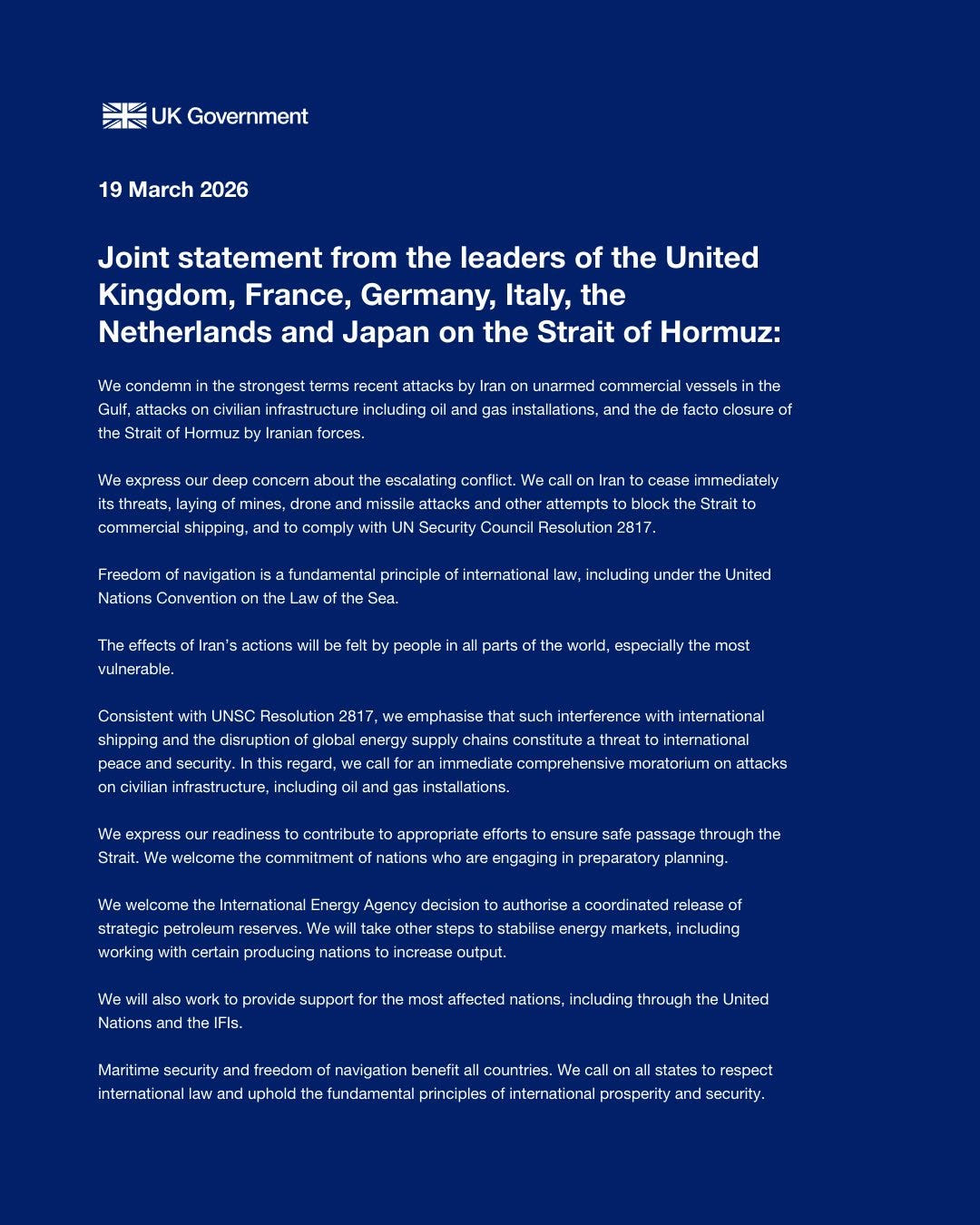
Carney endorsed the joint statement Thursday shortly after it was published by the U.K., France, Germany, Italy, the Netherlands and Japan.

“We express our readiness to contribute to appropriate efforts to ensure safe passage through the Strait. We welcome the commitment of nations who are engaging in preparatory planning,” reads the joint statement.

The statement does not say how the nations propose to help. Defence Minister David McGuinty has said Canada is “considering” aiding Iran’s neighbours to defend themselves if they seek assistance from the NATO alliance.

The statements came as Foreign Affairs Minister Anita Anand told The Canadian Press she will be pitching her G7 peers in Paris on possible diplomatic off-ramps to end the war next week.

In response to the U.S.-Israeli airstrikes launched on its territory last month, Iran limited traffic through the strait — through which one-fifth of the world’s oil and gas transits — and bombed major fuel shipping sites, causing global oil prices to spike.

At a news conference shortly before the statement was released, McGuinty said again that Canada was not consulted on the war before it began and doesn’t intend to join it. He did not rule out Canadian military involvement.

“If neighbouring states around Iran, in the Middle East and in the Gulf, require the assistance of NATO allies, this is something that NATO allies are considering and Canada is also considering,” he said.

“It’s also a very dangerous situation. It’s changing hour by hour, and it is sometimes difficult to get clear and hard intelligence, so we’re watching it very closely.”

Conservative MP Shuv Majumdar called out the government for joining the Thursday statement after allies had released it.

“He casts himself as a ringleader for middle powers. Instead, objectively, he’s flip-flopping his way through a major crisis,” Majumdar wrote on social media. “Our allies acted, then Carney’s Liberals begged to be read in after the fact. It’s like he has no idea what he’s doing.”

In London, Anand told The Guardian newspaper on Wednesday that she will present a “document of principles” to G7 officials in Paris to encourage “a collective and coordinated discussion about off-ramps.”

Anand refused to repeat the term “document of principles” in a Thursday interview with The Canadian Press.

“I would not use that terminology at this time, in order to preserve the trust of our partners,” she said. “For this kind of diplomacy to be effective, it is best to ensure that the conversations remained contained, and that is important in order to reach positive results.”

Anand said she has been reaching out to allies and countries in the Persian Gulf, where Canada has been signing various investment and partnership agreements.

Canada has four priorities on the war in Iran, Anand said Thursday.

“First and foremost, preventing the loss of civilian life. Second, preventing further escalation and reducing the risk of regional spillover. Third, minimizing collateral impacts on nonbelligerent states and civilian populations. And fourth, mitigating global economic shocks, energy, fertilizer and commercial supply chains,” she said.

Anand added that Iran’s actions in the Strait of Hormuz risk not just “very severe” economic impacts but humanitarian crises in poor countries which can’t receive fertilizer or other agricultural goods.

“We have seen those effects already at the fuel pumps,” she said. “But closing the Strait of Hormuz is contrary to international law and to the freedom of navigation. The consequences for countries around the world, including in the region itself, stand to be significant.”

This report by The Canadian Press was first published March 19, 2026.

More Major Epstein News, UN Makes Possible War Crimes Allegations, No End in Sight for DHS Shutdown

More Major Epstein News, UN Makes Possible War Crimes Allegations, No End in Sight for DHS Shutdown

Aaron Parnas
Mar 19

Another day, and there is a lot to cover, from Epstein to Iran to the Department of Homeland Security.

People in power benefit when the public is worn down. They benefit when the volume of information is so constant that nothing sticks, when one story replaces another before answers are ever delivered. Overwhelm is not accidental. It is a strategy designed to make you disengage.

Look at the Epstein files. It has been months since the Department of Justice failed to comply with the Epstein Files Transparency Act. Ask yourself a simple question. Do you still hear about this every day the way you once did?

You do not. That is the point. Flood the zone. Exhaust the audience. Let the story disappear.

I will not let that happen.

António Guterres, the United Nations Chief, said there are “reasonable grounds” to believe both sides in the U.S.-Israel conflict with Iran may have committed war crimes, citing attacks on energy infrastructure and civilians. He warned the conflict is rapidly escalating with severe humanitarian and global economic consequences, suggested Israel sought to draw the U.S. into war, and argued Washington holds the key to ending it. Guterres also stressed the urgency of de-escalation, warning the crisis is spiraling out of control and could have far-reaching global impacts, according to POLITICO.

The Pentagon is weighing sending additional troops to the Middle East, a move that could significantly escalate the war with Iran and deepen U.S. involvement. Discussions include deploying Marines to protect shipping in the Strait of Hormuz or potentially seize key sites, even as Donald Trump publicly downplays plans for ground troops. The talks come amid intensifying strikes, rising economic disruption, and concerns the conflict is expanding beyond its initial scope.

Darren Indyke, longtime attorney for Jeffrey Epstein, told a House committee he had no knowledge of Epstein’s crimes, rejecting claims he facilitated abuse. Lawmakers and victims’ attorneys have questioned that claim, arguing it is not credible given his close role in Epstein’s legal and financial affairs. The testimony comes as Congress investigates the network of individuals who may have enabled Epstein’s decades-long abuse and seeks greater accountability.

An attorney for survivors of Jeffrey Epstein criticized Darren Indyke’s congressional testimony, calling his claimed ignorance of Epstein’s abuse “deeply troubling” and indicative of a broader network of enablers. The statement emphasized that significant details remain hidden and called for full accountability from those connected to Epstein and from government authorities.

Dave Min said Darren Indyke may have repeatedly committed perjury during his deposition, expressing shock that he did not plead the fifth. Min questioned Indyke’s claims that he had no knowledge of abuse tied to Jeffrey Epstein.

Jes Staley’s wife, Debora Staley, has filed for divorce following fallout related to his ties to Jeffrey Epstein, with the case filed in New York and details kept confidential.

Police are expanding their investigation into Andrew beyond misconduct in public office to include potential corruption and alleged sex trafficking offenses linked to his relationship with Jeffrey Epstein. Investigators face a high legal bar for misconduct charges and are broadening the probe to strengthen the case, with any decisions likely to take months, according to The Times.

Iran warned it would show “zero restraint” after Israel struck its South Pars gas field, triggering retaliatory attacks across Gulf energy infrastructure and sharply escalating the conflict. The strikes damaged key facilities in Qatar and beyond, disrupting a significant share of global liquefied natural gas supply and sending energy prices higher. The escalation has raised fears of a broader regional crisis with major global economic consequences.

An ABC News analysis found that Iranian drones and missiles have struck at least 10 radar sites used by the U.S. and its allies, with satellite imagery suggesting some attacks successfully damaged sensitive missile-defense systems. The strikes highlight the vulnerability of these high-value systems and could reduce early warning capabilities, though the full extent of the damage remains unclear

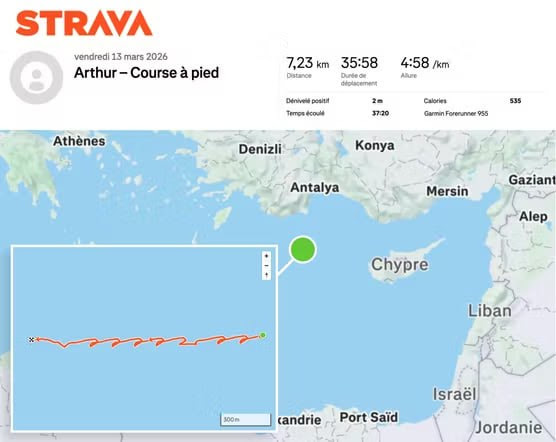
A French naval officer accidentally revealed the real-time location of the aircraft carrier French aircraft carrier Charles de Gaulle near Cyprus via a public Strava workout, creating a potential security risk despite the mission not being classified, according to Le Monde.

The Boxer Amphibious Ready Group—led by the USS Boxer (LHD-4) and including the USS Comstock (LSD-45) and USS Portland (LPD-27) with the 11th Marine Expeditionary Unit—has deployed from the U.S. West Coast to the Middle East, signaling a buildup of American military presence in the region.

An Iranian missile strike hit an oil refinery in Haifa, with footage showing smoke rising from the facility, highlighting the expansion of attacks on critical energy infrastructure in the conflict.

The U.S. war with Iran has likely cost tens of billions of dollars, with early Pentagon estimates putting spending at over $11 billion in just the first week and roughly $1 billion per day, meaning total costs could plausibly approach or exceed $25 billion as the conflict continues, though no official cumulative figure has been confirmed.

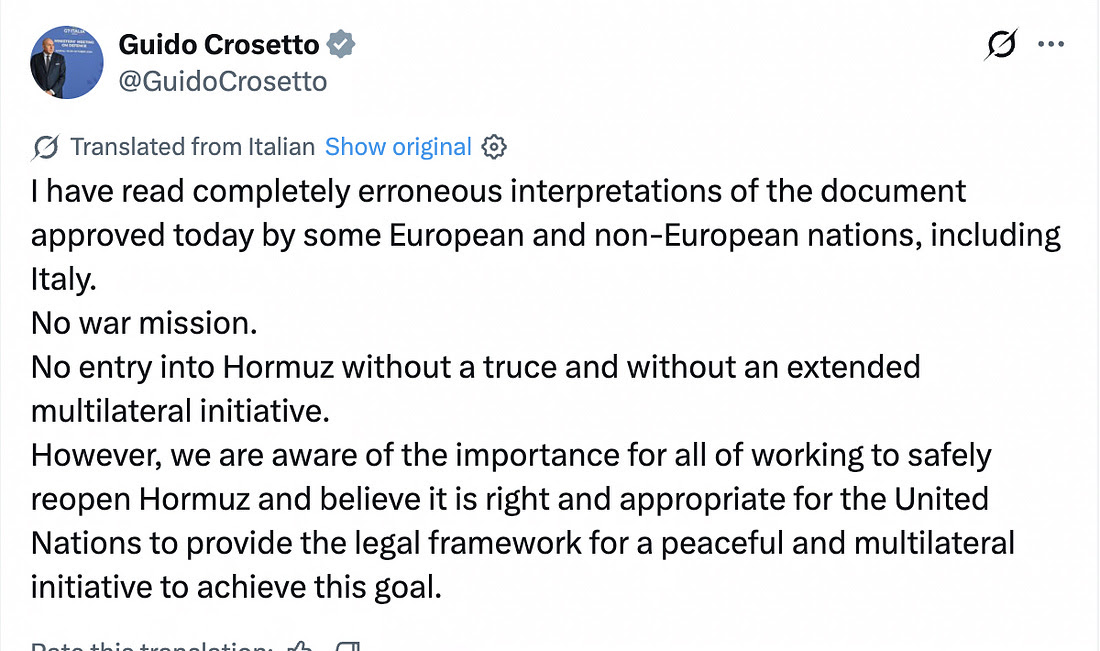
Italy’s Defense Minister Guido Crosetto said Europe’s major naval powers will not escort ships through the Strait of Hormuz during the conflict, stressing there will be no deployment without a ceasefire and broader multilateral agreement.

Benjamin Netanyahu acknowledged that while there are signs of “cracks” in the Iranian regime, its collapse is not guaranteed and it may survive the ongoing war. He emphasized that weakening Iran’s capabilities remains the primary goal, even if regime change does not occur.

At a House intelligence hearing, Tulsi Gabbard declined to say whether she agreed with claims by Joe Kent that Iran posed no imminent threat or that Israel pushed the US into war, but said she was concerned by his statements blaming Israel.

Rafael Grossi, the UN Nuclear Chief, said that despite significant damage from U.S. and Israeli strikes, much of Iran’s nuclear program remains intact, including enriched uranium stockpiles, infrastructure, and technical expertise. He warned that military action alone cannot fully eliminate Iran’s nuclear capabilities and that rebuilding remains possible, underscoring the need for diplomacy once the conflict ends.

Kash Patel told lawmakers that recently dismissed FBI agents were fired for ethical violations, amid scrutiny over whether the terminations—linked to investigations involving Donald Trump—were politically motivated.

Lawmakers have begun in-person negotiations to end the prolonged Department of Homeland Security shutdown, though both parties remain far apart on key demands. Republicans point to concessions from Markwayne Mullin—including requiring judicial warrants for certain immigration enforcement actions—while Democrats say proposals are insufficient without formal commitments. Despite renewed talks, officials warn a deal is not imminent and the shutdown could continue.

A federal arts panel approved plans for a large commemorative gold coin featuring Donald Trump, with members urging it be made “as large as possible.” The proposal, which Trump personally reviewed, reflects broader efforts by allies to memorialize his image in national symbols, though it has drawn criticism from some officials and collectors

Jeff Bezos is in early talks to raise $100 billion for an AI-focused manufacturing fund tied to Project Prometheus, seeking global investors to automate industrial companies, according to The Wall Street Journal.

A US immigration judge denied asylum to Liam Conejo Ramos and his family, who became a flashpoint after their detention during a crackdown by the Trump administration. The family is appealing as they face possible deportation, with advocates raising concerns about due process and humanitarian impacts on children. The case highlights broader controversy over aggressive immigration enforcement and family detentions in the US.

Mark Warner is questioning a reported $10 billion fee the Trump administration is collecting from investors as part of a deal allowing TikTok to continue operating in the U.S. He is seeking details on how the fee was negotiated, its legality, and how the funds will be used, raising concerns about transparency and potential conflicts of interest.

Governor Sarah Huckabee Sanders said she was asked to leave a Little Rock restaurant after staff told her security detail that her presence made employees uncomfortable. The restaurant said it made the decision to support staff and guests, noting concerns grew as her security presence became more visible, while Sanders’ office said the group had already finished dining and complied without incident. The episode reflects ongoing tensions around political figures in public spaces and sparked debate over discrimination and free expression

Royer Perez-Jimenez, a 19-year-old from Mexico, died in a Florida detention center, becoming the youngest person to die in custody during the current Trump administration. Officials say the death is a suspected suicide, though the cause remains under investigation. The incident adds to a growing number of deaths in ICE custody and renews concerns about detention conditions and oversight.

A Senate committee advanced Markwayne Mullin’s nomination to lead the Department of Homeland Security, putting him on track for confirmation by the full Senate. His candidacy has drawn criticism from Democrats over concerns about transparency, support for aggressive immigration policies, and past rhetoric seen as endorsing political violence. Despite opposition, Republicans largely back his nomination, signaling likely approval.

Two former FBI agents sued the federal government, alleging they were wrongfully fired for working on the 2020 election investigation involving Donald Trump. The lawsuit claims the terminations violated their constitutional rights and were politically motivated, as they were dismissed without due process or evidence.

According to the New York Times, the Trump administration plans to move the federal student loan portfolio—worth about $1.7 trillion—from the Department of Education to the Department of the Treasury. The shift is part of a broader effort to dismantle the Education Department by redistributing its functions across agencies rather than eliminating it outright.

James Comey has been subpoenaed as part of a Justice Department investigation into former Obama-era intelligence officials, a probe that has issued more than 130 subpoenas. The inquiry stems from allegations of a conspiracy tied to the 2016 election and has drawn criticism from some as politically motivated.

The FBI and Internal Revenue Service are launching a joint initiative to investigate nonprofit groups for potential links to domestic terrorism, including possible tax-related offenses. The effort follows a directive from the Justice Department to prioritize cases tied to extremist movements, though critics warn the approach raises legal and civil liberties concerns, according to CBS News.

Tennessee Republicans advanced a bill that would require healthcare providers to report detailed data on gender-affirming care—including dates, location, and medical history—to the state, with the information compiled into a public report. Critics warn the measure could effectively create a publicly accessible registry of transgender individuals and raise serious concerns about medical privacy and safety

A coalition of states is suing the Environmental Protection Agency under the Trump administration for repealing the 2009 “endangerment finding,” which established that greenhouse gases threaten public health. The lawsuit argues the rollback is illegal and undermines the legal basis for major US climate regulations. Officials and experts warn the move could weaken protections against pollution and worsen climate-related health and environmental impacts.

ABC has pulled the upcoming season of The Bachelorette after leaked footage showed its lead, Taylor Frankie Paul, assaulting her former partner. The decision follows prior legal issues and an ongoing investigation, raising concerns about airing the already-filmed season. The controversy adds to broader scrutiny over casting decisions and background vetting in reality TV.

A federal judge dismissed the Trump administration’s lawsuit challenging California’s egg production laws, ruling the government lacked legal standing and warning against using courts for political disputes. The decision upholds state regulations that the administration had argued were driving up egg prices.


Normalizing Depravity The goal is to convince people to accept the unacceptable

Normalizing Depravity
The goal is to convince people to accept the unacceptable

Mary L Trump
Mar 19

There is a case unfolding in a New Jersey federal courtroom that tells us something important about who this regime is protecting, leaving us to wonder why.

Judge Zahid Quraishi recently presided over what should have been a routine sentencing hearing for Francisco Villafane, a man who pled guilty to possession of child pornography. But given the venue, a federal court in New Jersey, this was anything but routine.

According to a report in The New York Times, the relatively inexperienced line prosecutor on the case, Daniel Rosenblum, showed up accompanied by a more senior colleague, Mark Coyne. Coyne, however, had not filed the appropriate paperwork and had no right to appear before the court. Judge Quraishi made it clear that while Coyne could sit there and pass notes to his colleague, he could not address the Court.

Judge Quraishi had some pointed questions, which he directed at Rosenblum. He wanted to know, for example, why the prosecution had moved forward with a plea agreement before it had all the evidence in hand, and why the defendant was given a favorable deal that allowed him to serve significantly less time than sentencing guidelines required. The judge asked:

How did the screw up happen? Was it your office, the U.S. attorney’s office, the FBI, or both? How did you execute a plea agreement without knowing all the evidence?

Despite the judge’s instruction, Coyne kept interjecting because Rosenblum was struggling to answer basic questions about who is running the New Jersey U.S. attorney’s office, which is in a state of profound dysfunction.

Here’s the background. Alina Habba, Donald’s longtime personal attorney, was appointed U.S. interim attorney, an appointment Judge Matthew Brann found to be unlawful. Attorney General Pam Bondi then installed a three-person leadership team consisting of Philip Lamparello, Jordan Fox, and Ari Fontecchio. Last week, Judge Brann ruled all those appointments to be unlawful as well.

Brann warned that Donald’s reliance on illegal maneuvering to install New Jersey’s top prosecutors could mean that scores of dangerous criminals might have their cases dismissed or their convictions overturned.

Habba, who is now a senior adviser to Attorney General Pam Bondi, has been spotted in the New Jersey office in recent weeks. No one seems to know exactly why. When Rosenblum was asked whether Habba still had some role in operating the office, he said he had no personal knowledge either way. For the record, Judge Quraishi was an assistant U.S. attorney for the district of New Jersey for five years and knows the office well and he has reasons to be suspicious of the leadership structure currently in place.

He ordered all three members of the so-called triumvirate to appear in his courtroom next month and testify under oath about who is actually in charge. Before the hearing ended, Judge Quraishi said this to Rosenblum:

You have lost the confidence and the trust of this court. You have lost the confidence and the trust of the New Jersey legal community, and you are losing the trust and confidence of the public.

This reminds me of something U.S. District Judge Mustafa T. Kasubhai of Oregon said about the attempts of Donald’s DOJ to seize state voter rolls:

The presumption of regularity that has been previously extended to [the government] that it could be taken at its word—with little doubt about its intentions and stated purposes—no longer holds.

This is how far we have fallen and it is precisely what many people knew would happen as the Trump regime fired prosecutors and civil servants with decades of expertise and replaced them with incompetent loyalists—or failed to replace them at all.

The way the DOJ is handling the case in New Jersey is emblematic of its unprofessionalism and dysfunction, and it also points to another deeply disturbing pattern. Typically, prosecutors take charges of child pornography seriously. The instinct should be to throw the book at offenders, not grant them sweetheart deals—especially when prosecutors failed to look at all of the available evidence, which is exactly what happened with the Villafane case.

It’s worth asking why Pam Bondi thinks a man who is guilty of child pornography deserves a sentence significant more lenient than sentencing guidelines call for.

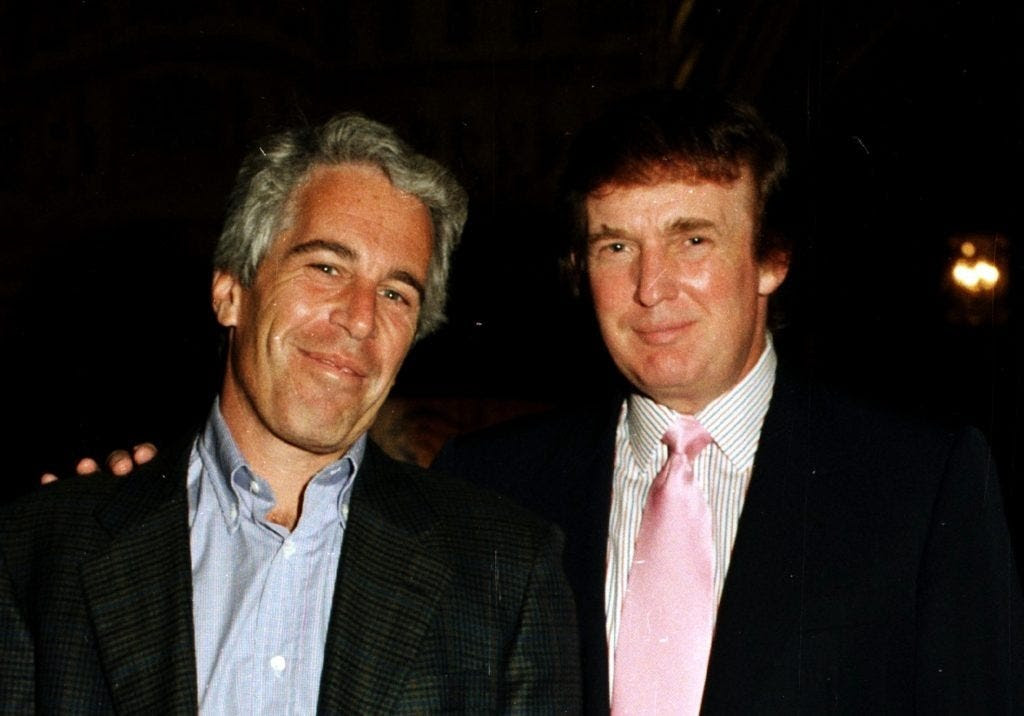
This bizarrely lax attitude towards sex crimes and those who commit them is endemic to the Trump regime and the DOJ as it is currently constituted, as exemplified most obviously by the extreme reluctance to release the Epstein files or investigate, charge, and try the guilty.

But then there’s Donald’s long history of associating with sexual abusers of women. Andrew Tate, one of the most openly and aggressively misogynistic figures in public life with a massive and influential social media following, is facing charges of rape and sex trafficking in both Romania and Great Britain. So is his brother, Tristan. Both were ordered to remain in Romania while the case against them was being built, but in the meantime, they forged alliances with members of the Trump family, including Donny and Barron.

After Donald’s second inauguration, according to Megan Twohey:

[A]n extraordinary order came down from the highest levels of the Romanian government instructing prosecutors to reach a compromise with the brothers.

And then those travel bans were lifted, which was something that the prosecutors did not want to do. . . . Once [Donald] was reelected, there were supporters of the Tates here in the United States who ascended into the administration, including a special diplomatic envoy named Richard Grenell, who . . . had at least two conversations with Romanian officials about the Tates’ case.

And then within days of that second conversation, the order came down in Romania ordering the compromise that led to the lifting of the travel bans. And we have been told that the Romanian prime minister believed that that would appease the Trump administration.

Very shortly after the ban was lifted, the Tates were flown by private jet to Florida.

The Trump regime is engaged in a systematic effort to normalize misogyny and the crimes of rape and sex trafficking and child pornography while protecting the men who commit those crimes.

So, we need to keep asking the questions: Why is Donald’s DOJ going easy on child pornographers? Why is it covering for men credibly accused of raping and trafficking girls and young women? Why is a man who is himself an adjudicated rapist and who has been credibly accused of sexual harassment and assault by almost two dozen women, associated with so many of these men? These are not rhetorical questions. We demand answers. In the meantime, the actions and the silence of the complicit speak for themselves.

Only One Man to Blame Trump seems dumbfounded by all the things going badly in Iran

Only One Man to Blame
Trump seems dumbfounded by all the things going badly in Iran

Dan Rather and Team Steady
Mar 19

It’s long been our mission here at Steady to help you navigate uncertain times. As we know, knowledge is power. And while we always aim to calm fears and ease anxiety, we also owe you the truth. Some days, that can be tough. And today is one of those days.

Increasingly, the president and his administration appear to have little to no idea of what they are doing when it comes to Iran — a muddled strategy, if any, no endgame, no clear picture of when and how this ends, and no one with the gumption to tell the commander in chief the truth.

In less than a month, Donald Trump has managed not only to endanger the U.S. economy, but most economies around the world. Quite a feat.

Today’s big headline is “Donald Trump Lied.” We could begin almost every piece with that sentence. But today’s lie is a whopper even by Trump standards, with massive implications. To get a clear understanding of those consequences, we need to back up 24 hours.

On Wednesday, Israel bombed Iran’s enormous natural gas facility, South Pars. It’s used primarily for domestic consumption by the Iranians. In retaliation, Iran twice bombed the world’s largest liquefied natural gas facility in Qatar. These attacks on global energy infrastructure sent markets reeling and prices rocketing skyward.

Soon after Iran’s second strike, overnight Wednesday, Trump took to social media to tell the Israelis and Iranians to essentially knock it off. In the post, the president said he knew nothing about Israel’s plans to bomb South Pars.

Not true, according to U.S. officials who spoke with the Wall Street Journal and Axios. They reported that not only did he know, he supported the military action to send a message to Tehran: Open up the Strait of Hormuz or else.

The president’s support of attacks on oil infrastructure anywhere is perhaps the most damaging thing he has done. Look at what it unleashed. Trump is now backing down from championing similar attacks, believing Iran got the message. Or maybe things have gone from bad to worse that he has no choice but to rethink what he is doing. And many observers argue that he should rethink it, for a multitude of reasons.

The U.S. Economy Doesn’t Like War
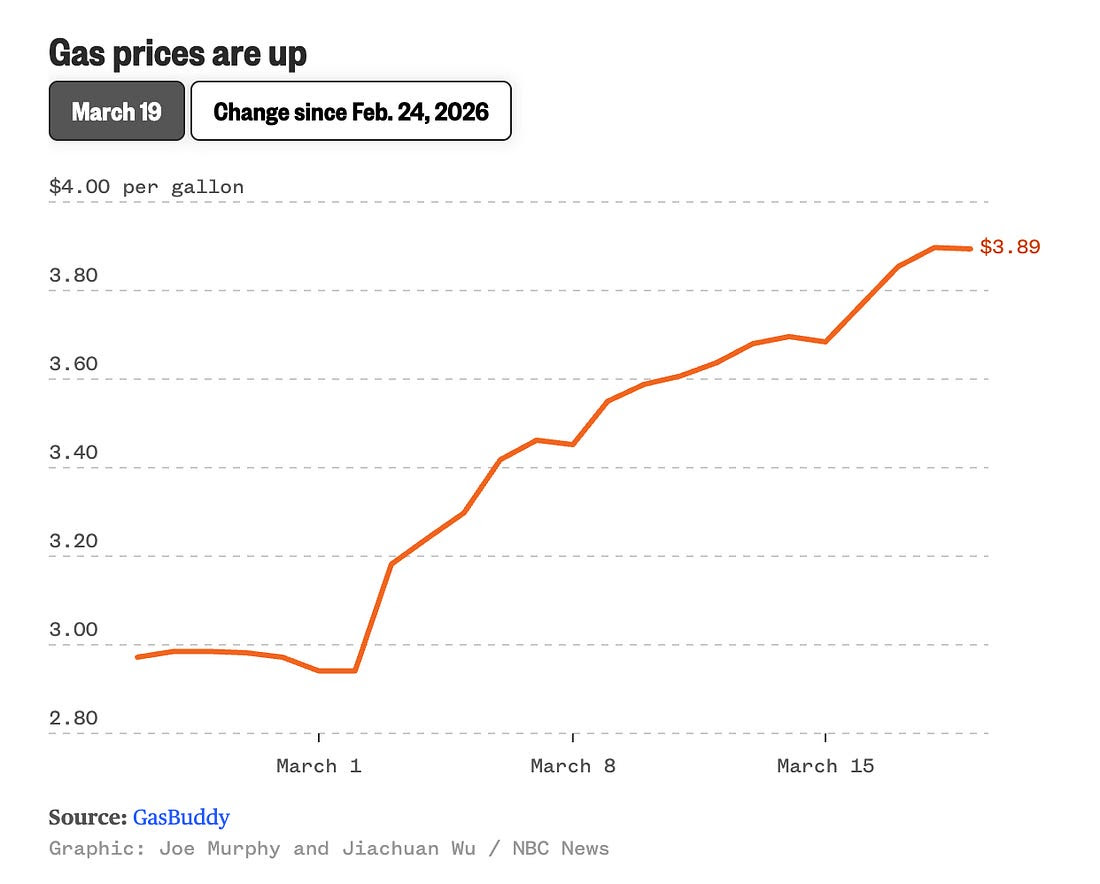
Oil prices are continuing their northward trek. As of this writing, Brent crude is $103 a barrel. The average price of a gallon of gas in the U.S. jumped from $2.98 to $3.88 since the war began. The stock market, which has remained robust through most of Trump’s second term, is not so sanguine about the war in Iran. U.S. stocks have fallen by about 4% with global markets faring even worse.

On top of all that sobering news, Thursday’s inflation report was worse than expected. Inflation is up to 3.4%. Hiring has stagnated and wage growth is falling. The federal debt is now $36 trillion, up $2 trillion in just seven months. And many economists are predicting a recession if hostilities don’t end soon in the Middle East.

Every U.S. recession — except the one in 2020 caused by the pandemic — has been preceded by rising oil prices. Moody’s puts the odds of a recession in the next year at 49%. Even if the war ends tomorrow, fixing the mess will take time. Don’t expect to see prices drop as quickly as they jumped.

The War Is As Unpopular As It is Costly
On the heels of all of the bad economic news, the Pentagon is reportedly asking the White House to approve a $200 billion request to Congress to further fund the war in Iran. That sum is considerably more than expected, and it signals the military thinks the conflict may well drag on longer than expected, though no one actually knows what to expect.

The White House is said to be weighing the idea of sending in ground troops, specifically to secure the Strait of Hormuz and Kharg Island, according to Reuters.

That is a hugely unpopular option. In a survey from Data for Progress released Wednesday, 68% of voters oppose deploying ground troops to Iran. Even half of Republicans do not support the option.

Any entry of ground troops would raise the specter of “mission creep,” the military’s term for what happened in Vietnam, Iraq, and Afghanistan. That is, what starts out to be a limited operation “creeps” into a larger and much more costly war.

Trump’s overall approval rating is dropping in sync with the bombs in Iran. According to The Silver Bulletin polling average, his net approval is now -15.3, the worst of his second term.

Gabbard on The Hot Seat
For the second day in a row, Tulsi Gabbard, the director of national intelligence, is on Capitol Hill to answer questions about the run-up to the war in Iran. Day two isn’t going much better than day one.

On Wednesday, in her opening remarks Gabbard omitted — for time, she claims — a line that was in her written remarks. It said, since Iran’s nuclear capabilities were “obliterated” by Trump in June, “there have been no efforts since to rebuild their enrichment capability.”

Democrats on the committee noted the omission since it undercuts the now-stated reason for the war.

At that hearing with the Senate Intelligence Committee, Gabbard bizarrely abdicated her most important authority to Trump, saying it is his job to determine who is a threat to the U.S.. Senator Jon Ossoff (D-GA) pressed her on whether there was an “imminent nuclear threat posed by the Iranian regime.”

Ossoff: “Yes or no?”

Gabbard: “It is not a responsibility of the intelligence community to determine what is or is not an imminent threat.”

Ossoff: “It is precisely your responsibility to determine what constitutes a threat to the United States.”

And the responsibility of the 80,000 members of the American intelligence community to make nonpolitical judgments about what constitutes a threat to the security of the country.

Gabbard’s testimony solidified an alarming reality: Everything is decided by one man, Donald Trump. The job of the massive federal government is simply to prop him up, to parrot him, and to do his bidding. No one in his orbit is allowed an original thought, especially if it runs counter to what he wants. And what he wants is a constantly moving target.

One of Gabbard’s colleagues in the intelligence community has had enough. Joe Kent, an avowed isolationist and MAGA poster boy, resigned as the director of the National Counterterrorism Center on Tuesday. In a scathing resignation letter, he said, “Iran posed no imminent threat to our nation, and it is clear that we started this war due to pressure from Israel and its powerful American lobby.”

Trump Is An Island Of His Own Making
Trump is not only isolating himself from his MAGA loyalists, who are openly divided and questioning his decision to attack Iran, but also from the international community. Most of our once stalwart allies are giving Trump the cold shoulder.

France “will never take part in operations to open or liberate the Strait of Hormuz in the current context,” said French President Emmanuel Macron. Canada “was not consulted prior to the offensive operation” and “has no intention of participating in it,” said Canada’s foreign minister, Anita Anand. And British Prime Minister Keir Starmer promised that his country would not be “drawn into the wider war.”

Rather than try to repair fissures with the world leaders, Trump did his damnedest to completely burn bridges.

“[W]e no longer ‘need,’ or desire, the NATO Countries’ assistance — WE NEVER DID! Likewise, Japan, Australia, or South Korea,” the president added. “In fact, speaking as President of the United States of America, by far the Most Powerful Country Anywhere in the World, WE DO NOT NEED THE HELP OF ANYONE!”, wrote the man who certainly needs help.

Even if the bombing stopped tomorrow, energy experts acknowledge it would take months to get online again. Energy production in the Middle East has shut down and you can’t just flip a switch and restart it. The Qatari facility bombed on Wednesday will take years to rebuild.

As The Economist noted, “Although president Donald Trump says he has ‘destroyed 100% of Iran’s military capability,’ the 0% that remains is playing havoc with the global economy.”

And if Iran keeps attacking oil infrastructure in the Gulf states, all bets are off. Iran said in a statement on Thursday that it will show “zero restraint” if its production facilities are attacked again.

And so the fog of war gets thicker and spreads wider. To what end, and when it ends remain a mystery, depending on the whims of one Donald Trump.

Trump Questions Why Japan Did Not Warn USA About Pearl Harbor in Meeting With Japan’s PM as U.S.-Israel Divisions Grow and Iran Claims Strike on F-35 Jet

Trump Questions Why Japan Did Not Warn USA About Pearl Harbor in Meeting With Japan’s PM as U.S.-Israel Divisions Grow and Iran Claims Strike on F-35 Jet

Aaron Parnas
Mar 19

In the Oval Office, President Trump raised eyebrows by questioning why Japan did not warn the United States about Pearl Harbor while seated alongside Japan’s prime minister. At the same time, tensions between the United States and Israel appear to be growing, with Trump urging Netanyahu to halt oil strikes, while Iran claims it has struck a U.S. F 35 jet, marking the first reported hit on an American aircraft in this conflict.

Meanwhile, economic pressure is building as fuel prices continue to surge and broader cost increases begin spreading across the economy.

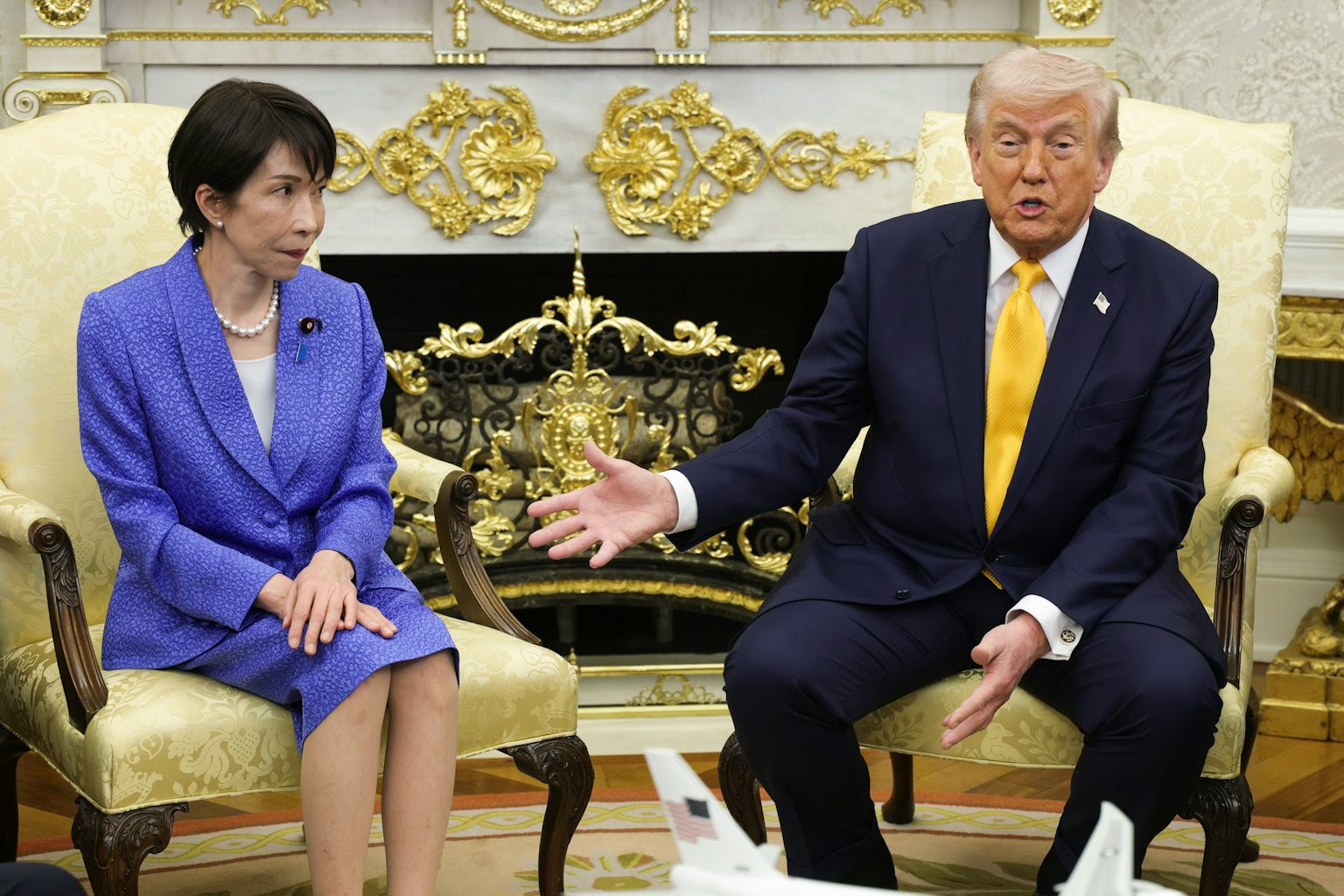
Trump said the U.S. kept the attack secret to preserve surprise, stating, “We wanted it to be a surprise. Who knows better about surprise than Japan? Why didn’t you tell me about Pearl Harbor?”—a remark he made while sitting next to the Japanese prime minister to justify not informing allies.

Strikes between Israel and Iran targeting major gas and energy facilities have sharply escalated the conflict and driven global oil and gas prices significantly higher. The attacks damaged critical infrastructure across the Gulf, raising fears of long term supply disruptions and broader economic shock. The situation has alarmed global leaders and allies, with warnings that continued escalation could destabilize energy markets and trigger lasting price increases worldwide.

Trump said he spoke to Netanyahu and told him not to attack oil and gas fields, and claims Netanyahu agreed not to do it.

According to Politico, House Speaker Mike Johnson said Congress must be prepared to fully fund defense as discussions intensify over a potential $200 billion request tied to the Iran war, emphasizing the need to respond to global threats. Lawmakers from both parties expressed uncertainty and concern about the size and scope of the funding, with some Republicans unsure if they would support it and Democrats signaling opposition. The debate highlights growing tension in Congress over the rising cost of the conflict and how to finance ongoing military operations.

Gas prices across the United States have surged since the start of the Iran war, rising from under $3 per gallon to nearly $3.90 nationwide. The increase includes a sharp jump in recent days, reflecting growing pressure on energy markets. The spike highlights the direct impact of the conflict on everyday costs for consumers.

President Trump said the Pentagon’s request for $200 billion in funding is not only tied to the war with Iran but also reflects broader military needs in a volatile global environment. He emphasized the scale and power of modern weapons while defending the request as careful and necessary. Defense Secretary Pete Hegseth supported the move, indicating that additional funding may still be required to sustain current operations and prepare for future military actions.

A U.S. F-35 fighter jet made an emergency landing after experiencing an inflight issue during a combat mission over Iran, with officials citing suspected enemy fire as a possible cause. The aircraft landed safely and the pilot is in stable condition, though the incident remains under investigation. Iran’s military claimed it had successfully struck and damaged the jet, highlighting escalating risks in the conflict.

China condemned Israel for killing senior Iranian officials, calling the targeting of state leaders and civilians unacceptable and opposing the use of force. Chinese officials urged an immediate ceasefire and warned that continued fighting could push the region toward an uncontrollable escalation. The statement reflects growing international concern over the widening conflict.

The United Arab Emirates condemned Iran’s strike on a major gas facility in Qatar, calling it a terrorist attack and warning it threatens global energy security. Officials said the attack caused significant damage and raised concerns about environmental and humanitarian consequences. The UAE also expressed support for Qatar and its efforts to protect its security and stability.

The United Nations has proposed creating a safety corridor to evacuate around 20,000 seafarers stranded on ships in the Persian Gulf amid the conflict. Officials warned that civilian crews should not be caught in geopolitical tensions and emphasized the risks they face, including danger and mental strain. The plan calls on all sides to allow safe passage for ships to protect those onboard.

Tulsi Gabbard said that the United States and Israel have different objectives in the war against Iran, noting that Israel is focused on targeting Iranian leadership while the U.S. aims to weaken Iran’s military capabilities. She explained that U.S. goals center on destroying missile systems, production capacity, and naval forces rather than pursuing leadership targets. Her comments highlight a strategic divergence between the two allies in how they are approaching the conflict.

Gabbard avoided directly answering questions about her personal views on the war with Iran, saying her role as Director of National Intelligence requires her to set aside personal opinions. When pressed about her past criticism of military action without congressional approval, she emphasized that her responsibility is to provide unbiased intelligence rather than express political positions. Her response frustrated some lawmakers who were seeking clarity on whether her views had changed.

Gabbard further refused to answer whether Iran was an imminent threat to the United States.

U.S. allies including the United Kingdom, France, and Germany said they are prepared to help reopen the Strait of Hormuz and ensure safe passage for shipping. They also signaled a willingness to take steps to stabilize global energy markets, including increasing production. The statement reflects growing international involvement as allies respond to disruptions caused by the conflict and condemn Iran’s attacks on shipping.

Politico has confirmed that the Trump administration told oil industry leaders it will not impose a ban on U.S. oil exports despite rising energy prices caused by the Iran war. Officials said they are exploring other ways to address soaring costs as global oil prices have surged significantly since the conflict began. The decision reflects concerns from industry leaders and highlights the challenges of stabilizing energy markets during the crisis.

Florida Governor Ron DeSantis rejected calls to suspend the state gas tax despite rising fuel prices, arguing that global oil fluctuations would likely cancel out any savings for consumers. He also warned that instability in Cuba could lead to a potential mass migration toward Florida, saying the state is preparing for that possibility. His comments reflect concerns about both the economic impact of the Iran conflict and broader regional instability.

A report found that the Trump administration has been deporting parents without giving them the opportunity to make arrangements for their children, in apparent violation of its own policies. Interviews with deported parents revealed many were removed quickly without being asked about their children or allowed to coordinate care, leading to family separations and significant emotional distress. The findings have raised serious concerns about immigration practices, child welfare, and compliance with existing protections.

Mortgage rates in the United States have risen to their highest level in more than three months as the Iran war fuels inflation concerns and drives up energy prices. The increase reflects broader market fears that higher oil costs could keep inflation elevated and delay expected interest rate cuts. The rising rates are already putting pressure on the housing market, with mortgage applications declining and affordability worsening for buyers.

ICE Just Detained a 7-Year-Old Canadian Girl With Autism at the Infamous “Cage” Facility in McAllen, Texas. No Criminal Record. Valid Documents. No Reason.

ICE Just Detained a 7-Year-Old Canadian Girl With Autism at the Infamous “Cage” Facility in McAllen, Texas. No Criminal Record. Valid Documents. No Reason.

A 7-Year-Old Canadian Girl With Autism Is Sitting in Trump’s Most Infamous Detention Center Right Now. Her Stepfather Is American. Her Mom’s Papers Are Good. ICE Doesn’t Care.

Dean Blundell
Mar 19

Ayla Lucas has been caged at Ursula — the facility doctors compared to a torture facility — since Saturday. Her stepfather is American. Her mother is a lawful alien with the right to work. ICE won’t say why. Canada won’t intervene. And a little girl with autism is being destroyed by a loud, cold, overcrowded warehouse while Washington decides if the paperwork that has already been approved is real.

Her name is Ayla Lucas. She is seven years old. She is Canadian. She has autism. And as of this writing, she is sitting inside the Rio Grande Valley Central Processing Center in McAllen, Texas — the facility the entire world knows as Ursula — wrapped in a mylar space blanket, sleeping on a floor mat, subjected to 24-hour lights, noise, overcrowding, and the kind of sensory chaos that experts say can cause irreparable neurological harm to autistic children.

She has been there since Saturday.

Her mother, Tania Warner, is a Canadian citizen from British Columbia. She has lived legally in the United States for five years. Her social security documentation lists her status explicitly as “Lawful Alien Allowed to Work.” She has a Texas driver’s licence. She has a work visa. She has her actual visa. She was working on her green card.

Her husband — Ayla’s stepfather, Edward Warner — is an American citizen.

ICE has them both locked up anyway.

No criminal record. No final removal order. No explanation. Just a bureaucratic system error that Washington decided, upon review, was reason enough to cage a seven-year-old autistic girl from Canada in a warehouse that a board-certified pediatrician once formally compared to a torture facility.

How This Happened
The family wasn’t doing anything suspicious. They weren’t crossing the border illegally. They were driving home.

Edward, Tania, and Ayla were returning to their home in Kingsville, Texas after attending a baby shower in Raymondville — a normal Saturday, the kind of afternoon that ends with tired kids and leftovers. On the way back, they hit a routine border patrol checkpoint in Sarita.

Edward showed his ID. Tania showed her Texas driver’s licence, her work visa, and her visa. Standard. Legal. Complete.

Officers took Tania inside for what they said was routine fingerprinting.

She never came back out.

Ten or twenty minutes later, officers returned and said Ayla needed fingerprinting too.

She never came back out either.

Edward Warner — an American citizen — was left standing alone at a checkpoint while his wife and seven-year-old stepdaughter were swallowed by a system that apparently couldn’t find their paperwork in a database. The local center sent their fingerprints to Washington. Washington reviewed the file. Washington decided the mother and child were not free to go.

“It’s scary, it’s really frustrating, especially when they have paperwork that’s good, and it doesn’t come up in the system as being good,” Edward told CTV News. “It didn’t come up as having paperwork at all.”

A database error. That’s it. That’s the reason a little girl with autism is sitting in a federal cage right now. A database didn’t talk to another database, Washington punted, and Ayla Lucas is paying the price in a facility so brutal that every member of Congress who has ever toured it has come out visibly shaken.

What Ursula Is. What It Does to Children. What It’s Already Doing to Ayla.
If you don’t know the name Ursula, you should. It is not a detention center in any meaningful sense of the word. It is a retrofitted 77,000-square-foot warehouse on West Ursula Avenue in McAllen, Texas. It is the largest immigration processing and detention facility run by Border Patrol and CBP in the United States. It opened in 2014 and became infamous in 2018 when photos emerged of children being held inside large chain-link cages — the images that defined the first Trump administration’s family separation policy and made the front page of every newspaper on the planet.

The chain-link fencing is technically gone now. Removed during a 2022 renovation. The Trump administration would like you to focus on that detail.

What remains: the warehouse. The concrete floors. The Mylar blankets. The lights that never turn off. The overcrowding. The cold. The noise. The food that Edward Warner described as “terrible.” The two phone calls a day. The utter absence of anything a child — let alone an autistic child — needs to survive psychologically intact.

Board-certified pediatrician Dr. Dolly Lucio Sevier assessed 39 children detained at Ursula and filed a formal medical declaration stating the conditions “could be compared to torture facilities — extreme cold temperatures, lights on 24 hours a day, no adequate access to medical care, basic sanitation, water, or adequate food.”

Every single one of the 39 children she assessed showed signs of trauma. Every. Single. One.

Congressional visitors described children hiding under Mylar blankets, peering out with exhausted eyes, asking when they could leave. Rep. Jackie Speier said the only sounds audible from the facility were rushing air conditioning and the cries of small children and babies. Rep. Jim McGovern reported migrants who hadn’t showered in 40 days. The smell, multiple witnesses reported, was overwhelming.

That is where Ayla Lucas is right now.

“It’s no place for a seven-year-old to be,” Edward said. “They’re just very stressed out right now.”

Stressed out. For a neurotypical child, that sentence is bad enough. For an autistic child, it is a five-alarm emergency.

What ICE Is Doing to Ayla’s Brain
This is not opinion. This is child developmental science.

Dr. Gilbert Kliman — a child psychiatrist and autism expert who has personally evaluated minors in immigration detention — described the prolonged confinement of an autistic child as the “antithesis of good treatment” that risks inflicting irreparable harm. Autistic children depend on structured, predictable environments. They depend on routine. They depend on familiar sensory input. They are frequently overwhelmed by the world even under normal circumstances.

Ursula is the precise opposite of every single thing an autistic child needs to function.

Loud. Unpredictable. Overcrowded. Bright lights at all hours. Strangers in every direction. Cold. Chaotic. Terrifying.

Researchers describe detention environments — the noise, the lights, the unfamiliar adults, the absence of safe touch — as a “form of developmental threat” to children. The clinical summary is brutal in its simplicity: “The brain learns: I am not safe anywhere.”

We have documented precedent for what this looks like in practice. A 9-year-old boy named Kenek, who has severe autism, spent more than 80 days at another South Texas family detention facility. Without access to therapy, he became increasingly disoriented. He started hitting himself. He cried through the night. He begged his mother to let him go back to school. He was only released after a pro bono legal clinic filed a parole request specifically documenting his autism diagnosis and the self-harm that detention had induced.

Another case: a 14-year-old Venezuelan boy with autism spent 70 days in detention, received zero autism-specific care, and suffered repeated panic attacks. When his attorney filed a motion citing his autism as grounds for release, the immigration judge looked up from the bench and responded: “So what?”

Ayla Lucas is seven. She has been there since Saturday. The clock is running.

The Legal Framework ICE Is Shredding
There is a legal agreement — the Flores Settlement Agreement — that has governed the detention of migrant children since 1997. It exists precisely because the United States government has a long and ugly history of treating detained children as administrative objects rather than human beings. Under Flores, children can be held only for the time reasonably necessary to arrange their release — a standard federal courts have interpreted as no longer than 20 days.

The Trump administration has detained more than 900 children past that legal limit. That is not a rounding error. That is a policy.

And here’s the structural indictment that makes all of this worse: ICE and DHS are not legally mandated to protect the basic human rights of children. Their agents are trained in law enforcement and security. The agency’s own mandate is incompatible with providing trauma-informed, developmentally appropriate care to a child. It is not equipped to do it. It was never designed to do it. And under this administration, it has no interest in doing it.

The system is not broken. The system is working exactly as designed. The design is the problem.

The Canadian Pattern Nobody In Ottawa Is Screaming About Loudly Enough
Ayla Lucas is not an anomaly. She is a data point in an accelerating trend that Canada’s government has been embarrassingly reluctant to name for what it is.

An estimated 207 Canadians have been held in ICE custody since January 2025 — up from 130 for all of 2024. Forty-four percent of those detained had no criminal record and no pending charges. At least six Canadian children have been detained in that period. One of them was held for 51 days — more than double the 20-day legal limit that American courts have established as the maximum allowable detention for any child.

A Canadian child. In a U.S. detention facility. For 51 days. Held illegally by any measure. And Ottawa issued a travel advisory.

When Edward Warner reached out to Global Affairs Canada, the response from consulate staff in Texas was staggering in its uselessness: they could only help if Tania and Ayla wanted to return to Canada. Not to fight for their legal right to remain in the country where they have lived for five years. Not to challenge an unlawful detention. Just — do you want a one-way ticket home?

B.C.-based immigration lawyer Richard Kurland didn’t mince words: “We’re being revoked for our special relationship, and we have to be on guard. You’re a stranger in a strange land.” He fears Ayla may be “a pawn” in the broader trade and immigration war between Washington and Ottawa.

Canada’s official travel advisory, meanwhile, warns Canadians to “expect scrutiny at ports of entry” and notes that “individual border agents often have significant discretion.”

That’s it. That’s the warning. Scrutiny. Discretion.

Not: a border agent can decide your lawful documents don’t exist, take your autistic child from your arms, lock them in a facility that doctors have compared to a torture facility, and leave your American husband standing alone in a parking lot in Sarita, Texas with no answers and no timeline and no recourse while Washington reviews a database that didn’t load correctly.

That’s what “scrutiny” and “discretion” look like in practice in 2026. Write it down.

What Needs to Happen Right Now
Edward Warner has hired a lawyer, launched a GoFundMe, and contacted every official body he can reach. ICE and DHS acknowledged media inquiries and answered zero questions.

Ayla Lucas is seven years old. She has autism. She is Canadian. Her mother has valid documentation. Her stepfather is American. There is no legitimate law enforcement purpose being served by their continued detention. None. This is bureaucratic cruelty operating on autopilot, and the machine does not stop on its own.

The Canadian government — the Carney government, which has spent the last several weeks correctly positioning Canada as a sovereign nation that will not be bullied by Washington — needs to treat this case as what it is: an unlawful detention of a Canadian child in conditions that experts have described as developmentally catastrophic, by a foreign government that has already demonstrated it will not self-correct.

Consular services. Legal intervention. Diplomatic pressure. Public naming. All of it. Now.

Because what’s happening to Ayla Lucas isn’t just wrong. It’s a preview. It’s what happens when a government decides that rules, documentation, and basic human decency are optional — and nobody with the power to stop it decides that this particular seven-year-old girl is the line.

She’s the line, Mark Carney.

Get her out.

News for the 21st Century