Tag Archives: Trump

Articles of Impeachment for Bondi Introduced, Some Airports May Shutdown, SAVE Act in Trouble, Russia

Articles of Impeachment for Bondi Introduced, Some Airports May Shut Down, SAVE Act in Trouble, Russia Helps Iran Even More

Aaron Parnas
Mar 17

There is a lot to cover this afternoon. Articles of impeachment have been filed against Pam Bondi. Some airports may begin shutting down as the government shutdown escalates. The SAVE Act is in serious trouble, lacking enough Senate support to pass. At the same time, Russia is increasing its support for Iran in the ongoing war.

Meanwhile, new data shows CBS Evening News ratings are dropping sharply as independent media continue to surge. We are doing this differently, and we are doing it better. Why? Because we answer to you.

Rep. Summer Lee has introduced articles of impeachment against Attorney General Pam Bondi, alleging a wide range of misconduct, including defying congressional subpoenas to release unredacted Epstein files, violating federal law, misleading Congress and the courts, and abusing prosecutorial authority. The resolution also accuses Bondi of politicizing the Justice Department by targeting political opponents, dismissing cases involving allies, and retaliating against officials and journalists, as Lee and several Democratic co-sponsors argue her actions undermine the rule of law and warrant removal from office.

House Oversight Chair James Comer has subpoenaed former Attorney General Pam Bondi to testify under oath in an ongoing probe into the Justice Department’s handling of the Epstein investigation, citing concerns about potential mismanagement and failure to comply with transparency laws. The move follows bipartisan frustration over heavily redacted files and escalates congressional scrutiny, even as the DOJ calls the subpoena unnecessary and offers briefings instead.

Senior Justice Department officials are set to brief a bipartisan group of lawmakers at the Capitol on the handling and release of Epstein-related documents, as congressional scrutiny intensifies over transparency and the DOJ’s actions.

A group of more than three dozen House conservatives has staged a revolt against their own party leadership by voting down even routine, bipartisan legislation to pressure the Senate into taking up the SAVE Act, openly defying Speaker Mike Johnson, disrupting the House’s normal legislative process, and signaling they are willing to block all Senate-originated bills—including “must-pass” measures—until their demands are met.

A prolonged government funding standoff has led to a mounting workforce revolt among TSA officers, who have been working without pay for weeks and are increasingly calling out or quitting, severely straining airport security operations. Absentee rates have surged far above normal levels, causing long screening delays and operational disruptions at major hubs, while officials warn that if the situation continues, staffing shortages could force the closure of some smaller airports—especially as travel demand ramps up during the busy spring season.

The Senate narrowly voted 51–48 to open debate on the SAVE America Act, but some Republicans showed internal division: Sen. Lisa Murkowski voted against it, Sen. Thom Tillis missed the vote after opposing it, and Sen. Mitch McConnell—who doesn’t support the bill—only voted to proceed as a procedural courtesy, highlighting fractures within the GOP despite overall backing for the legislation.

DNI Tulsi Gabbard responded to Joe Kent’s resignation in protest of the Iran war.

According to the Wall Street Journal, Russia is significantly ramping up its military and intelligence support for Iran by sharing satellite imagery and upgrading drone capabilities, enhancing Tehran’s ability to target U.S. forces and sustain operations in the region. The cooperation reflects a deepening strategic partnership, with Moscow aiming to keep Iran engaged against U.S. and Israeli forces while prolonging a conflict that benefits Russia by diverting Western attention and creating military and economic advantages.

Iranian state media has confirmed that top security official Ali Larijani was killed in an Israeli airstrike on Tehran, marking the first acknowledgment from Iran after earlier Israeli claims and signaling a major escalation in the conflict with the loss of one of the country’s most senior leaders.

According to the Washington Post, the U.S. aircraft carrier Gerald R. Ford, deployed in operations against Iran, is set to make a temporary port stop after a significant onboard fire injured nearly 200 sailors with smoke exposure, disrupted living quarters, and took hours to contain, impacting its operational readiness during the ongoing conflict.

Rep. Pat Ryan sharply attacked Defense Secretary Pete Hegseth, accusing him of increasingly erratic behavior, blaming him for the deaths of 13 Americans, and calling for him to be held accountable.

French President Emmanuel Macron rejected claims by Donald Trump that France would help reopen the Strait of Hormuz, stating France would not participate in such operations and signaling a split with the U.S. over how to respond to escalating tensions in the region.

Iran confirmed the killing of Basij commander Gholamreza Soleimani in an اسرائیلی strike, marking one of the highest-level assassinations of the war, as regional tensions escalate with ongoing missile exchanges, heavy civilian casualties in Lebanon, and warnings from the UN that Israeli strikes on civilian areas may constitute war crimes.

The conflict is widening politically and militarily: Trump is pressuring but also criticizing NATO allies for not joining U.S. efforts in the Strait of Hormuz, key partners like France are refusing involvement, internal dissent is growing in the U.S. (including a senior resignation), and Iranian leaders warn the strategic waterway will not return to normal conditions.

Ireland’s leader Micheál Martin publicly pushed back on Donald Trump’s criticism of UK Prime Minister Keir Starmer during a White House meeting, diplomatically defending Starmer and Europe while avoiding confrontation, highlighting growing transatlantic tensions over the Iran war and NATO.

Arizona has escalated its crackdown on prediction market platform Kalshi by filing its first-ever criminal charges, accusing the company of operating an unlicensed gambling and election-betting business as part of a broader, multi-state legal battle over whether such platforms fall under federal financial regulation or state gambling laws.

A federal judge ordered a sweeping reversal of Kari Lake’s dismantling of Voice of America, mandating the reinstatement of about 1,000 employees and rebuking her for disregarding congressionally mandated legal requirements.

According to Axios, Senator Ruben Gallego is pressing the Energy Department for details on potential releases from the Strategic Petroleum Reserve as gas prices rise, highlighting growing political pressure in Washington over the domestic impact of the Iran war on energy markets.
 

Iran called Trump’s bluff — and now he’s spiraling and ‘out of ideas’: expert

Iran called Trump’s bluff—and now he’s spiraling and ‘out of ideas’: expert

Travis Gettys
March 17, 2026, 3:28PM ET (RAWSTORY)

None of President Donald Trump’s usual bailouts are coming after he launched a war on Iran, and the situation has quickly spiraled out of his control.

The 79-year-old president has long relied on lies, bluster, and escalation to stay one step ahead of consequences in his business, political, and personal life, but those tactics are proving woefully ineffective against the global energy market that’s been choked off by Iran in response to the military operation he impulsively authorized, wrote political scientist Nicholas Grossman for MS NOW.

“In response to the U.S.-Israeli attack, Iran played its biggest card, closing the Strait of Hormuz,” wrote Grossman, a political science professor at the University of Illinois. “It’s a narrow choke point at the end of the Persian Gulf, and a kink in the waterway leaves it exposed to a lot of Iran’s coastline. About 20 percent of the world’s oil passes through Hormuz, and it isn’t hard for Iran to stop the traffic.”

“Iran can’t prevent U.S. and Israeli forces from flying over the gulf, and they probably couldn’t keep the U.S. Navy out of it, but to close the strait, they don’t need to,” he added. “They only have to make shipping companies afraid to sail, and insurance companies think the risk of insuring the ships is too high. With threats, a few attacks on tankers, and now possibly sea mines Iran has.”

That development should have been expected, Grossman wrote, but the president seems caught off guard by the strategic closure that’s threatening to tip the global economy into a tailspin, so Trump has fallen back on his habitual tactics to wriggle out of the jam he created for himself.

“Trump tried saying the war is almost over and the U.S. already won,” Grossman wrote. “It made the oil price drop back down for a bit, but as U.S.-Israeli bombardment continued and market disruptions got worse, it rose again.”

“Trump tried telling ships to traverse the Strait of Hormuz, but most wouldn’t, and a few who did exploded, presumably at Iran’s hand,” he added. “He tried releasing oil from America’s strategic reserve, and some other countries did from theirs. But that’s a Band-Aid on a gaping wound and had little impact.”

He tried bombing Kharg Island, which Iran uses for oil exports, in the apparent belief that slowing down Iran’s shipping would force it to stop blocking other nations’ ships in the Persian Gulf, and Grossman saw a parallel in Trump’s business career.

“That recalls one of Trump’s go-to moves in business: the bad faith lawsuit,” Grossman wrote. “He’d break a contract, screw someone over, and dare them to sue him. Or would initiate legal action himself. Either way, he bet that he’d have more resources and greater tolerance for a protracted legal fight, and the other party would settle even when the facts were on their side.”

“That won’t work with Iran,” Grossman warned.

Trump has incentivized the Iranian regime to use every bit of leverage they have and endure as much punishment as they can take, and U.S. allies aren’t willing to bail him out after he alienated them and launched an illegal war without first consulting them.

“Much of the time when Trump was in the private sector and messed up, his rich dad bailed him out or he’d declare bankruptcy,” Grossman wrote. “Instead of holding equity or debt, Trump would have the business pay him a salary and bonuses so that money was gone when the company went under, and his partners and contractors would take most of the losses.”

“Trump started something that quickly spiraled and seems out of ideas,” he added. “There’s no one to sue, no rules to manipulate, just the hard realities of resource shortages and war. And there’s a good chance Iran can tolerate being bombed more than the U.S. can tolerate a rapidly rising oil price and the economic damage it causes.”

This unforgivable lie is Trump’s most heinous insult to troops yet

This unforgivable lie is Trump’s most heinous insult to troops yet

John Casey
March 17, 2026 8:21AM ET (RAWSTORY)

Donald Trump has a fixation with numbers. He must get this trait from his uncle, who taught at MIT. Trump claims his uncle had three university degrees “in nuclear, chemical, and math.”

That’s a lie, of course. And it fits. And math? What? We surely know Trump failed his math courses. That’s because Trump’s obsession with numbers usually involves numbers he makes up, pulls out of thin air, and, well, lies about, just like he lies about his uncle.

He doesn’t just lie about numbers. He remakes them as he sees fit: larger, smaller, higher, lower, more pleasing, and more flattering. He has a long history of making false or misleading statements about figures, consistently exaggerating numbers related to his achievements, support, and events.

Throughout his life—and in the interest of brevity, let’s stick to his political career—Trump has treated data not as a collection of facts but as a tool for image-making.

From the moment he was sworn in, he famously inflated his 2017 inauguration crowd size. Later, he compared the crowd that participated in the insurrection he provoked on January 6th to the historic crowds of the March on Washington in 1963.

These weren’t just wildly false. They were insulting.

And if you’re a glutton for lies and keep up with Trump’s fibs, you know the pattern extends to the economy, immigration, job numbers, gas prices, and on and on. He routinely posts whoppers on Truth Social and delivers them during interviews, rallies, and even State of the Union speeches.

He constantly claims “record-breaking” statistics, such as 20 million illegal border crossings or inheriting “record” inflation, even when the numbers are grossly exaggerated or the opposite is true.

Former New Jersey Governor Chris Christie once explained Trump’s reliance on falsity: “Trump looked at my wife and said, Whether it’s true or not, if I say it enough times, it becomes true… He takes what he knows is incorrect and convinces himself by saying it enough times.”

This habitual distortion creates a phony version of leadership where popularity and success are measured by unadulterated nonsense rather than real results, i.e. electoral victory as a “landslide” or unfavorable approval ratings as “fake news.”

Trump has established a perverse precedent where obvious facts become inconvenient. His reliance on fabricated numbers doesn’t just mislead supporters; it erodes the shared seriousness required for a functioning democracy.

Alarmingly, we watched him do it six years ago with COVID. The question now, as his Iran war enters its third week and injuries and fatalities begin to mount, is whether we will watch him do it again.

On Thursday, a second military evacuation flight landed at Ramstein Air Base carrying roughly 19 more wounded American troops, including two injured in a drone attack whose details the Pentagon has declined to fully disclose. This follows about 20 who arrived days earlier. The official Pentagon tally now sits at roughly 140 injured and 13 dead.

Some of those numbers reached the public through leaks, not through clear, direct briefings from the equally fact-challenged Pete Hegseth.

When wartime casualty data has to escape through back channels to reach the American public, you don’t need a history degree to understand what’s happening. You just need a memory.

During the Vietnam War, the Johnson administration manipulated, obscured, and downplayed U.S. involvement and casualties to manage public opinion and conceal the lack of progress.

Trump has traversed this dubious road before. In the spring of 2020, he suggested that COVID case counts could be reduced simply by doing less testing.

“When you do testing to that extent, you’re going to find more people; you’re going to find more cases,” he said. “So I said to my people, ‘Slow the testing down, please.’” The White House said it was a joke. It wasn’t. And if it were, these are people’s lives we are talking about.

He pressured the CDC. He slow-walked through reporting. He feuded publicly with his own health officials when their projections made him look bad. He even tried to keep cruise ships away from U.S. shores so that the infected passengers wouldn’t raise the ominous COVID numbers.

He turned the routine act of counting the dead into a political liability to be managed rather than a solemn obligation to be honored. By the time it was over, the United States had one of the highest COVID death tolls in the developed world.

Now here we are again.

The Iran war is just over two weeks old. It has already cost American taxpayers more than $11 billion in its first week alone. Gas prices are rising by the day. A military refueling plane crashed, and the administration was remarkably quick, suspiciously quick, to distance the incident from enemy fire.

Meanwhile, the White House communications operation has been running this conflict like a winter blockbuster, complete with NFL-style highlight reels and video game-style footage. It’s disgusting. War is not a game. It is deadly. People are maimed. People die.

Trump worked hard to manipulate COVID data. Public health experts and career officials forced some transparency. But now, in his second term, he has a compliant inner circle, a press operation built for deflection, and an instinct to reward officials who shade the truth in the boss’s favor.

Consider what happened in August 2025, when Trump fired the commissioner of the Bureau of Labor Statistics after a weak jobs report, accusing the agency of producing “fake” or politically motivated data. The message was clear: numbers that make him look bad are unacceptable.

Unlike a virus or a jobs report, this war has names and faces and anxious families waiting by their phones. Those families deserve accurate information. They deserve to know exactly how many of their sons and daughters have been hurt and how badly.

Our troops are not inconvenient data points to be managed around an approval rating.

They are human beings in harm’s way. Every one of them deserves to be counted fully, honestly, and publicly.

Trump has ridiculed our troops before; under-counting the injured and dead may be his greatest insult toward them.


‘Funny how that works’: Nobel-winner warns Trump’s allies won’t help him out of ‘trap’

‘Funny how that works’: Nobel-winner warns Trump’s allies won’t help him out of ‘trap.’

Ewan Gleadow
March 17, 2026, 2:30PM ET (RAWSTORY)

A new brief of tariffs from the Trump administration could be the worst yet, according to Nobel Prize-winning economist Paul Krugman.

Krugman warned that new tariffs set to be introduced by the president’s team will affect not just U.S. citizens but the world as he lashes out at NATO for not helping with the war in Iran. The economist believes a proposed tariff on 60 countries, including members of the European Union, Canada, and the United Kingdom, will cruelly hinder economies across the world during a time of domestic crisis.

Krugman wrote, “Trump imposed tariffs on almost every other nation, including islands inhabited only by penguins, by invoking the International Emergency Economic Powers Act.” This use of IEEPA was blatantly illegal, and after dragging its heels for many months, the Supreme Court finally agreed with lower courts that the tariffs were, in fact, illegal.

“One important point that isn’t emphasized enough is that in addition to being illegal under U.S. law, the IEEPA tariffs were a gross breach of contract. Most U.S. tariff rates were set in 1995, as part of the negotiations that, among other things, created the World Trade Organization.

“These tariffs were ‘bound’ by international agreements, which have almost as much force as treaties. But the U.S. just ripped those agreements up without even trying to make a case for its actions.

“Now the IEEPA tariffs are gone, but Trump isn’t giving up. On Sunday night he posted a long, falsehood-filled rant about the court, beginning with a condemnation of its tariff ruling. And while he can’t simply defy Supreme Court rulings—not yet, anyway—his officials have been scrambling for legal strategies to reimpose high tariffs.”

Krugman has warned that, despite the Supreme Court intervening in Trump’s tariff powers, the worst is yet to come as the administration looks to hinder its allies, enemies, and trading partners with a new round of economic changes.

“Under U.S. law the executive branch has the authority to impose tariffs without new legislation in certain specified circumstances,” Krugman wrote. These include Section 232 tariffs to protect national security, the (spurious) basis for most of the tariffs that survived the Supreme Court’s ruling.

“Trump officials are planning to impose another major round of tariffs using Section 301, designed to cope with unfair foreign trading practices. In particular, they’re proposing tariffs on 60 (!) countries, including Canada, the UK, and the European Union, that they accuse of violating rules against international trade in goods produced with forced labor.

“The current U.S. government has, as Trump would say, treated our erstwhile allies very, very badly in multiple ways, with the arbitrary, illegal imposition of tariffs the most consequential. And now those erstwhile allies have no inclination to help Trump out of the Iran trap he created for himself. Funny how that works.”

‘Never heard him so angry’: MAGA senator posts – then deletes – story of furious Trump

‘Never heard him so angry’: MAGA senator posts – then deletes – story of furious Trump

Alexander Willis
March 17, 2026 11:12AM ET (RAWSTORY)

Sen. Lindsey Graham (R-SC) published—and immediately deleted—a post on social media Tuesday sharing details of a conversation he had moments earlier with President Donald Trump, who, according to Graham, was absolutely furious over his pleas for other countries to aid his Iran war effort being largely ignored.

“Just spoke to President Trump about our European allies’ unwillingness to provide assets to keep the Strait of Hormuz functioning, which benefits Europe far more than America,” Graham wrote in a social media post on X Tuesday, a post that was deleted within minutes.

“I have never heard him so angry in my life. I share that anger given what’s at stake.”

Not long after Trump first authorized strikes on Iran, the Middle East nation vowed to attack any sea vessels aligned with the United States and its allies attempting to pass through the Strait of Hormuz, a crucial shipping route through which 20% of the world’s oil trade flows. Oil prices have skyrocketed as a result, reportedly sparking panic within the Trump administration and prompting Trump to call on other nations to support its war effort.

Those calls have mostly landed on deaf ears, however, and were met with “little in the way of immediate commitments,” The Wall Street Journal reported Sunday.

Trump’s apparent fury was shared by Graham, who wrote in his now-deleted social media post that the perceived snub from European nations made him “second guess the value” of U.S. alliances.

“The arrogance of our allies to suggest that Iran with a nuclear weapon is of little concern and that military action to stop the ayatollah from acquiring a nuclear bomb is our problem, not theirs, is beyond offensive,” Graham wrote.

“I consider myself very forward-leaning on supporting alliances; however, at a time of real testing like this, it makes me second-guess the value of these alliances. I am certain I am not the only senator who feels this way.”

Despite deleting the post, Graham republished a revised version about 40 minutes later, and with minimal and inconsequential changes.

White House melts down with vulgar response after being called out on stunning reversal

White House melts down with vulgar response after being called out on stunning reversal

Nicole Charky-Chami
March 17, 2026 3:51PM ET (RAWSTORY)

The Trump administration was raging on Tuesday, dropping a bizarre comeback after it was called out over previous claims involving the Iran war.

White House Press Secretary Karoline Leavitt reversed her comments from last week, when she was critical of an ABC News report and blamed the outlet in a post on X for “providing false information to intentionally alarm the American people.”

“TO BE CLEAR: No such threat from Iran to our homeland exists, and it never did,” Leavitt wrote.

But the White House was furious after people started noting the apparent change in tune from the Trump administration and clapped back with a surprising response on X.

“No such threat to our homeland of Iran launching a drone offensive on our West Coast, dumbass. The nuclear threat of the psychotic, murderous Iranian regime is very real, however. Thank God we finally have a president who’s doing something about it,” the White House Rapid Response account on X wrote.

Leavitt, earlier Tuesday, had responded on X with a lengthy post pointing to a public statement from U.S. intelligence official Joe Kent. Kent had resigned publicly via X and, in his letter to President Donald Trump, cited his reasons for leaving his position that Trump appointed him to, insisting that Iran had not posed an imminent threat.

“There are many false claims in this letter, but let me address one specifically: that ‘Iran posed no imminent threat to our nation,'” Leavitt wrote in rebuttal to Kent’s resignation letter. “This is the same false claim that Democrats and some in the liberal media have been repeating over and over.”

Revealed: Trump Likely to Send Ground Troops to Iran

Trump knew Americans would die and went to war anyway; former presidents say Trump lying about phone call, CBS journalists walk off the job

Raw America
Mar 17

Three weeks into a war that nobody voted for, the stories breaking this morning are not about battlefield victories. They are about a president who knew exactly what was coming, lied to your face about it, invented a former president who never called him and whose own allies are now privately warning that ground troops in Iran may be inevitable. And through all of it, CBS News is bleeding journalists and replacing them with Bari Weiss, while the FCC chairman rattles sabers at any broadcaster who covers the war honestly.

Trump Knew. His Own Intelligence, Officials Say So.
Donald Trump stood before reporters and said nobody, not one expert, not one intelligence official, could have predicted that Iran would retaliate against U.S. allies across the Gulf. “We were shocked!” he said.

Sources with direct knowledge of the pre-war intelligence assessments told journalists Monday that is flatly untrue. Iranian retaliation against military assets and allied targets across the region was not guaranteed, but it was, in the words of one source, firmly “on the list of potential outcomes.” Two additional sources confirmed that Trump was also specifically warned Iran might attempt to close the Strait of Hormuz. His own press secretary has since confirmed he received those briefings and chose to proceed anyway.

Iran was not exactly secretive about its intentions either. Less than ten days before the U.S. launched strikes on February 28th, Iranian officials sent a letter to the United Nations stating explicitly that all bases and assets of any hostile force in the region would constitute legitimate targets in the event of a military attack. That letter is a public document.

More than 1,400 Iranians have been killed in U.S. and Israeli strikes, including dozens of children killed when a U.S. missile struck a girls’ elementary school in the southern city of Minab on the first day of the war. Thirteen American service members are dead. The Strait of Hormuz is effectively closed. Gas is near four dollars a gallon with midterms approaching. And the president is telling the American public he had no idea any of this could happen. His own intelligence community is telling you otherwise.

When a president can lie about what he knew before sending Americans to die and face no immediate consequence for it, we’re not just talking about one bad actor. We’re watching what happens when the guardrails of democratic accountability have been quietly dismantled, one norm at a time. That’s the thing about lies in wartime. They don’t just mislead. They kill.

Every Living Former President Says Trump Lied About That Phone Call
On Monday, Donald Trump claimed not once but twice that he had spoken with a former U.S. president who told him he wished he had attacked Iran himself. He refused to say who it was, adding that revealing the name would be bad for the person’s “career, even though they have no career left.” Later in the day, he hinted strongly it was Bill Clinton, describing the mystery caller as a member of the opposing party who happens to like him.

Within hours, aides to all four living former presidents, Clinton, George W. Bush, Barack Obama, and Joe Biden, told multiple news organizations that their bosses had not spoken with Trump about Iran. Not one of them. The call did not happen.

This matters beyond the embarrassment of it. Trump used this fabricated endorsement to defend a war that has killed 13 Americans and more than 1,400 Iranians. He also repeated his long-debunked claim that Iran was two to three years away from a nuclear weapon it would have used against Israel and then the United States, a claim contradicted by his own intelligence agencies. The president is constructing a fictional justification for a real war, and when pressed on the details, every piece of it falls apart.

We’ve seen this before. Presidents who need a war to stay popular have always needed a story to go with it. From the Gulf of Tonkin to weapons of mass destruction, the pattern is the same. What’s different now is that the lie got fact-checked within hours by the offices of four former presidents, and it still didn’t matter to a significant chunk of the country. That’s not a Trump problem. That’s an information-ecosystem problem, and it’s one of the deepest threats to self-governance this country has ever faced.

Trump’s Own Allies Are Warning This Could Mean Boots on the Ground
The most alarming story of the morning comes from inside the White House itself. Sources close to the administration are now privately warning that Trump has lost control of this conflict’s trajectory and that the only remaining path to saving face may involve deploying American ground troops inside Iran.

The core problem is the Strait of Hormuz. Keeping oil shipments moving through the strait against sustained Iranian attacks almost certainly requires seizing Iranian territory on the ground. One White House insider put it plainly: “They decide how long we’re involved, and they decide if we put boots on the ground. And it doesn’t seem to me that there’s a way around that, if we want to save face.”

A second source said the situation has fundamentally changed. “The terms have changed. The off-ramps don’t work anymore because Iran is driving the asymmetric action.”

Some of this is a direct consequence of Trump’s own choices on the first day of the war. By assassinating Supreme Leader Ayatollah Khamenei along with senior commanders and family members, the administration may have made Iranian capitulation politically impossible. The new Supreme Leader is Khamenei’s son. His father was killed in a U.S. strike. His mother was killed in a U.S. strike. One White House source asked the obvious question out loud: “Do you think he’s going to be more or less reasonable?”

The “America First” coalition that cheered this war three weeks ago is now quietly panicking. Republicans heading into midterms are watching gas prices climb and a war with no exit. This is what happens when you launch a military campaign without a plan.

This is the oldest and most tragic story in American foreign policy. Young men and women end up dying not because a strategy succeeded, but because a president can’t figure out how to stop without losing face. And the people who’ll pay the price for that pride are not sitting in the White House. They’re sitting in forward operating bases and in families across this country, waiting for a phone call they don’t want to get.

CBS News Is Walking Off the Job, and Bari Weiss Is the Reason
Dozens of CBS News 24/7 staffers are expected to walk out today in the first labor action of Bari Weiss’s tenure running CBS News. The streaming unit’s workers have been negotiating with management since February over wages, overtime protections, and severance. After letting their three-year contract expire without a deal, and after management proposed annual raises of just 1.75 percent in a period of significant inflation, the 60-person unit delivered a strike pledge.

This is the same CBS that has lost anchor John Dickerson, correspondent Scott MacFarlane, CBS Mornings boss Shawna Thomas, and others who quietly exited rather than work under Weiss’s direction. Weiss told staff at a January town hall that CBS has been too focused on its current audience and needs to shift toward, in her words, “the center, the center-right, and the center-left.” Staff say the real message was simpler: get on board or get out.

The striking workers are fighting for basics. Overtime pay for twelve-hour weekend shifts. Severance protections ahead of a pending $110 billion merger between CBS’s parent company and Warner Bros. Discovery could mean another wave of layoffs. Union representatives say editorial interference, political pressure, and layoff threats have all become existential concerns since the Paramount Skydance merger closed. The workers walking out Tuesday are not making a political statement. They are trying to protect their jobs and their profession. The fact that they have to fight Bari Weiss to do it tells you everything about what CBS News is becoming.

A free press isn’t just a nice thing to have in a democracy. It’s the mechanism by which citizens hold power accountable. When billionaires buy the newsrooms and install editors whose job is to sand off the edges, they aren’t just changing the product. They’re dismantling the early warning system. These CBS workers walking off the job today aren’t just fighting for a paycheck. They’re fighting for the idea that journalism is still supposed to serve the public, not the people who own it.

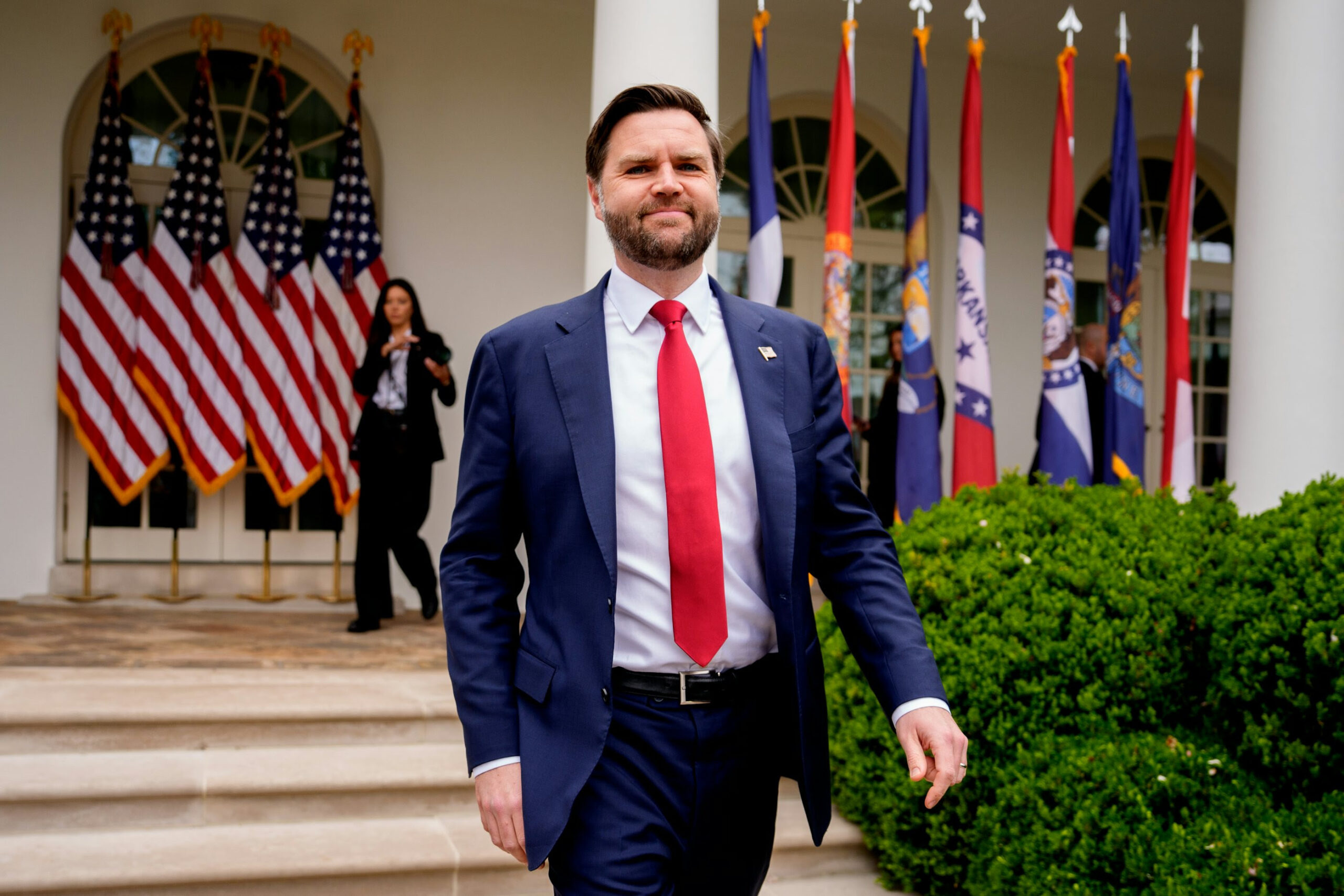
Is JD Vance Rooting for the Iran War to Fail?

Recent reporting leaves little doubt: Trump’s vice president thinks that if the war goes badly, it will help him secure the 2028 Republican nomination for president.

By Alex Shephard (TNR)

The Opportunist
Is JD Vance rooting for the Iran War to fail?
Recent reporting leaves little doubt: Trump’s vice president thinks that if the war goes badly, it will help him secure the 2028 Republican nomination for president.

If you want to understand how Donald Trump is managing the Iran war, a glimpse at the president’s recent public statements tells you all you need to know. On Thursday alone, he boasted that the United States and Israel are “totally destroying” Iran, ominously warned the country’s soccer team to stay away from the U.S.-co-hosted 2026 World Cup “for their own life and safety,” and posted a 60-year-old photo of himself in military school uniform—the phony implication being that the president, who infamously avoided the Vietnam draft thanks to “bone spurs,” is deep down a troop.

This is Trump’s take on the “wartime president” trope: self-aggrandizing, a little scary, and utterly embarrassing. He’s the architect of this already disastrous conflict, but he isn’t alone in owning it. Justifying his fake new title as “secretary of war,” Pete Hegseth has tried to outdo his boss with bloodthirsty, sociopathic, and downright stupid public statements. Secretary of State Marco Rubio has been more dignified—it would be hard to be less dignified than Hegseth—which has caused his profile to skyrocket: He is now the clear front-runner to succeed Trump with both MAGA powerbrokers and the Republican base.

One person, however, is conspicuously absent from this cheerleading squad: Vice President JD Vance. But he hasn’t been silent, exactly. Instead, as the war has dragged on, he has carefully seeded a message to the press that has steadily grown more aggressive: he’s not a fan of Trump’s war.

Publicly, of course, Vance is doing his best to tow the line. He has attempted to square his long-standing opposition to prolonged conflict in the Middle East by insisting this war is different from the ones waged in Iraq and Afghanistan. “The idea that we’re going to be in a Middle Eastern war for years with no end in sight—there is no chance that will happen,” Vance told The Washington Post two days before an Israeli airstrike killed Ayatollah Ali Khamenei. In the intervening days, he has repeated that claim, made a few tepid statements in support of the war, and attended the dignified transfer of the remains of a U.S. service member who died as a result of it.

The real story, however, is what’s playing out behind the scenes. A March 3 New York Times piece about the lead-up to the war captured the vice president trying to have it both ways. Vance, the Times reported, “appeared to personally lean against military attacks” but also “argued that a limited strike was a mistake. If the United States was going to hit Iran, he told the group, it should ‘go big and go fast.’”

It’s not a particularly coherent position—Vance appears to have simultaneously opposed the war and advocated on behalf of waging it aggressively—but it is a revealing one. There is a palpable sense that he wanted to come out against the war but couldn’t because doing so would risk his standing with the president and his base. Instead, Vance staked out a position that he wouldn’t have to shed if he were to come out more strongly against the war later: that it should be big and fast, which is a clever way of saying the U.S. should end it quickly by winning.

One could argue that the U.S. did go big and fast when it hit Iran—and that it didn’t work. After two weeks of devastating airstrikes and targeted assassination, there is no sign that the regime is crumbling, let alone that it is on the brink of granting the “unconditional surrender” Trump has demanded. Instead, there are strong signs that the war will go on for at least a month and perhaps much longer. It is already massively unpopular—though Republican voters back it almost unanimously—and if it continues, it will likely be economically ruinous, especially if the Strait of Hormuz, a vital shipping channel for much of the global oil supply, remains partially or completely closed.

The war is going badly, in other words—which is exactly what Vance planned for. And so, this week, he started to tweak his story. Citing two senior Trump officials, Politico reported on Friday that Vance wasn’t actually torn about striking Iran. He was “skeptical.” Two weeks in, he is not only worried about success but also opposes the war, according to one of those officials. The message couldn’t be clearer: None of this is JD’s fault.

Vance’s opposition may be sincere—ever since his belated conversion to the MAGA cause, he has been one of the loudest anti-intervention voices in the Republican Party—but this is a Machiavellian and astonishingly self-serving manoeuvre for a sitting vice president to take during wartime. An inveterate striver, Vance clearly thinks that coming out against the war early is a savvy long-term bet. So he is doing everything he can, short of saying it himself, to make it clear he opposes the war in Iran, while ostensibly standing behind the president who is overseeing it. And he is doing so in large part to damage the standing of that president’s secretary of state, his principal rival for the party’s 2028 nomination, who would be severely damaged if Iran turns into a Iraq-like quagmire.

The war may be popular among the Republican faithful now, but Vance is gambling that support for it will crumble. His stance, moreover, helps him stake out a position that could prove powerful come the 2028 primaries: that the war was ultimately a costly distraction that prevented the Trump administration from fulfilling its core promises, particularly on immigration and trade. Vance would essentially be arguing that real MAGA policy has never been tried and that his election was necessary to ultimately fulfill the promises that Trump thrice campaigned on.

This move is also completely in character for Vance, whose political ambition, opportunism, and outright contortionism have proved boundless since his emergence as a public figure a decade ago. He made a bad bet against Trump in 2016, assuming Trump would quickly crash and burn. But he rebounded quickly after Trump won. In less than four years, he had remade himself as not only a MAGA disciple but also a thought leader who would fill the considerable intellectual vacuum at the centre of the president’s movement. No longer the neo-Reaganite of his Hillbilly Elegy days, when he called for slashing welfare spending in the name of “personal responsibility,” Vance now is an anti-corporate, anti-intervention crusader—credentials that led to his selection as Trump’s running mate in 2024.
But Vance didn’t do all of that just to be vice president. So now he’s making another bet—a bolder, riskier one. He thinks he can not just evade responsibility for the war in Iran but stick it on his rivals without jeopardizing his standing with Trump or his base. The unfolding disaster in Iran—the horrific bombing of an elementary school, 13 dead U.S. service members, the disruption of global maritime trade, and so much more—is just another opportunity for JD Vance to climb further up the ladder of power in America.

https://newrepublic.com/article/207770/jd-vance-iran-war-disaster-2028-rubio?utm_source=newsletter&utm_medium=email&utm_campaign=tnr_daily

‘Wow’: Observers horrified by ‘scary’ Trump brag showing he’s following ‘Putin’s playbook’

David McAfee
March 15, 2026 7:28AM ET (RAWSTORY)

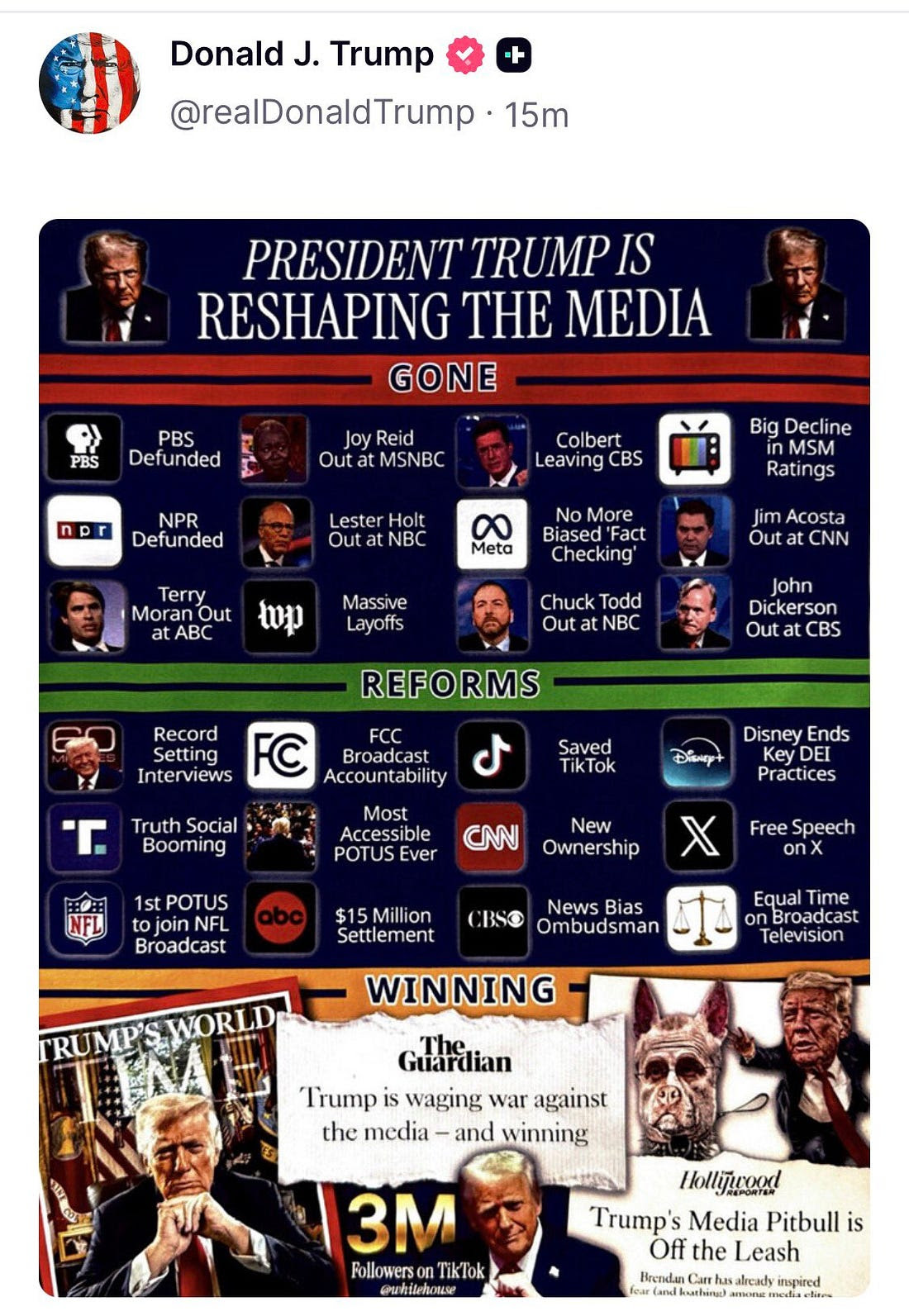
Donald Trump over the weekend posted a graphic that alarmed numerous political observers.

Trump took to his own social media site, Truth Social, to post the graphic, which is called “President Trump is reshaping the media.” “The image celebrates that NPR, Stephen Colbert, Jim Acosta, and others in the media are “gone,” while noting that CNN and the FCC have both been “reformed” by the president.

That graphic sent shivers down the spines of some onlookers, who took to X to express their concern.

Republicans against Trump noted, “Trump posted an image claiming he is ‘reshaping the media,'” to which political science professor Michael McFaul replied, “Wow.” Scary. Reminds me of Putin’s early years of reshaping Russian media.”

WaPo media reporter Scott Nover chimed in, “latest Truth Social posts includes a series of boasts about how he’s ‘reshaping the media.'”

Garry Kasparov, founder of Renew Democracy, also added, “Fascism doesn’t sneak up on you. It boasts in your face about war, attacks ‘internal enemies’ and the free press, takes total power, and tells you that you must embrace it, not fight it. Consolidating and purging media into loyal hands is Putin’s playbook.”

One popular news curator, @SkylineReport, also noted that “Trump just posted a graphic bragging that he’s ‘reshaping the media.'”

They added, “It literally lists journalists pushed out, public broadcasters ‘defunded,’ layoffs at major outlets, and regulatory pressure as ‘wins.’ Read that again. A president openly celebrating the use of political power to punish critics and pressure the press. That’s not media criticism. That’s media capture—the playbook authoritarian leaders use to bend the information system toward themselves. And the most dangerous part? He’s not hiding it anymore.”


https://www.rawstory.com/trump-media-2676119670/?utm_source=Iterable&utm_medium=email&utm_campaign=Mar.15.2026_1.01pm

Trump ridiculed for ‘sending out invitations to WWIII’ as he ‘pleads’ allies for Iran help

David McAfee
March 14, 2026 8:32PM ET (RAWSTORY)

President Donald J. Trump spurred a variety of alarmed reactions on Saturday after he asked other countries to help the U.S. with the Iran war amid escalating tensions in the Strait of Hormuz.

“The United States of America has beaten and completely decimated Iran, both Militarily, Economically, and in every other way,” Trump wrote, before shifting to call for international cooperation. He urged countries reliant on oil transit through the strait to “take care of that passage,” promising substantial U.S. assistance and coordination to ensure “everything goes quickly, smoothly, and well.” Trump framed the effort as a long-overdue “team” approach that would foster “Harmony, Security, and Everlasting Peace!”

The post drew immediate online backlash, with critics highlighting what they saw as a glaring contradiction: claiming total Iranian defeat while seeking help to secure the vital waterway through which roughly one-fifth of global oil flows.

Professor Phillips P. O’Brien, a noted historian and strategist, described the message as “a work of art” worthy of preservation. He pointed out the irony: if Iran’s military capability is “100% destroyed,” why plead with frequently insulted allies to intervene in the Gulf?

Online reactions spread rapidly. PatriotTakes, which monitors right-wing extremism, quipped that Trump was “sending out invitations to WWIII.”

MS NOW’s Chris Hayes called it an “instant classic.”

Detractors mocked the pivot as evidence of overreach in the ongoing U.S.-Iran conflict, where recent airstrikes—including on Kharg Island’s military targets—have disrupted shipping but not fully neutralized threats like mines or asymmetric attacks. Supporters, however, viewed it as pragmatic leadership, emphasizing U.S. dominance and the need for shared burdens in global security.

The statement also underscores broader challenges in Trump’s foreign policy approach: bold claims of triumph paired with appeals for multilateral support in a region where unilateral action has proven costly. As oil prices surge and tanker traffic remains vulnerable, the post highlights the delicate balance between projecting strength and acknowledging real-world limitations in securing critical chokepoints.


https://www.rawstory.com/trump-iran-2676118637/?u=119b60d179004daa4a11f0327e221740d541b54821cf8fbaf39e7e57f8b9f336&utm_source=Iterable&utm_medium=email&utm_campaign=Mar.15.2026_1.01pm