
Tag Archives: White House

Somebody Finally Stood Up to RFK Jr. A federal judge’s ruling highlights the ways Kennedy’s anti-vax agenda is putting public health at risk.

Somebody Finally Stood Up to RFK Jr.
A federal judge’s ruling highlights the ways Kennedy’s anti-vax agenda is putting public health at risk.

Jonathan Cohn (The Bulwark)
Mar 18

WELL, WELL, WELL. The brainworm may finally have turned.

Robert F. Kennedy Jr. has spent the past year systematically dismantling federal support for vaccines. From his perch atop the Department of Health and Human Services, he has canceled funding for vaccine research, published misinformation about supposed vaccine dangers, forced out or fired respected scientists who might resist his agenda, and withdrawn federal recommendations for a half dozen childhood vaccines.

Until recently, Kennedy had run into little resistance. Donald Trump, who gave Kennedy all this power, has lauded Kennedy and amplified his attacks on vaccines. Bill Cassidy, the high-profile Senate Republican and Louisiana physician, has—despite some angry statements—refused to use his chairmanship of the Health, Education, Labor, and Pensions Committee to demand changes or even explanations for Kennedy’s actions.

But this week Kennedy suffered a major setback. And it came at the hands of the judiciary.

On Monday, a federal judge in Boston blocked several of Kennedy’s most consequential policy changes, arguing that he had violated legal rules for how the HHS secretary is supposed to make key decisions. The 45-page ruling was a big win for the plaintiffs—a group of medical organizations and affected individuals led by the American Academy of Pediatrics—who have been protesting Kennedy’s actions from the get-go.

“There is a method to how these decisions historically have been made—a method scientific in nature and codified into law through procedural requirements,” Judge Brian Murphy wrote in his opinion. “Unfortunately, the government has disregarded those methods and thereby undermined the integrity of its actions.”

Murphy’s order “stays” several key actions taken by Kennedy’s department—meaning that they are not fully prohibited, but rather they are put on hold as the legal proceedings fully play out. Judges in higher courts may not see things the same way; they could reverse some or all of Murphy’s ruling if the Trump administration appeals, as officials are already promising to do.

“HHS looks forward to this judge’s decision being overturned just like his other attempts to keep the Trump administration from governing,” HHS spokesman Andrew Nixon told reporters after the ruling. ¹

The underlying legal issues here include genuinely complex questions about which powers the HHS secretary really has and the extent to which judges can or should determine what qualifies as an expert. It also involves questions over who has legal “standing” to bring a lawsuit like this. Murphy is a Joe Biden appointee with a reputation as a liberal. It’s not at all hard to imagine conservative judges—including Trump’s appointees on the Supreme Court, if the case gets that far—ruling differently.

But Murphy’s order will help keep vaccines in the news. And that alone has important consequences, given how the politics around the issue seem to be shifting.

In just the last few weeks, the White House has taken a series of steps to get a tighter grip on operations at HHS and to tamp down on some of the anti-vaccine rhetoric coming from Kennedy and his camp. It’s not clear whether Trump is having second thoughts about his full-throated endorsements of Kennedy. What is clear is that people around the president have gotten nervous that the anti-vaccine agenda is alienating the majority of voters who support vaccination strongly.

In short, Team Trump would prefer to change the subject. Murphy’s ruling makes that harder.

Which, perhaps, is appropriate. The debate here isn’t simply about whether Kennedy is making decisions in ways that comply with the law. It’s also about whether he is making decisions in ways that are good for public health. And this case highlights multiple ways in which he is not.
White House melts down with vulgar response after being called out on stunning reversal

White House melts down with vulgar response after being called out on stunning reversal

Nicole Charky-Chami
March 17, 2026 3:51PM ET (RAWSTORY)

The Trump administration was raging on Tuesday, dropping a bizarre comeback after it was called out over previous claims involving the Iran war.

White House Press Secretary Karoline Leavitt reversed her comments from last week, when she was critical of an ABC News report and blamed the outlet in a post on X for “providing false information to intentionally alarm the American people.”

“TO BE CLEAR: No such threat from Iran to our homeland exists, and it never did,” Leavitt wrote.

But the White House was furious after people started noting the apparent change in tune from the Trump administration and clapped back with a surprising response on X.

“No such threat to our homeland of Iran launching a drone offensive on our West Coast, dumbass. The nuclear threat of the psychotic, murderous Iranian regime is very real, however. Thank God we finally have a president who’s doing something about it,” the White House Rapid Response account on X wrote.

Leavitt, earlier Tuesday, had responded on X with a lengthy post pointing to a public statement from U.S. intelligence official Joe Kent. Kent had resigned publicly via X and, in his letter to President Donald Trump, cited his reasons for leaving his position that Trump appointed him to, insisting that Iran had not posed an imminent threat.

“There are many false claims in this letter, but let me address one specifically: that ‘Iran posed no imminent threat to our nation,'” Leavitt wrote in rebuttal to Kent’s resignation letter. “This is the same false claim that Democrats and some in the liberal media have been repeating over and over.”

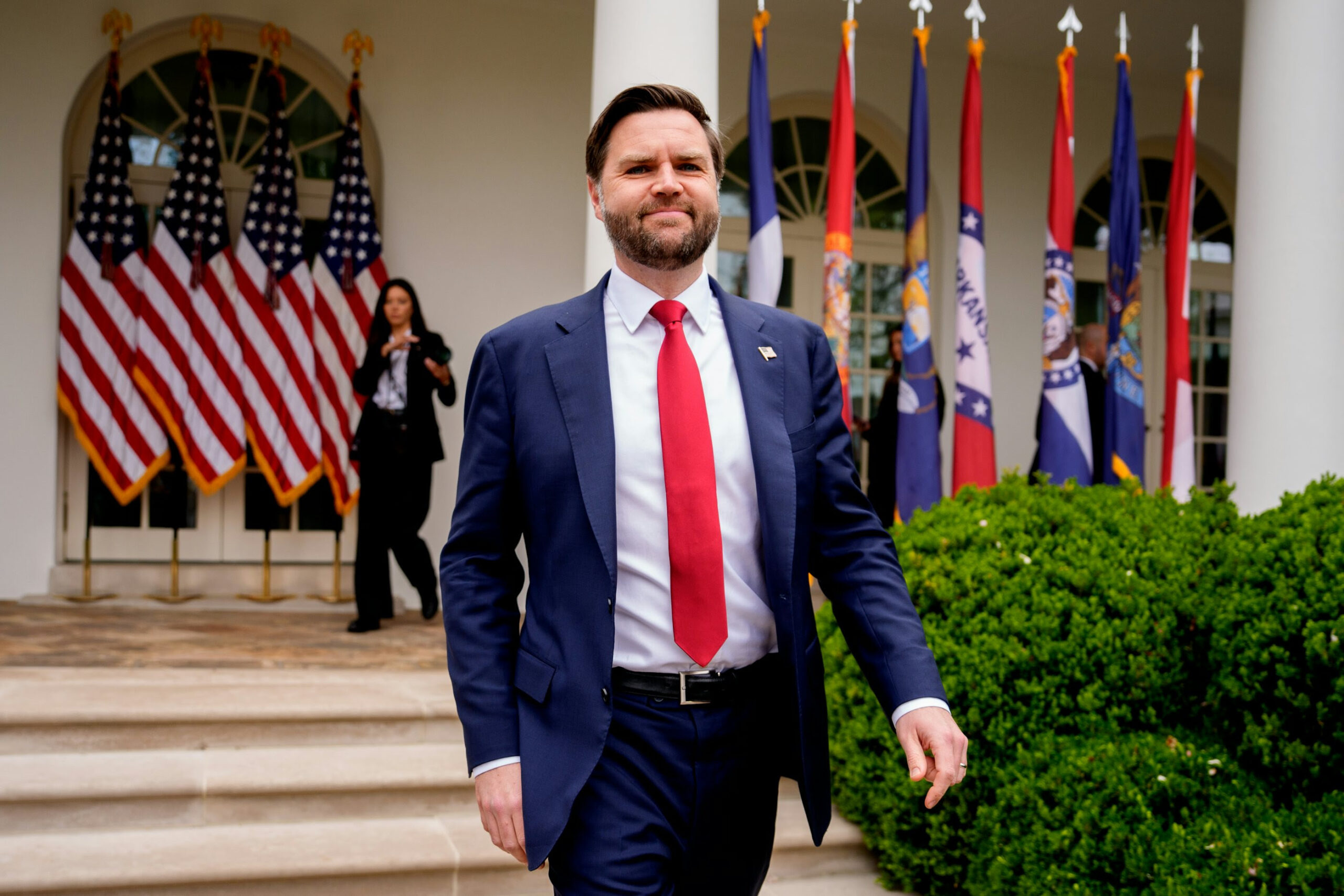
Is JD Vance Rooting for the Iran War to Fail?

Recent reporting leaves little doubt: Trump’s vice president thinks that if the war goes badly, it will help him secure the 2028 Republican nomination for president.

By Alex Shephard (TNR)

The Opportunist
Is JD Vance rooting for the Iran War to fail?
Recent reporting leaves little doubt: Trump’s vice president thinks that if the war goes badly, it will help him secure the 2028 Republican nomination for president.

If you want to understand how Donald Trump is managing the Iran war, a glimpse at the president’s recent public statements tells you all you need to know. On Thursday alone, he boasted that the United States and Israel are “totally destroying” Iran, ominously warned the country’s soccer team to stay away from the U.S.-co-hosted 2026 World Cup “for their own life and safety,” and posted a 60-year-old photo of himself in military school uniform—the phony implication being that the president, who infamously avoided the Vietnam draft thanks to “bone spurs,” is deep down a troop.

This is Trump’s take on the “wartime president” trope: self-aggrandizing, a little scary, and utterly embarrassing. He’s the architect of this already disastrous conflict, but he isn’t alone in owning it. Justifying his fake new title as “secretary of war,” Pete Hegseth has tried to outdo his boss with bloodthirsty, sociopathic, and downright stupid public statements. Secretary of State Marco Rubio has been more dignified—it would be hard to be less dignified than Hegseth—which has caused his profile to skyrocket: He is now the clear front-runner to succeed Trump with both MAGA powerbrokers and the Republican base.

One person, however, is conspicuously absent from this cheerleading squad: Vice President JD Vance. But he hasn’t been silent, exactly. Instead, as the war has dragged on, he has carefully seeded a message to the press that has steadily grown more aggressive: he’s not a fan of Trump’s war.

Publicly, of course, Vance is doing his best to tow the line. He has attempted to square his long-standing opposition to prolonged conflict in the Middle East by insisting this war is different from the ones waged in Iraq and Afghanistan. “The idea that we’re going to be in a Middle Eastern war for years with no end in sight—there is no chance that will happen,” Vance told The Washington Post two days before an Israeli airstrike killed Ayatollah Ali Khamenei. In the intervening days, he has repeated that claim, made a few tepid statements in support of the war, and attended the dignified transfer of the remains of a U.S. service member who died as a result of it.

The real story, however, is what’s playing out behind the scenes. A March 3 New York Times piece about the lead-up to the war captured the vice president trying to have it both ways. Vance, the Times reported, “appeared to personally lean against military attacks” but also “argued that a limited strike was a mistake. If the United States was going to hit Iran, he told the group, it should ‘go big and go fast.’”

It’s not a particularly coherent position—Vance appears to have simultaneously opposed the war and advocated on behalf of waging it aggressively—but it is a revealing one. There is a palpable sense that he wanted to come out against the war but couldn’t because doing so would risk his standing with the president and his base. Instead, Vance staked out a position that he wouldn’t have to shed if he were to come out more strongly against the war later: that it should be big and fast, which is a clever way of saying the U.S. should end it quickly by winning.

One could argue that the U.S. did go big and fast when it hit Iran—and that it didn’t work. After two weeks of devastating airstrikes and targeted assassination, there is no sign that the regime is crumbling, let alone that it is on the brink of granting the “unconditional surrender” Trump has demanded. Instead, there are strong signs that the war will go on for at least a month and perhaps much longer. It is already massively unpopular—though Republican voters back it almost unanimously—and if it continues, it will likely be economically ruinous, especially if the Strait of Hormuz, a vital shipping channel for much of the global oil supply, remains partially or completely closed.

The war is going badly, in other words—which is exactly what Vance planned for. And so, this week, he started to tweak his story. Citing two senior Trump officials, Politico reported on Friday that Vance wasn’t actually torn about striking Iran. He was “skeptical.” Two weeks in, he is not only worried about success but also opposes the war, according to one of those officials. The message couldn’t be clearer: None of this is JD’s fault.

Vance’s opposition may be sincere—ever since his belated conversion to the MAGA cause, he has been one of the loudest anti-intervention voices in the Republican Party—but this is a Machiavellian and astonishingly self-serving manoeuvre for a sitting vice president to take during wartime. An inveterate striver, Vance clearly thinks that coming out against the war early is a savvy long-term bet. So he is doing everything he can, short of saying it himself, to make it clear he opposes the war in Iran, while ostensibly standing behind the president who is overseeing it. And he is doing so in large part to damage the standing of that president’s secretary of state, his principal rival for the party’s 2028 nomination, who would be severely damaged if Iran turns into a Iraq-like quagmire.

The war may be popular among the Republican faithful now, but Vance is gambling that support for it will crumble. His stance, moreover, helps him stake out a position that could prove powerful come the 2028 primaries: that the war was ultimately a costly distraction that prevented the Trump administration from fulfilling its core promises, particularly on immigration and trade. Vance would essentially be arguing that real MAGA policy has never been tried and that his election was necessary to ultimately fulfill the promises that Trump thrice campaigned on.

This move is also completely in character for Vance, whose political ambition, opportunism, and outright contortionism have proved boundless since his emergence as a public figure a decade ago. He made a bad bet against Trump in 2016, assuming Trump would quickly crash and burn. But he rebounded quickly after Trump won. In less than four years, he had remade himself as not only a MAGA disciple but also a thought leader who would fill the considerable intellectual vacuum at the centre of the president’s movement. No longer the neo-Reaganite of his Hillbilly Elegy days, when he called for slashing welfare spending in the name of “personal responsibility,” Vance now is an anti-corporate, anti-intervention crusader—credentials that led to his selection as Trump’s running mate in 2024.
But Vance didn’t do all of that just to be vice president. So now he’s making another bet—a bolder, riskier one. He thinks he can not just evade responsibility for the war in Iran but stick it on his rivals without jeopardizing his standing with Trump or his base. The unfolding disaster in Iran—the horrific bombing of an elementary school, 13 dead U.S. service members, the disruption of global maritime trade, and so much more—is just another opportunity for JD Vance to climb further up the ladder of power in America.

https://newrepublic.com/article/207770/jd-vance-iran-war-disaster-2028-rubio?utm_source=newsletter&utm_medium=email&utm_campaign=tnr_daily