Category Archives: International

Iran’s military warns ‘parks, recreational areas and tourist destinations’ worldwide won’t be safe for enemies

Iran’s military warns ‘parks, recreational areas and tourist destinations’ worldwide won’t be safe for enemies

Iran’s military has warned that “parks, recreational areas and tourist destinations” worldwide won’t be safe for the country’s enemies.

By The Associated Press
Updated: March 20, 2026,https://www.ctvnews.ca/world/mideast-conflict/article/irans-military-warns-parks-recreational-areas-and-tourist-destinations-worldwide-wont-be-safe-for-enemies/ at 11:34AM EDT
Published: March 20, 2026, at 6:39AM EDT
By Jon Gambrell, Sam Mednick, and David Rising.

Iran threatened to target recreational and tourist sites worldwide and insisted it was still building missiles. Its supreme leader issued another defiant statement on Friday, nearly three weeks into U.S.-Israeli strikes that have killed a slew of Tehran’s top leaders and hammered its weapons and energy industries.

The United States was meanwhile deploying three more warships and roughly 2,500 additional Marines to the Middle East, a U.S. official told The Associated Press.

Iran fired on Israel and energy sites in neighbouring Gulf Arab states as many in the region marked one of the holiest days on the Muslim calendar. Iranians were also celebrating the Persian New Year, known as Nowruz, a normally festive holiday that is more subdued this year.

With little information coming out of Iran, it was not clear how much damage its arms, nuclear, or energy facilities have sustained since the war began Feb. 28 or even who was truly in charge of the country. But Iran has showed it is still capable of attacks that are choking off oil supplies and denting the global economy, raising food and fuel prices far beyond the Middle East.

The U.S. and Israel have offered shifting rationales for the war, from hoping to foment an uprising that topples Iran’s leadership to eliminating its nuclear and missile programs.

There have been no public signs of any such uprising and no end in sight to the war.
Supreme leader hails Iran’s steadfastness as the military threatens tourist sites
Iranian Supreme Leader Ayatollah Mojtaba Khamenei praised Iranians’ steadfastness in the face of war in a written statement read on Iranian television to mark the Persian New Year, Nowruz.

Khamenei said the U.S. and Israeli attacks were based on an illusion that killing Iran’s top leaders could cause the overthrow of the government. He commended Iranians for “building a nationwide defensive front” and ”delivering such a bewildering blow that the enemy fell into contradictions and irrational statements.”

Khamenei has not been seen in public since he became supreme leader following the assassination of his father, Ayatollah Ali Khamenei, in Israeli strikes at the start of the war. U.S. and Israeli officials suspect the younger Khamenei was wounded.
Iran’s top military spokesman, Gen. Abolfazl Shekarchi, warned Friday that “parks, recreational areas, and tourist destinations” worldwide won’t be safe for Tehran’s enemies. The threat renewed concerns that Iran may revert to using militant attacks beyond the Middle East as a pressure tactic.

A U.S. official confirmed the further buildup of American forces in the region, saying the USS Boxer and two other amphibious assault ships have deployed along with roughly 2,500 Marines. Two other U.S. officials confirmed that ships were deploying, without saying where they were headed.

All three officials spoke on condition of anonymity to discuss sensitive military operations.

U.S. and Israeli leaders have said that weeks of strikes have decimated Iran’s military. Airstrikes have also killed its supreme leader, the head of its Supreme National Security Council and a raft of other top-ranking military and political leaders.

The Israeli military said Friday that Esmail Ahmadi, head of intelligence for the Basij and internal security force, had been killed by a strike earlier in the week that hit other Basij leaders.

On Thursday, Israeli Prime Minister Benjamin Netanyahu claimed Iran’s navy was sunk and its air force in tatters, while adding that its ability to produce ballistic missiles had been taken out. Iran’s paramilitary Revolutionary Guard disputed the missile claim on Friday.

“We are producing missiles even during war conditions, which is amazing, and there is no particular problem in stockpiling,” spokesman Gen. Ali Mohammad Naeini was quoted as saying in Iran’s state-run IRAN newspaper.

A short time after the statement was released, Iranian state television said Naeini was killed in an airstrike.

A Kuwait refinery comes under attack and explosions shake Dubai
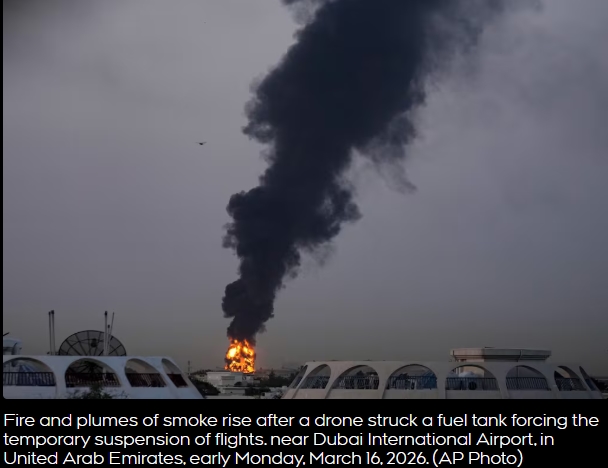
Iran has stepped up its attacks on energy sites in Gulf Arab states after Israel bombed Iran’s massive South Pars offshore natural gas field earlier in the week.

Two waves of Iranian drones attacked a Kuwaiti oil refinery early Friday, sparking a fire. The Mina Al-Ahmadi refinery, which can process some 730,000 barrels of oil per day, is one of the largest in the Middle East. It was damaged Thursday in another Iranian attack.

Bahrain said a fire broke out after shrapnel from an intercepted projectile landed on a warehouse, and Saudi Arabia reported shooting down multiple drones targeting its oil-rich eastern province.

Heavy explosions shook Dubai as air defences intercepted incoming fire over the city, where many were observing Eid al-Fitr, the end of the Muslim fasting month of Ramadan.

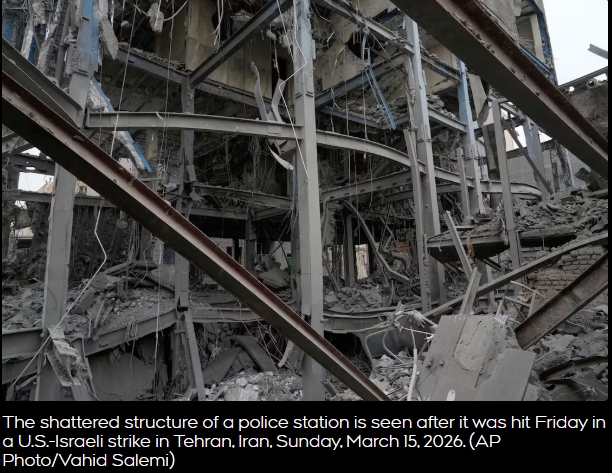
In Iran, meanwhile, many were marking Nowruz even as Israel said it had launched new strikes, and explosions were heard over Tehran. The Persian New Year, which coincides with the spring equinox, is a tradition observed across southwestern Asia that dates back thousands of years.

Loud explosions could also be heard in Jerusalem after the Israeli army warned of incoming Iranian missiles. First responders said they treated two people around 70 years old who were lightly wounded.

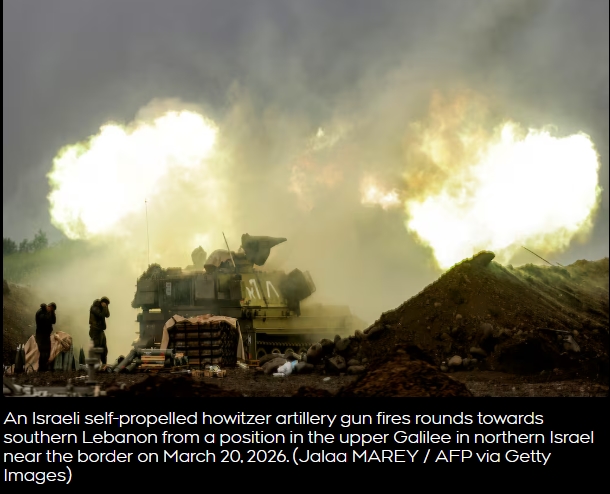
In addition to steadily striking Iran, Israel has regularly hit Lebanon, targeting Iran-backed Hezbollah militants who have been firing rockets and drones into Israel.

On Friday, Israel broadened its attacks to Syria, saying it hit infrastructure there in response to what it described as attacks on the Druze minority. Syria’s state-run SANA news agency did not immediately acknowledge the attack.

More than 1,300 people have been killed in Iran during the war. Israeli strikes in Lebanon have displaced more than 1 million people, according to the Lebanese government, which says more than 1,000 people have been killed. Israel says it has killed more than 500 Hezbollah militants.

In Israel, 15 people have been killed by Iranian missile fire. Four people were also killed in the occupied West Bank by an Iranian missile strike.

At least 13 U.S. military members have been killed.

The war is raising risks to the world economy

Iran’s attacks on energy infrastructure in the Gulf, combined with its stranglehold on shipping in the Strait of Hormuz, a strategic waterway through which a fifth of the world’s oil and other critical goods are transported, have raised concerns of a global energy crisis.
U.S. President Donald Trump lobbed fresh insults at NATO allies who have spurned his call for help protecting the strait. U.S. allies have refused to join the war, saying they weren’t consulted before the U.S. and Israel launched it.

Trump called NATO members “COWARDS” in a social media post, saying, “NATO IS A PAPER TIGER.”
Brent crude oil, the international standard, has soared during the fighting and was around US$108 per barrel on Friday, up from roughly $70 per barrel before the war began.

Surging fuel prices come at a moment when many world leaders are already struggling to bring down high prices of food and many consumer goods. Asia is getting hit hard, as most of the oil and gas exiting the Strait of Hormuz is transported there.

But the price shocks are reverberating throughout the global economy. Key raw materials—like helium, used in making computer chips, and sulphur, a raw material in fertilizer—have been obstructed and could be in short supply soon, raising the prices of goods all the way down the supply chain.
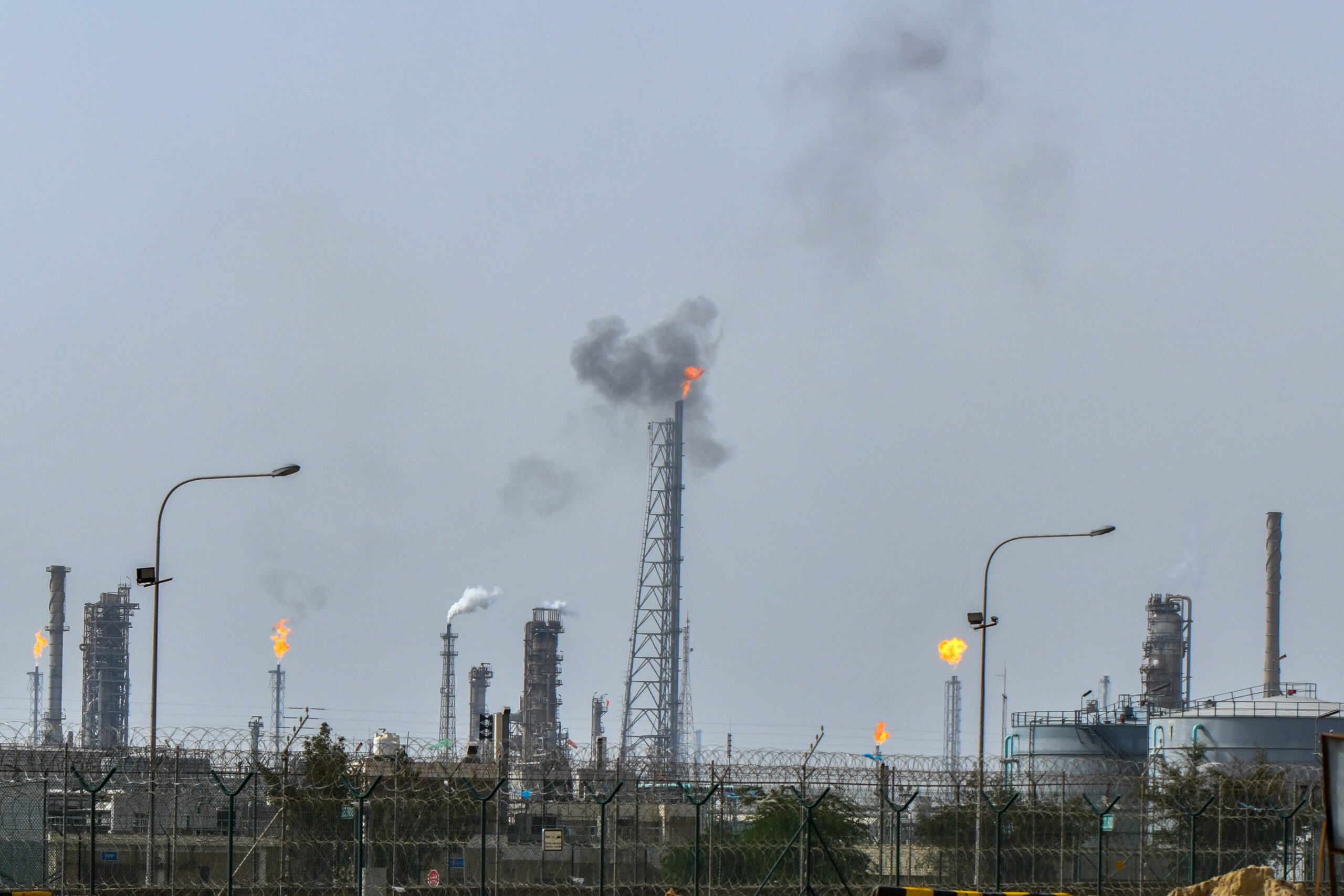
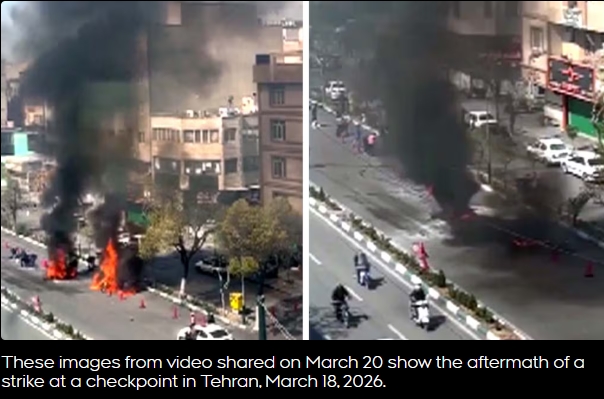
A general view of Mina Al-Ahmadi refinery in Kuwait, Friday, March 20, 2026. (AP Photo)

The final catastrophe phase Donald Trump has no class. None.

The final catastrophe phase
Donald Trump has no class. None.

Steve Schmidt (Substack)
Mar 20

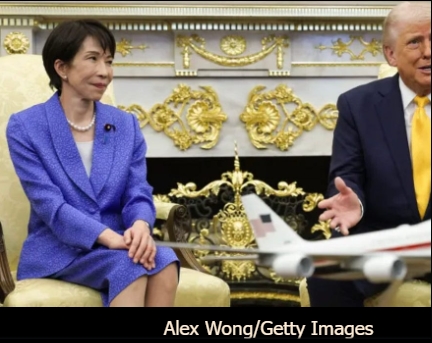
He is an embarrassment to every American, a living canker sore. His performance in front of Japanese Prime Minister Sanae Takaichi was pure idiocy.

When Trump was asked why the U.S. did not inform allies, such as Japan, before carrying out the attacks against Iran, he responded:

Who knows better about surprises than Japan … Why didn’t you tell me about Pearl Harbour?

Each time there is a new photo from the Oval Office, it leaves me speechless.

What’s the word for this?

Tacky doesn’t quite fit.

There will come a day when all of Trump’s gilded crapola will be scraped off the wall. It will all be gone by 12:15 pm on January 20, 2029.

Trump’s name will be jackhammered off of the Kennedy Centre by the time the sun sets.

Corey Lewandowski is a great example of what life is going to be like for so many of Donald’s minions who were overcome by their arrogance and greed. Yesterday, NBC reported that Corey Lewandowski was demanding that some DHS contractors pay him to win—or continue to keep—contracts with the department.

The investigations will never stop.

Every detail of the corruption will become known.

More than $31 million in fees were paid out to consultants who were very close to Kristi Noem out of the $220 million advertising campaign, in which Noem was able to play dress-up and exhibit her dental work, hair extensions, and Mar-a-Lago face at taxpayer expense. All the while, she has been shacked up with Corey Lewandowski from the boudoir aboard Air F*ck One to the Coast Guard commandant’s residence.

Congressional investigators and journalists are going to follow the money, and it’s going to lead straight to Kristi Noem.

Pam Bondi is another corrupt Trump dimbulb on thin ice. She unravelled during congressional testimony during which she embarrassed herself and confirmed that the Department of Justice is lawless, incompetent, and dishonest.

During her testimony, Bondi claimed that Donald Trump had never had credible criminal claims made against him.

That was a lie.

Yesterday, Congressman Dan Goldman read FBI documents into the congressional record regarding allegations by a young girl that, between the ages of 13 and 15, she was sexually assaulted by Donald Trump. They were deemed credible.

Incredible.

MAGA is untroubled by these latest allegations against Donald Trump, though they are increasingly divided.

They are divided over the spiralling disaster in the Middle East, where the Iranian regime has withstood American and Israeli attacks and triggered the greatest disruption of global energy shipments in history. The economic shockwave is growing, and a cornered Trump is left without allies or options.

He has two moves: forward or back.

He can retreat or escalate.

Donald Trump will double down.

Donald Trump will order US Marines and conventional forces to attack, occupy, and hold Iranian cities’ territory on Kharg Island, which is the hub of Iran’s energy economy. Trump will reason that he will be able to blackmail the Iranians into reopening the Strait of Hormuz by threatening to destroy the captured facilities.

I am certain that the capture of Kharg Island is not worth the life of a single US Marine, and there will be many casualties.

That will be no surprise.

Donald Trump’s Pearl Harbour joke was tasteless idiocy, and his war is a spiralling disaster.

Trump can’t talk his way through it.

He can’t outrun Jeffrey Epstein, just like America’s consumers can’t outrun Trump’s high prices and inflation.

MAGA is entering its full catastrophe phase, and every American will feel the sting.

Worse and worse are what lie ahead.

BREAKING: Trump Commits Thousands Of Troops To The Middle East – Iran Has Been Waiting For “US Boots On The Ground” For 47 Years.

BREAKING: Trump Commits Thousands Of Troops To The Middle East—Iran Has Been Waiting For “US Boots On The Ground” For 47 Years.
Trump is gearing up to seize Kharg Island. The IRGC built their entire military doctrine around the day America tried.

Dean Blundell (Substack)
Mar 20

What’s Deployed, What’s Coming, And What The Numbers Actually Mean

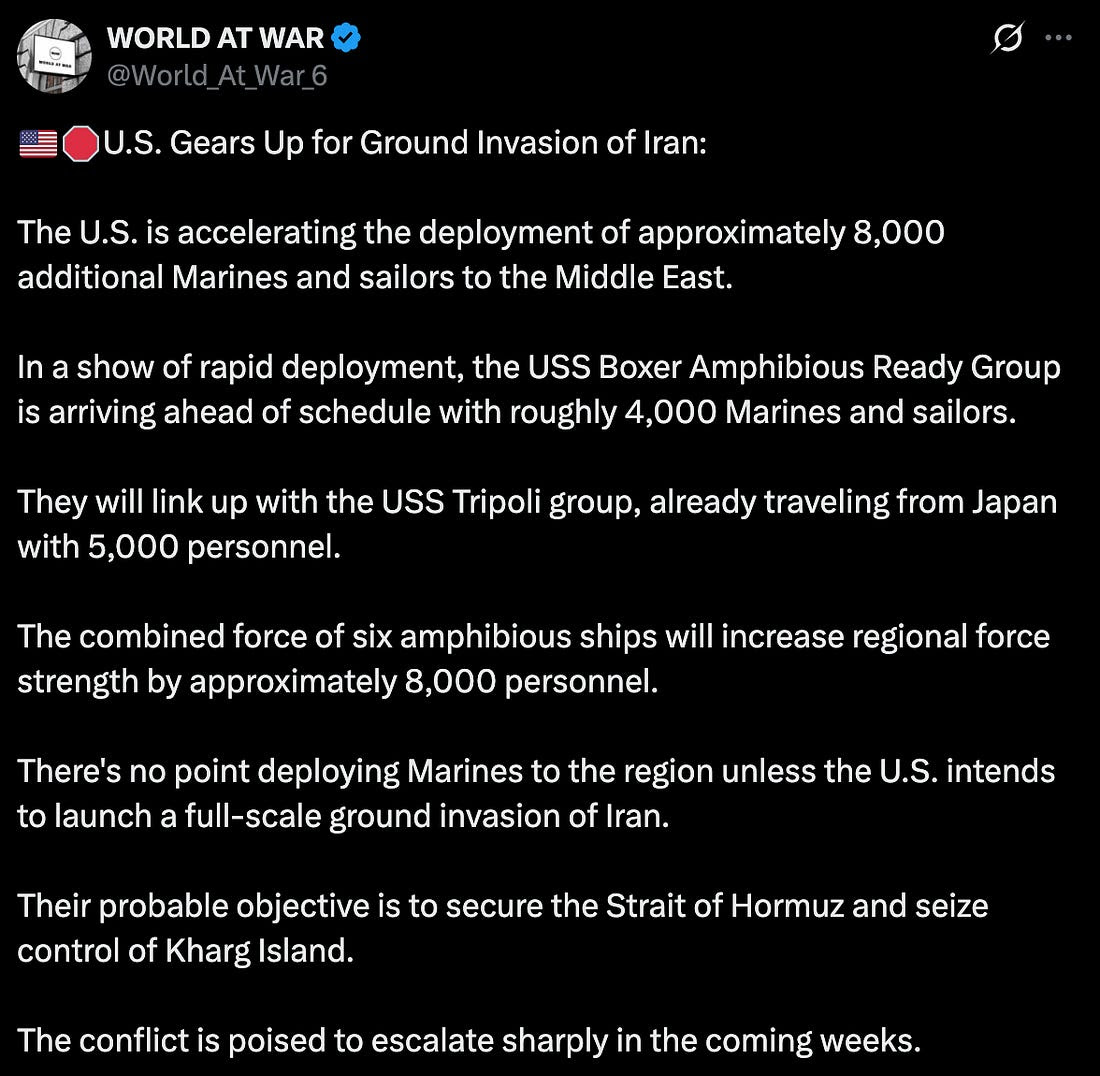
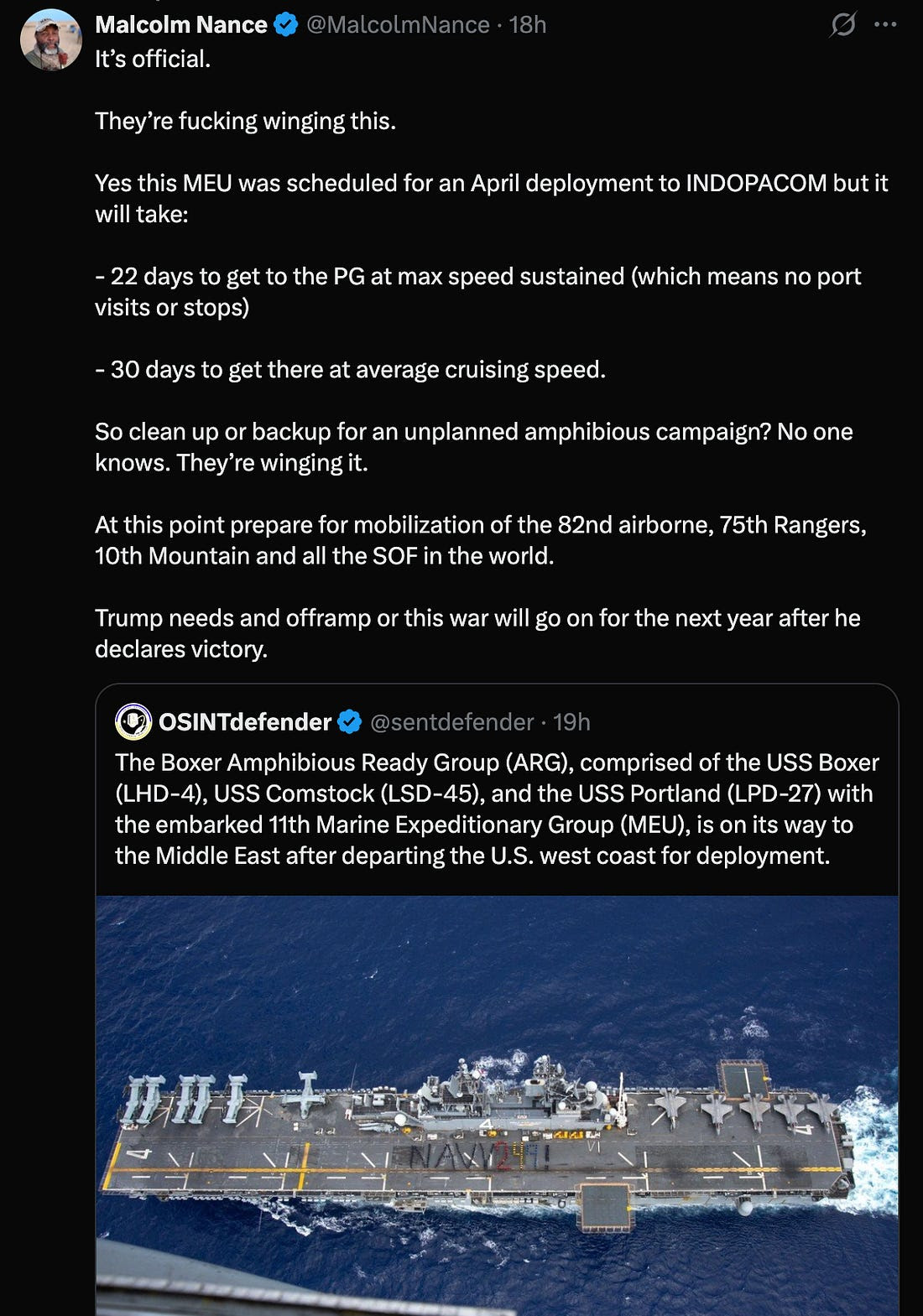
The USS Boxer Amphibious Ready Group—Boxer, USS Portland, and USS Comstock—departed San Diego on March 18, ahead of its originally scheduled deployment window. The Boxer ARG carries approximately 2,500 Marines from Camp Pendleton’s 11th Marine Expeditionary Unit, bringing total personnel, including sailors, to roughly 4,000 aboard those three ships.

They’re linking up with the USS Tripoli group, already transiting from Japan with the Okinawa-based 31st Marine Expeditionary Unit—approximately 2,200 Marines plus around 2,000 sailors, totaling 4,200 to 4,400 personnel. Once the two groups merge, six amphibious ships will have added roughly 8,000 service members to a region where 50,000 U.S. troops are already deployed.

The Boxer is a small aircraft carrier. F-35B stealth jets. V-22 Osprey tiltrotors. Hovercraft in the well deck. The 11th MEU can conduct amphibious landings. The 31st MEU is specifically trained for limited-scale raids and seizure of maritime platforms.

The Navy spokesperson told NBC San Diego this is “routine training that ensures the continued war-fighting readiness of Navy and Marine forces.” That’s the same Navy currently fighting a war with Iran.

The Target Is Already Named

This morning, Axios reported — citing four sources with direct knowledge — that the Trump administration is actively considering plans to occupy or blockade Iran’s Kharg Island to pressure Tehran into reopening the Strait of Hormuz.

“He wants Hormuz open. If he has to take Kharg Island to make it happen, that’s going to happen. If he decides to have a coastal invasion, that’s going to happen. But that decision hasn’t been made,” a senior administration official told Axios.

Kharg Island is a five-mile strip of coral in the Persian Gulf, 15 miles off Iran’s coast and 500 miles past the Strait of Hormuz. It processes roughly 90% of Iran’s crude oil exports. Destroy it or seize it, and you’ve grabbed Iran’s economy by the throat.

The U.S. already bombed it. On March 13, American forces conducted what Trump called “one of the most powerful bombing raids in the history of the Middle East,” targeting over 90 military sites on Kharg—naval mine storage, missile bunkers, IRGC naval bases, and the runway—while deliberately sparing the oil infrastructure. The message: We know where the off switch is, and we haven’t thrown it yet.

Trump told Fox News Radio the same day that if he were going to take Kharg Island, he certainly wouldn’t tell anyone about it. Then he spent the next week publicly threatening to bomb the oil pipelines. So.

White House thinking, per Axios sources: “We need about a month to weaken the Iranians more with strikes, take the island, and then get them by the balls and use it for negotiations.”

But Here’s What’s Waiting For Them

This is where the story gets complicated — and where the cheerleading from certain corners of Fox News needs to stop.

Iran has been preparing for this exact scenario since 1979. Not metaphorically. Literally. The entire military doctrine of the Islamic Revolutionary Guard Corps was built around the day America tried to come ashore in the Persian Gulf.

The lesson Iran learned in 1988 is the foundation of everything that followed. After the U.S. Navy sank roughly half of Iran’s conventional fleet in a single day during Operation Praying Mantis—retaliation for Iran mining a U.S. warship—Tehran reached an obvious conclusion: you cannot fight the U.S. Navy ship-for-ship and win. What followed was nearly four decades of building something else entirely.

The IRGC Navy isn’t a navy. It’s a guerrilla force at sea. Jane’s Defence—the gold standard for military analysis—recognizes it as the world’s most prominent practitioner of small boat swarm tactics: speed, mass, coordinated manoeuvre, low radar signature, and concealment. Iran is believed to possess around 3,000 fast-attack craft capable of these operations. Here’s how it works in practice: 10 to 20 boats swarm a single vessel from every direction simultaneously. They target the bridge to blind it and the engine room to kill it. Hidden in the chaos are unmanned suicide vessels — remote-controlled drone boats packed with explosives — steered directly into the hull. While the crew is overwhelmed, other boats drop tethered naval mines directly into the ships’ path. If the swarm doesn’t finish you, anti-ship missiles fired from mobile trucks that immediately retreat into fortified mountain caves will.

Then there are the mines. A former U.S. Navy admiral has stated publicly that Iran retains the capacity to mine the Strait of Hormuz in ways that would take many months to clear even without any hostile fire. A former British security analyst adds that Iran can deploy manned and unmanned submersible vehicles—small submarines, underwater drones—from concealed shore tunnels. You have to clear the strait before you can even reach Kharg. And you’re doing it under fire, in shallow water, in a channel 21 miles wide at its narrowest point.

Then there’s the “Mosaic Defence.” In 2005, the IRGC formalized what it calls a decentralized command-and-control doctrine—essentially a military designed from the ground up to absorb and survive decapitation strikes. Every regional IRGC unit operates semi-autonomously with its own intelligence, weapons stockpile, and command structure. You can kill the leadership — and the U.S. and Israel killed Supreme Leader Khamenei and dozens of senior IRGC commanders on day one of Operation Epic Fury — and the machine keeps running. Iran’s foreign minister announced this openly on February 28th: “Bombings in our capital have no impact on our ability to conduct war. Decentralized Mosaic Defence enables us to decide when — and how — war will end.”

Then there’s the cost math. A Shahed drone costs $20,000 to $50,000 to produce. A U.S. Patriot interceptor costs $4 million per shot. Iran has already forced the U.S. to burn through Tomahawk stockpiles and air defence interceptors at a pace that’s alarming Pentagon planners. This is the same playbook the Houthis ran in the Red Sea for months — low-cost attrition against expensive American systems — and Tehran has been watching and refining it the entire time.

Then there’s the Strait of Hormuz. To take Kharg Island, you need to get through the Strait of Hormuz. NE is getting through the Strait of Hormuz without lighting up the Iranian coast and mountain ranges for DAYS with ammo the US simply does not have.

What The Experts Say About Actually Taking Kharg

Former U.S. Army intelligence analyst Harrison Mann, who resigned from the Defence Intelligence Agency over Biden’s Gaza policy and has no axe to grind for either side, put it plainly: any attempt to seize Kharg Island would be “close to a suicide mission.” The Marines would be 500 miles past the Strait of Hormuz — a chokepoint the U.S. Navy currently considers too dangerous to enter — 15 miles off the Iranian coast, within range of weapons the IRGC hasn’t even had the opportunity to deploy yet in this war. Artillery rockets. Short-range drones. Shore-based systems that have been waiting for exactly this moment.

A helicopter assault avoids anti-ship weapons but creates a different problem: the MEU’s Ospreys and helicopters would need at least three trips to insert the full Marine force. Those are three trips of predictable flight paths, landing zones, and sitting targets while Iranian forces calibrate their sights. Resupply and evacuation by sea means running the gauntlet again. Resupply by air means doing it indefinitely, under fire, on an island 15 miles from the Iranian mainland.

Responsible Statecraft’s assessment: for the troops who receive those orders, “the operation would land somewhere between a suicide mission and a self-imposed hostage crisis.”

There is a counter-argument. One analysis published this week argues the March 13 strikes degraded Kharg’s fixed defences severely enough—destroying SAM batteries, missile bunkers, and the IRGC naval base—that what’s left is a broken garrison of 200 to 500 personnel without command infrastructure or reinforcement capability. Under that scenario, 2,200 Marines against a destroyed garrison with total U.S. air superiority is an overwhelming force. The 82nd Airborne’s ready brigade has quietly cancelled scheduled exercises. Army battalions are already in Kuwait. Pentagon planning reportedly covers multiple island seizures simultaneously—Kharg, Hormuz, Qeshm, and Kish. If Rump keeps this Operation Epstein thing up, the US military is going to need all the help it can get, considering the USS Gerald Ford is on its way to Greece to have the shitters fixed and to start preparing it to be seaworthy enough to head back to the US after a mysterious 30-hour fire broke out on board.

That analysis assumes the intelligence assessment is right. The regime is too broken to mount a coherent response. Because Iran doesn’t have mobile capabilities, the bombing runs missed. That they don’t mine the waters around Kharg the moment the ships appear on radar.

If that assessment is correct, Kharg falls and the war ends on American terms.

If it’s wrong, the United States has Marines trapped on an island 15 miles from Iran with a hostile sea between them and resupply.

Iran has been building toward that second scenario for 47 years. The ships are sailing. The decision hasn’t been made. But the window is closing, and the math is brutal.

Way To Go, MAGA. Is this the great America you were hoping for?

Way To Go, MAGA.
Is this the great America you were hoping for?

Adam Kinzinger (Substack)
Mar 20

Yesterday, the president of the United States made a Pearl Harbour joke to the Japanese prime minister. Not in a private moment of breathtaking social incompetence, but on the world stage, in a diplomatic meeting, where the entire point of the exercise is to convince our most important Pacific ally that we are a serious, reliable partner in an increasingly dangerous world. Prime Minister Sanae Takaichi responded the way any seasoned diplomat responds when trapped in a room with a man who just stepped on every rake simultaneously—she offered the polished, glacial smile of someone checking her watch and calculating how many minutes until she could escape.

Then, because the moment clearly needed more texture, Trump led her down the “Wall of Presidents”—a proud American tradition—and made sure to point out, with evident satisfaction, the spot where Biden’s autopen photo had been replaced. A diplomatic masterclass. Truly. The Japanese delegation flew thousands of miles for a hallway tour and a WWII call back.

Brilliant. Just brilliant.

Here’s the thing about “Making America Great Again”—at some point, you have to reckon with the scorecard.

It’s been roughly one year. Let’s check in.

We are now an unreliable ally. The nations that built the post-World War II order with us — nations that sent their sons and daughters to fight beside ours, that opened their markets, their bases, their intelligence networks to us — are quietly, urgently making contingency plans that don’t include Washington. Not because they want to. Because they have to.

We are a non-threatening adversary to Russia and China. This is a sentence that would have been considered treasonous fever dream fiction five years ago. Today it’s foreign policy. We have provided Russia with effective sanctions relief despite documented evidence that Russia supplied targeting intelligence to Iran, which used it to kill American troops. Read that again slowly. And yet here we are, apparently decided that the real enemy is a trans activist in Vermont.

We have started, or accelerated, a conflict that is holding the global energy market hostage, with no coherent exit strategy, no clear diplomatic framework, and no apparent adult in the room with a whiteboard. The economic ripple effects are slamming against the shores of every nation on earth, and we’re the ones who threw the stone.

We have threatened to invade Canada. Canada. Our largest trading partner. The country that shares the longest undefended border in human history with us. We have also, for variety, rattled sabres at Colombia, Cuba, Greenland, Panama, and presumably anyone else who looked at us funny on a Tuesday. NATO allies are not quietly reassured by this energy.

China—and this is the part that should make every American, regardless of party affiliation, sit down and breathe into a bag—is being considered by the international community as a more reliable strategic partner than the United States. China. The authoritarian surveillance state that imprisons ethnic minorities in camps and jails journalists. More reliable than us. We did that. We handed them that gift, wrapped it in a bow, and personally delivered it.

And China, watching us shred our alliances like a raccoon who got into the filing cabinet, is quietly accelerating their internal timeline for Taiwan. Why wouldn’t they? The cavalry just announced it’s not coming.

Here’s the part that really stings, beneath the geopolitical catastrophe and the economic whiplash and the international humiliation: we did this to ourselves because Fox News successfully convinced a significant portion of the American electorate that the real existential threat to this country wasn’t Russia, or China, or climate change, or crumbling infrastructure—it was your neighbour who voted Democrat.

The White House communications operation—which was once the most powerful messaging apparatus on the planet—has been handed to people whose primary credential is posting on X at 2 AM. Governance has been replaced by content creation. Policy has been replaced by the performance of policy. The hard, grinding, unglamorous work of actually running a country has been outsourced to a reality television production that has apparently never heard of a second act.

And while all of this is happening, while the world is reorganizing itself around our absence, while our allies are building new arrangements and our adversaries are growing bolder, this administration is actively working to keep the Epstein files sealed. The party that ran on draining the swamp is apparently very concerned that you don’t get a good look at what’s in the swamp. Funny how that works.

The base was told the elites were hiding something. They were right. They just voted for the cover-up.

Here is the geopolitical truth that is not complicated, even if it’s been made to seem so:

Alliances are the source of American power. Not our aircraft carriers — though those are nice. Not our GDP — though that matters. What made America the indispensable nation was that we built, over 80 years, a network of relationships, treaties, shared institutions, and mutual commitments that no adversary could match. NATO. The Pacific alliance structure. The WTO. The international financial architecture. The basic credibility that when America said something, it meant it.

That is what we are burning. And unlike aircraft carriers, you can’t build alliances on a procurement schedule. Trust, once broken, takes a generation to rebuild — if it rebuilds at all.

We didn’t lose our strength by being outcompeted. We walked into the room, pulled the pin on a grenade, and set it on the table ourselves.

Here is where I refuse to join the doom choir, because doom is a luxury we can’t afford right now.

America has survived catastrophic failures of leadership before. We survived the Civil War. We survived McCarthyism. We survived Watergate. We survived every preceding era in which people in power decided that their grip on that power was more important than the republic itself.

We will survive this too — but only if we treat it as the clarion call it is.

The Democrats will win Congress. The arithmetic of backlash is not subtle. When you torch the economy, terrify your allies, embolden your enemies, and run the country like a particularly chaotic episode of a failing streaming show, the voters who stayed home or held their noses or convinced themselves it couldn’t be that bad—those voters show up. They’re already showing up. The 2026 midterms will not be a gentle course correction. There will be a verdict.

And when Donald Trump finally leaves the stage — removed by term limits, by elections, by the weight of history — America will do what it has always done with its worst chapters: it will process, reckon, and move on. The Trump name will join the ranks of historical cautionary tales taught in classrooms, cited in poli-sci papers, referenced as the inflection point when the country looked into the abyss and decided, collectively, that it preferred not to fall in.

History has a long memory and no mercy for those who mistake a moment for a mandate.

The lesson, if we’re paying attention, is not that democracy is fragile — though it is. The lesson is that democracy requires maintenance. It requires coalitions of people who believe in it to remain active, engaged, organized, and frankly a little bit angry.

The answer to the unravelling of American alliances abroad is the building of alliances at home—across party lines where possible, across demographic lines certainly, unified not by ideology but by the simple conviction that the American experiment is worth preserving.

Large, durable, pro-democracy coalitions. That’s it. That’s the whole strategy.

We don’t need to out-meme them. We need to out-organize them, out-vote them, and then — once we have the keys back — rebuild, slowly and unglamorously, the institutions and relationships that made this country worth fighting for in the first place.

And hold them to account legally when appropriate. Not for retribution, but for the future. So lessons learned will stick. Jail has a way of doing that.

America is not going to be great again because someone told us it would be.

It’s going to be great again because enough of us decided to make it so—the hard way, the only way that actually works.

The toilet of history awaits. The rest of us have work to do to flush it.

Saying No to the Toddler Resisting consistently is the key

Saying No to the Toddler
Resisting consistently is the key

Mary L Trump
Mar 18

As you may have heard, despite declaring the war over, Donald has been desperately seeking help from U.S. allies to reopen the Strait of Hormuz. I have bad news for him. His delusions aside, every single country he has asked so far has said no. What we’re now seeing play out on the world stage is something long overdue: a toddler finally being told no.

Our allies’ united refusal is not the only thing rattling Donald right now. I think the latest phase of his unraveling began earlier this year when his corrupt, illegitimate supermajority of the Supreme Court that has bent over backwards to enable him nearly every step of the way finally drew a line when it declared his tariffs were unconstitutional and must be undone. How did Donald respond?

He attacked the justices who had, up to that point, given him almost everything he could hope for, including near-total presidential immunity. These justices have bent the law and broken the Constitution in ways that continue to protect him while expanding his power. The one time they told him something he did not want to hear, he lashed out; he insulted them; he called them traitors. And then he refused to comply with their decision anyway.

That’s right, instead of following the court’s ruling, he doubled down and imposed another 15% tariff across the board.

After all, who’s going to stop him? Donald continues to do what he’s always done: push the envelope to see what he can get away with. If nobody stops him (which they almost always never do), he pushes further and gets away with more. On those rare occasions when he’s thwarted, he doesn’t course correct like a mature human being; he doesn’t come up with a different strategy. He doubles down.

When the person engaging in this kind of behavior has the power to bring the world to the brink of economic chaos and a war nobody but him wants, we should all be on our guard. But it’s a long-established pattern: Most frequently, the person who stands up to him—after being threatened or blackmailed—eventually backs down. This gives him more room, more power, more oxygen. He becomes emboldened to do worse things, to take bigger risks, to inflict more pain, and to acquire more wealth and more power. Rarely has anybody stood up and said no in a way that sticks.

But that may finally be shifting.

Donald has dragged America into a war of his choosing without the permission of the U.S. government or the support of the American people. Nobody, with the exception of Donald and Israeli Prime Minister Benjamin Netanyahu, wanted this. It is a war that nobody, including Donald, can justify. And perhaps most telling of all, it is a war that nobody, including Donald, knows how to end.

For once, our allies are not falling in line behind him. Instead of humoring him, they’re standing up against him. They are finally, at long last, saying that very simple and powerful word: “no.” They are saying, “We do not want this. We did not ask for this. You did not consult us before starting this, and therefore we owe you nothing.”

And most importantly, they’re saying, “We will not risk our blood and treasure to help you wage an illegal and unconstitutional war that endangers us all.”

They will not participate in Donald’s war crimes; nor will they help him clean up the political disasters he has created for himself, both at home and abroad. Make no mistake, this situation is already costing him politically. His reckless and ill-considered actions have helped drive massive spikes in oil prices and the kind of economic shock that reverberates quickly across the globe.

Our allies are beginning to understand something that people inside the U.S. government often pretend not to understand: weakening Donald politically is actually good for the United States, and it is good for the rest of the world.

I suspect that many of our allies are quietly relieved to see Donald’s position weakening, because a diminished Trump regime means a more secure international coalition, fewer reckless decisions, fewer unilateral acts of aggression, and fewer moments during which the entire world has to hold its breath hoping that American leadership doesn’t plunge all of us further into chaos.

In this context, it’s particularly revealing who Donald has not asked for help—that embarrassing gaggle of failing democracies and autocracies that make up his so-called Board of Peace, countries like Israel, Saudi Arabia, Egypt, Turkey, and Hungary. Donald created that group as a way to convince people, erroneously, that he has global support when, in reality, he does not. The “Board of Peace” is also a very effective mechanism through which to steal more money from the American people. On February 26, Donald pledged $10 billion American dollars, funds over which he, as permanent chair, has discretion.

Donald, instead, has turned to China to help him out of the geopolitical mess he created. This serves to empower China further (it’s important to keep in mind that this entire fiasco benefits China and Russia—two of our greatest adversaries—at least until Donald gets back into the Oval Office in 2025. And it benefits them at the expense of American influence and security. And yet even China said, “No.”

Everyone is saying no to him. These refusals, though, will only matter if they are unwavering.

Over the past few days, we’ve seen signs that Donald is losing control to a degree that we may not have seen before. His behavior toward reporters has become even more volatile and inappropriate. Journalists asking basic, legitimate questions about the war he started, questions any president should be prepared to answer, are being met with insults and temper tantrums.

When a female reporter asked a straightforward question:

Can you explain why you are sending 5,000 additional Marines and sailors?

Donald shushed her and said,

You’re a very obnoxious person.

He then turned to a male reporter who, without missing a beat, asked another question without any concern for how his colleague had been treated (a conversation for another time).

This is how Donald has always operated, but there’s an important difference between throwing temper tantrums during business negotiations, when you have all of the power and leverage, and doing it while managing multiple international crises, most of them of your own making.

Donald likes to claim that he is a master dealmaker—he is not now, nor has he ever been. Not even if we entertain that myth for a moment, the reality is that as a businessman, he always negotiated from a position of overwhelming advantage.

When he was at the Trump Organization, thanks to my grandfather, Donald had more money, more lawyers, more resources, and more leverage than the people he was dealing with. Every negotiation was structured in his favor from the very beginning, and by the time a deal was ready to be finalized, all Donald had to do to make sure he got his way was show up at the last minute, and if the other party did not give him everything he wanted, he’d throw a tantrum, and, if necessary, threaten to bury them in lawsuits if they didn’t comply with his wishes.

That’s not how negotiations work. That is how weak people without any moral compass behave when they are handed enormous, unfair advantages.

What we are witnessing now is something Donald has almost certainly never experienced in his life: he is negotiating from a position of increasing weakness, and he has absolutely no idea how to handle it.

For most of his life, Donald has been protected by wealth, by privilege, and by individuals and institutions that were reluctant to hold him accountable. Even when he failed, the consequences were mitigated by those who realized he was still of use to them. Even when he crossed lines, someone eventually stepped in to smooth things over for him.

But we are living in a very different moment, because this is not just about him and his business interests anymore, and we’re not just talking about the Republican Party anymore. We’re talking about the fact that, through his reckless and dangerous actions, Donald has put the entire world at risk without having secured the support of the American people, of Congress, or other world leaders.

In response, our allies are showing us something that has been missing for far too long: resolve.

To our allies around the world, if you care about the future of NATO and Western liberal democracy, and if you care about America and the survival of our democracy, which you should, keep doing exactly what you are doing.

Keep saying no.

Articles of Impeachment for Bondi Introduced, Some Airports May Shutdown, SAVE Act in Trouble, Russia

Articles of Impeachment for Bondi Introduced, Some Airports May Shut Down, SAVE Act in Trouble, Russia Helps Iran Even More

Aaron Parnas
Mar 17

There is a lot to cover this afternoon. Articles of impeachment have been filed against Pam Bondi. Some airports may begin shutting down as the government shutdown escalates. The SAVE Act is in serious trouble, lacking enough Senate support to pass. At the same time, Russia is increasing its support for Iran in the ongoing war.

Meanwhile, new data shows CBS Evening News ratings are dropping sharply as independent media continue to surge. We are doing this differently, and we are doing it better. Why? Because we answer to you.

Rep. Summer Lee has introduced articles of impeachment against Attorney General Pam Bondi, alleging a wide range of misconduct, including defying congressional subpoenas to release unredacted Epstein files, violating federal law, misleading Congress and the courts, and abusing prosecutorial authority. The resolution also accuses Bondi of politicizing the Justice Department by targeting political opponents, dismissing cases involving allies, and retaliating against officials and journalists, as Lee and several Democratic co-sponsors argue her actions undermine the rule of law and warrant removal from office.

House Oversight Chair James Comer has subpoenaed former Attorney General Pam Bondi to testify under oath in an ongoing probe into the Justice Department’s handling of the Epstein investigation, citing concerns about potential mismanagement and failure to comply with transparency laws. The move follows bipartisan frustration over heavily redacted files and escalates congressional scrutiny, even as the DOJ calls the subpoena unnecessary and offers briefings instead.

Senior Justice Department officials are set to brief a bipartisan group of lawmakers at the Capitol on the handling and release of Epstein-related documents, as congressional scrutiny intensifies over transparency and the DOJ’s actions.

A group of more than three dozen House conservatives has staged a revolt against their own party leadership by voting down even routine, bipartisan legislation to pressure the Senate into taking up the SAVE Act, openly defying Speaker Mike Johnson, disrupting the House’s normal legislative process, and signaling they are willing to block all Senate-originated bills—including “must-pass” measures—until their demands are met.

A prolonged government funding standoff has led to a mounting workforce revolt among TSA officers, who have been working without pay for weeks and are increasingly calling out or quitting, severely straining airport security operations. Absentee rates have surged far above normal levels, causing long screening delays and operational disruptions at major hubs, while officials warn that if the situation continues, staffing shortages could force the closure of some smaller airports—especially as travel demand ramps up during the busy spring season.

The Senate narrowly voted 51–48 to open debate on the SAVE America Act, but some Republicans showed internal division: Sen. Lisa Murkowski voted against it, Sen. Thom Tillis missed the vote after opposing it, and Sen. Mitch McConnell—who doesn’t support the bill—only voted to proceed as a procedural courtesy, highlighting fractures within the GOP despite overall backing for the legislation.

DNI Tulsi Gabbard responded to Joe Kent’s resignation in protest of the Iran war.

According to the Wall Street Journal, Russia is significantly ramping up its military and intelligence support for Iran by sharing satellite imagery and upgrading drone capabilities, enhancing Tehran’s ability to target U.S. forces and sustain operations in the region. The cooperation reflects a deepening strategic partnership, with Moscow aiming to keep Iran engaged against U.S. and Israeli forces while prolonging a conflict that benefits Russia by diverting Western attention and creating military and economic advantages.

Iranian state media has confirmed that top security official Ali Larijani was killed in an Israeli airstrike on Tehran, marking the first acknowledgment from Iran after earlier Israeli claims and signaling a major escalation in the conflict with the loss of one of the country’s most senior leaders.

According to the Washington Post, the U.S. aircraft carrier Gerald R. Ford, deployed in operations against Iran, is set to make a temporary port stop after a significant onboard fire injured nearly 200 sailors with smoke exposure, disrupted living quarters, and took hours to contain, impacting its operational readiness during the ongoing conflict.

Rep. Pat Ryan sharply attacked Defense Secretary Pete Hegseth, accusing him of increasingly erratic behavior, blaming him for the deaths of 13 Americans, and calling for him to be held accountable.

French President Emmanuel Macron rejected claims by Donald Trump that France would help reopen the Strait of Hormuz, stating France would not participate in such operations and signaling a split with the U.S. over how to respond to escalating tensions in the region.

Iran confirmed the killing of Basij commander Gholamreza Soleimani in an اسرائیلی strike, marking one of the highest-level assassinations of the war, as regional tensions escalate with ongoing missile exchanges, heavy civilian casualties in Lebanon, and warnings from the UN that Israeli strikes on civilian areas may constitute war crimes.

The conflict is widening politically and militarily: Trump is pressuring but also criticizing NATO allies for not joining U.S. efforts in the Strait of Hormuz, key partners like France are refusing involvement, internal dissent is growing in the U.S. (including a senior resignation), and Iranian leaders warn the strategic waterway will not return to normal conditions.

Ireland’s leader Micheál Martin publicly pushed back on Donald Trump’s criticism of UK Prime Minister Keir Starmer during a White House meeting, diplomatically defending Starmer and Europe while avoiding confrontation, highlighting growing transatlantic tensions over the Iran war and NATO.

Arizona has escalated its crackdown on prediction market platform Kalshi by filing its first-ever criminal charges, accusing the company of operating an unlicensed gambling and election-betting business as part of a broader, multi-state legal battle over whether such platforms fall under federal financial regulation or state gambling laws.

A federal judge ordered a sweeping reversal of Kari Lake’s dismantling of Voice of America, mandating the reinstatement of about 1,000 employees and rebuking her for disregarding congressionally mandated legal requirements.

According to Axios, Senator Ruben Gallego is pressing the Energy Department for details on potential releases from the Strategic Petroleum Reserve as gas prices rise, highlighting growing political pressure in Washington over the domestic impact of the Iran war on energy markets.


Iran called Trump’s bluff — and now he’s spiraling and ‘out of ideas’: expert

Iran called Trump’s bluff—and now he’s spiraling and ‘out of ideas’: expert

Travis Gettys
March 17, 2026, 3:28PM ET (RAWSTORY)

None of President Donald Trump’s usual bailouts are coming after he launched a war on Iran, and the situation has quickly spiraled out of his control.

The 79-year-old president has long relied on lies, bluster, and escalation to stay one step ahead of consequences in his business, political, and personal life, but those tactics are proving woefully ineffective against the global energy market that’s been choked off by Iran in response to the military operation he impulsively authorized, wrote political scientist Nicholas Grossman for MS NOW.

“In response to the U.S.-Israeli attack, Iran played its biggest card, closing the Strait of Hormuz,” wrote Grossman, a political science professor at the University of Illinois. “It’s a narrow choke point at the end of the Persian Gulf, and a kink in the waterway leaves it exposed to a lot of Iran’s coastline. About 20 percent of the world’s oil passes through Hormuz, and it isn’t hard for Iran to stop the traffic.”

“Iran can’t prevent U.S. and Israeli forces from flying over the gulf, and they probably couldn’t keep the U.S. Navy out of it, but to close the strait, they don’t need to,” he added. “They only have to make shipping companies afraid to sail, and insurance companies think the risk of insuring the ships is too high. With threats, a few attacks on tankers, and now possibly sea mines Iran has.”

That development should have been expected, Grossman wrote, but the president seems caught off guard by the strategic closure that’s threatening to tip the global economy into a tailspin, so Trump has fallen back on his habitual tactics to wriggle out of the jam he created for himself.

“Trump tried saying the war is almost over and the U.S. already won,” Grossman wrote. “It made the oil price drop back down for a bit, but as U.S.-Israeli bombardment continued and market disruptions got worse, it rose again.”

“Trump tried telling ships to traverse the Strait of Hormuz, but most wouldn’t, and a few who did exploded, presumably at Iran’s hand,” he added. “He tried releasing oil from America’s strategic reserve, and some other countries did from theirs. But that’s a Band-Aid on a gaping wound and had little impact.”

He tried bombing Kharg Island, which Iran uses for oil exports, in the apparent belief that slowing down Iran’s shipping would force it to stop blocking other nations’ ships in the Persian Gulf, and Grossman saw a parallel in Trump’s business career.

“That recalls one of Trump’s go-to moves in business: the bad faith lawsuit,” Grossman wrote. “He’d break a contract, screw someone over, and dare them to sue him. Or would initiate legal action himself. Either way, he bet that he’d have more resources and greater tolerance for a protracted legal fight, and the other party would settle even when the facts were on their side.”

“That won’t work with Iran,” Grossman warned.

Trump has incentivized the Iranian regime to use every bit of leverage they have and endure as much punishment as they can take, and U.S. allies aren’t willing to bail him out after he alienated them and launched an illegal war without first consulting them.

“Much of the time when Trump was in the private sector and messed up, his rich dad bailed him out or he’d declare bankruptcy,” Grossman wrote. “Instead of holding equity or debt, Trump would have the business pay him a salary and bonuses so that money was gone when the company went under, and his partners and contractors would take most of the losses.”

“Trump started something that quickly spiraled and seems out of ideas,” he added. “There’s no one to sue, no rules to manipulate, just the hard realities of resource shortages and war. And there’s a good chance Iran can tolerate being bombed more than the U.S. can tolerate a rapidly rising oil price and the economic damage it causes.”

‘Funny how that works’: Nobel-winner warns Trump’s allies won’t help him out of ‘trap’

‘Funny how that works’: Nobel-winner warns Trump’s allies won’t help him out of ‘trap.’

Ewan Gleadow
March 17, 2026, 2:30PM ET (RAWSTORY)

A new brief of tariffs from the Trump administration could be the worst yet, according to Nobel Prize-winning economist Paul Krugman.

Krugman warned that new tariffs set to be introduced by the president’s team will affect not just U.S. citizens but the world as he lashes out at NATO for not helping with the war in Iran. The economist believes a proposed tariff on 60 countries, including members of the European Union, Canada, and the United Kingdom, will cruelly hinder economies across the world during a time of domestic crisis.

Krugman wrote, “Trump imposed tariffs on almost every other nation, including islands inhabited only by penguins, by invoking the International Emergency Economic Powers Act.” This use of IEEPA was blatantly illegal, and after dragging its heels for many months, the Supreme Court finally agreed with lower courts that the tariffs were, in fact, illegal.

“One important point that isn’t emphasized enough is that in addition to being illegal under U.S. law, the IEEPA tariffs were a gross breach of contract. Most U.S. tariff rates were set in 1995, as part of the negotiations that, among other things, created the World Trade Organization.

“These tariffs were ‘bound’ by international agreements, which have almost as much force as treaties. But the U.S. just ripped those agreements up without even trying to make a case for its actions.

“Now the IEEPA tariffs are gone, but Trump isn’t giving up. On Sunday night he posted a long, falsehood-filled rant about the court, beginning with a condemnation of its tariff ruling. And while he can’t simply defy Supreme Court rulings—not yet, anyway—his officials have been scrambling for legal strategies to reimpose high tariffs.”

Krugman has warned that, despite the Supreme Court intervening in Trump’s tariff powers, the worst is yet to come as the administration looks to hinder its allies, enemies, and trading partners with a new round of economic changes.

“Under U.S. law the executive branch has the authority to impose tariffs without new legislation in certain specified circumstances,” Krugman wrote. These include Section 232 tariffs to protect national security, the (spurious) basis for most of the tariffs that survived the Supreme Court’s ruling.

“Trump officials are planning to impose another major round of tariffs using Section 301, designed to cope with unfair foreign trading practices. In particular, they’re proposing tariffs on 60 (!) countries, including Canada, the UK, and the European Union, that they accuse of violating rules against international trade in goods produced with forced labor.

“The current U.S. government has, as Trump would say, treated our erstwhile allies very, very badly in multiple ways, with the arbitrary, illegal imposition of tariffs the most consequential. And now those erstwhile allies have no inclination to help Trump out of the Iran trap he created for himself. Funny how that works.”

‘Never heard him so angry’: MAGA senator posts – then deletes – story of furious Trump

‘Never heard him so angry’: MAGA senator posts – then deletes – story of furious Trump

Alexander Willis
March 17, 2026 11:12AM ET (RAWSTORY)

Sen. Lindsey Graham (R-SC) published—and immediately deleted—a post on social media Tuesday sharing details of a conversation he had moments earlier with President Donald Trump, who, according to Graham, was absolutely furious over his pleas for other countries to aid his Iran war effort being largely ignored.

“Just spoke to President Trump about our European allies’ unwillingness to provide assets to keep the Strait of Hormuz functioning, which benefits Europe far more than America,” Graham wrote in a social media post on X Tuesday, a post that was deleted within minutes.

“I have never heard him so angry in my life. I share that anger given what’s at stake.”

Not long after Trump first authorized strikes on Iran, the Middle East nation vowed to attack any sea vessels aligned with the United States and its allies attempting to pass through the Strait of Hormuz, a crucial shipping route through which 20% of the world’s oil trade flows. Oil prices have skyrocketed as a result, reportedly sparking panic within the Trump administration and prompting Trump to call on other nations to support its war effort.

Those calls have mostly landed on deaf ears, however, and were met with “little in the way of immediate commitments,” The Wall Street Journal reported Sunday.

Trump’s apparent fury was shared by Graham, who wrote in his now-deleted social media post that the perceived snub from European nations made him “second guess the value” of U.S. alliances.

“The arrogance of our allies to suggest that Iran with a nuclear weapon is of little concern and that military action to stop the ayatollah from acquiring a nuclear bomb is our problem, not theirs, is beyond offensive,” Graham wrote.

“I consider myself very forward-leaning on supporting alliances; however, at a time of real testing like this, it makes me second-guess the value of these alliances. I am certain I am not the only senator who feels this way.”

Despite deleting the post, Graham republished a revised version about 40 minutes later, and with minimal and inconsequential changes.

Revealed: Trump Likely to Send Ground Troops to Iran

Trump knew Americans would die and went to war anyway; former presidents say Trump lying about phone call, CBS journalists walk off the job

Raw America
Mar 17

Three weeks into a war that nobody voted for, the stories breaking this morning are not about battlefield victories. They are about a president who knew exactly what was coming, lied to your face about it, invented a former president who never called him and whose own allies are now privately warning that ground troops in Iran may be inevitable. And through all of it, CBS News is bleeding journalists and replacing them with Bari Weiss, while the FCC chairman rattles sabers at any broadcaster who covers the war honestly.

Trump Knew. His Own Intelligence, Officials Say So.
Donald Trump stood before reporters and said nobody, not one expert, not one intelligence official, could have predicted that Iran would retaliate against U.S. allies across the Gulf. “We were shocked!” he said.

Sources with direct knowledge of the pre-war intelligence assessments told journalists Monday that is flatly untrue. Iranian retaliation against military assets and allied targets across the region was not guaranteed, but it was, in the words of one source, firmly “on the list of potential outcomes.” Two additional sources confirmed that Trump was also specifically warned Iran might attempt to close the Strait of Hormuz. His own press secretary has since confirmed he received those briefings and chose to proceed anyway.

Iran was not exactly secretive about its intentions either. Less than ten days before the U.S. launched strikes on February 28th, Iranian officials sent a letter to the United Nations stating explicitly that all bases and assets of any hostile force in the region would constitute legitimate targets in the event of a military attack. That letter is a public document.

More than 1,400 Iranians have been killed in U.S. and Israeli strikes, including dozens of children killed when a U.S. missile struck a girls’ elementary school in the southern city of Minab on the first day of the war. Thirteen American service members are dead. The Strait of Hormuz is effectively closed. Gas is near four dollars a gallon with midterms approaching. And the president is telling the American public he had no idea any of this could happen. His own intelligence community is telling you otherwise.

When a president can lie about what he knew before sending Americans to die and face no immediate consequence for it, we’re not just talking about one bad actor. We’re watching what happens when the guardrails of democratic accountability have been quietly dismantled, one norm at a time. That’s the thing about lies in wartime. They don’t just mislead. They kill.

Every Living Former President Says Trump Lied About That Phone Call
On Monday, Donald Trump claimed not once but twice that he had spoken with a former U.S. president who told him he wished he had attacked Iran himself. He refused to say who it was, adding that revealing the name would be bad for the person’s “career, even though they have no career left.” Later in the day, he hinted strongly it was Bill Clinton, describing the mystery caller as a member of the opposing party who happens to like him.

Within hours, aides to all four living former presidents, Clinton, George W. Bush, Barack Obama, and Joe Biden, told multiple news organizations that their bosses had not spoken with Trump about Iran. Not one of them. The call did not happen.

This matters beyond the embarrassment of it. Trump used this fabricated endorsement to defend a war that has killed 13 Americans and more than 1,400 Iranians. He also repeated his long-debunked claim that Iran was two to three years away from a nuclear weapon it would have used against Israel and then the United States, a claim contradicted by his own intelligence agencies. The president is constructing a fictional justification for a real war, and when pressed on the details, every piece of it falls apart.

We’ve seen this before. Presidents who need a war to stay popular have always needed a story to go with it. From the Gulf of Tonkin to weapons of mass destruction, the pattern is the same. What’s different now is that the lie got fact-checked within hours by the offices of four former presidents, and it still didn’t matter to a significant chunk of the country. That’s not a Trump problem. That’s an information-ecosystem problem, and it’s one of the deepest threats to self-governance this country has ever faced.

Trump’s Own Allies Are Warning This Could Mean Boots on the Ground
The most alarming story of the morning comes from inside the White House itself. Sources close to the administration are now privately warning that Trump has lost control of this conflict’s trajectory and that the only remaining path to saving face may involve deploying American ground troops inside Iran.

The core problem is the Strait of Hormuz. Keeping oil shipments moving through the strait against sustained Iranian attacks almost certainly requires seizing Iranian territory on the ground. One White House insider put it plainly: “They decide how long we’re involved, and they decide if we put boots on the ground. And it doesn’t seem to me that there’s a way around that, if we want to save face.”

A second source said the situation has fundamentally changed. “The terms have changed. The off-ramps don’t work anymore because Iran is driving the asymmetric action.”

Some of this is a direct consequence of Trump’s own choices on the first day of the war. By assassinating Supreme Leader Ayatollah Khamenei along with senior commanders and family members, the administration may have made Iranian capitulation politically impossible. The new Supreme Leader is Khamenei’s son. His father was killed in a U.S. strike. His mother was killed in a U.S. strike. One White House source asked the obvious question out loud: “Do you think he’s going to be more or less reasonable?”

The “America First” coalition that cheered this war three weeks ago is now quietly panicking. Republicans heading into midterms are watching gas prices climb and a war with no exit. This is what happens when you launch a military campaign without a plan.

This is the oldest and most tragic story in American foreign policy. Young men and women end up dying not because a strategy succeeded, but because a president can’t figure out how to stop without losing face. And the people who’ll pay the price for that pride are not sitting in the White House. They’re sitting in forward operating bases and in families across this country, waiting for a phone call they don’t want to get.

CBS News Is Walking Off the Job, and Bari Weiss Is the Reason
Dozens of CBS News 24/7 staffers are expected to walk out today in the first labor action of Bari Weiss’s tenure running CBS News. The streaming unit’s workers have been negotiating with management since February over wages, overtime protections, and severance. After letting their three-year contract expire without a deal, and after management proposed annual raises of just 1.75 percent in a period of significant inflation, the 60-person unit delivered a strike pledge.

This is the same CBS that has lost anchor John Dickerson, correspondent Scott MacFarlane, CBS Mornings boss Shawna Thomas, and others who quietly exited rather than work under Weiss’s direction. Weiss told staff at a January town hall that CBS has been too focused on its current audience and needs to shift toward, in her words, “the center, the center-right, and the center-left.” Staff say the real message was simpler: get on board or get out.

The striking workers are fighting for basics. Overtime pay for twelve-hour weekend shifts. Severance protections ahead of a pending $110 billion merger between CBS’s parent company and Warner Bros. Discovery could mean another wave of layoffs. Union representatives say editorial interference, political pressure, and layoff threats have all become existential concerns since the Paramount Skydance merger closed. The workers walking out Tuesday are not making a political statement. They are trying to protect their jobs and their profession. The fact that they have to fight Bari Weiss to do it tells you everything about what CBS News is becoming.

A free press isn’t just a nice thing to have in a democracy. It’s the mechanism by which citizens hold power accountable. When billionaires buy the newsrooms and install editors whose job is to sand off the edges, they aren’t just changing the product. They’re dismantling the early warning system. These CBS workers walking off the job today aren’t just fighting for a paycheck. They’re fighting for the idea that journalism is still supposed to serve the public, not the people who own it.