Category Archives: International

Is JD Vance Rooting for the Iran War to Fail?

Recent reporting leaves little doubt: Trump’s vice president thinks that if the war goes badly, it will help him secure the 2028 Republican nomination for president.

By Alex Shephard (TNR)

The Opportunist
Is JD Vance rooting for the Iran War to fail?
Recent reporting leaves little doubt: Trump’s vice president thinks that if the war goes badly, it will help him secure the 2028 Republican nomination for president.

If you want to understand how Donald Trump is managing the Iran war, a glimpse at the president’s recent public statements tells you all you need to know. On Thursday alone, he boasted that the United States and Israel are “totally destroying” Iran, ominously warned the country’s soccer team to stay away from the U.S.-co-hosted 2026 World Cup “for their own life and safety,” and posted a 60-year-old photo of himself in military school uniform—the phony implication being that the president, who infamously avoided the Vietnam draft thanks to “bone spurs,” is deep down a troop.

This is Trump’s take on the “wartime president” trope: self-aggrandizing, a little scary, and utterly embarrassing. He’s the architect of this already disastrous conflict, but he isn’t alone in owning it. Justifying his fake new title as “secretary of war,” Pete Hegseth has tried to outdo his boss with bloodthirsty, sociopathic, and downright stupid public statements. Secretary of State Marco Rubio has been more dignified—it would be hard to be less dignified than Hegseth—which has caused his profile to skyrocket: He is now the clear front-runner to succeed Trump with both MAGA powerbrokers and the Republican base.

One person, however, is conspicuously absent from this cheerleading squad: Vice President JD Vance. But he hasn’t been silent, exactly. Instead, as the war has dragged on, he has carefully seeded a message to the press that has steadily grown more aggressive: he’s not a fan of Trump’s war.

Publicly, of course, Vance is doing his best to tow the line. He has attempted to square his long-standing opposition to prolonged conflict in the Middle East by insisting this war is different from the ones waged in Iraq and Afghanistan. “The idea that we’re going to be in a Middle Eastern war for years with no end in sight—there is no chance that will happen,” Vance told The Washington Post two days before an Israeli airstrike killed Ayatollah Ali Khamenei. In the intervening days, he has repeated that claim, made a few tepid statements in support of the war, and attended the dignified transfer of the remains of a U.S. service member who died as a result of it.

The real story, however, is what’s playing out behind the scenes. A March 3 New York Times piece about the lead-up to the war captured the vice president trying to have it both ways. Vance, the Times reported, “appeared to personally lean against military attacks” but also “argued that a limited strike was a mistake. If the United States was going to hit Iran, he told the group, it should ‘go big and go fast.’”

It’s not a particularly coherent position—Vance appears to have simultaneously opposed the war and advocated on behalf of waging it aggressively—but it is a revealing one. There is a palpable sense that he wanted to come out against the war but couldn’t because doing so would risk his standing with the president and his base. Instead, Vance staked out a position that he wouldn’t have to shed if he were to come out more strongly against the war later: that it should be big and fast, which is a clever way of saying the U.S. should end it quickly by winning.

One could argue that the U.S. did go big and fast when it hit Iran—and that it didn’t work. After two weeks of devastating airstrikes and targeted assassination, there is no sign that the regime is crumbling, let alone that it is on the brink of granting the “unconditional surrender” Trump has demanded. Instead, there are strong signs that the war will go on for at least a month and perhaps much longer. It is already massively unpopular—though Republican voters back it almost unanimously—and if it continues, it will likely be economically ruinous, especially if the Strait of Hormuz, a vital shipping channel for much of the global oil supply, remains partially or completely closed.

The war is going badly, in other words—which is exactly what Vance planned for. And so, this week, he started to tweak his story. Citing two senior Trump officials, Politico reported on Friday that Vance wasn’t actually torn about striking Iran. He was “skeptical.” Two weeks in, he is not only worried about success but also opposes the war, according to one of those officials. The message couldn’t be clearer: None of this is JD’s fault.

Vance’s opposition may be sincere—ever since his belated conversion to the MAGA cause, he has been one of the loudest anti-intervention voices in the Republican Party—but this is a Machiavellian and astonishingly self-serving manoeuvre for a sitting vice president to take during wartime. An inveterate striver, Vance clearly thinks that coming out against the war early is a savvy long-term bet. So he is doing everything he can, short of saying it himself, to make it clear he opposes the war in Iran, while ostensibly standing behind the president who is overseeing it. And he is doing so in large part to damage the standing of that president’s secretary of state, his principal rival for the party’s 2028 nomination, who would be severely damaged if Iran turns into a Iraq-like quagmire.

The war may be popular among the Republican faithful now, but Vance is gambling that support for it will crumble. His stance, moreover, helps him stake out a position that could prove powerful come the 2028 primaries: that the war was ultimately a costly distraction that prevented the Trump administration from fulfilling its core promises, particularly on immigration and trade. Vance would essentially be arguing that real MAGA policy has never been tried and that his election was necessary to ultimately fulfill the promises that Trump thrice campaigned on.

This move is also completely in character for Vance, whose political ambition, opportunism, and outright contortionism have proved boundless since his emergence as a public figure a decade ago. He made a bad bet against Trump in 2016, assuming Trump would quickly crash and burn. But he rebounded quickly after Trump won. In less than four years, he had remade himself as not only a MAGA disciple but also a thought leader who would fill the considerable intellectual vacuum at the centre of the president’s movement. No longer the neo-Reaganite of his Hillbilly Elegy days, when he called for slashing welfare spending in the name of “personal responsibility,” Vance now is an anti-corporate, anti-intervention crusader—credentials that led to his selection as Trump’s running mate in 2024.
But Vance didn’t do all of that just to be vice president. So now he’s making another bet—a bolder, riskier one. He thinks he can not just evade responsibility for the war in Iran but stick it on his rivals without jeopardizing his standing with Trump or his base. The unfolding disaster in Iran—the horrific bombing of an elementary school, 13 dead U.S. service members, the disruption of global maritime trade, and so much more—is just another opportunity for JD Vance to climb further up the ladder of power in America.

https://newrepublic.com/article/207770/jd-vance-iran-war-disaster-2028-rubio?utm_source=newsletter&utm_medium=email&utm_campaign=tnr_daily
Trump ridiculed for ‘sending out invitations to WWIII’ as he ‘pleads’ allies for Iran help

David McAfee
March 14, 2026 8:32PM ET (RAWSTORY)

President Donald J. Trump spurred a variety of alarmed reactions on Saturday after he asked other countries to help the U.S. with the Iran war amid escalating tensions in the Strait of Hormuz.

“The United States of America has beaten and completely decimated Iran, both Militarily, Economically, and in every other way,” Trump wrote, before shifting to call for international cooperation. He urged countries reliant on oil transit through the strait to “take care of that passage,” promising substantial U.S. assistance and coordination to ensure “everything goes quickly, smoothly, and well.” Trump framed the effort as a long-overdue “team” approach that would foster “Harmony, Security, and Everlasting Peace!”

The post drew immediate online backlash, with critics highlighting what they saw as a glaring contradiction: claiming total Iranian defeat while seeking help to secure the vital waterway through which roughly one-fifth of global oil flows.

Professor Phillips P. O’Brien, a noted historian and strategist, described the message as “a work of art” worthy of preservation. He pointed out the irony: if Iran’s military capability is “100% destroyed,” why plead with frequently insulted allies to intervene in the Gulf?

Online reactions spread rapidly. PatriotTakes, which monitors right-wing extremism, quipped that Trump was “sending out invitations to WWIII.”

MS NOW’s Chris Hayes called it an “instant classic.”

Detractors mocked the pivot as evidence of overreach in the ongoing U.S.-Iran conflict, where recent airstrikes—including on Kharg Island’s military targets—have disrupted shipping but not fully neutralized threats like mines or asymmetric attacks. Supporters, however, viewed it as pragmatic leadership, emphasizing U.S. dominance and the need for shared burdens in global security.

The statement also underscores broader challenges in Trump’s foreign policy approach: bold claims of triumph paired with appeals for multilateral support in a region where unilateral action has proven costly. As oil prices surge and tanker traffic remains vulnerable, the post highlights the delicate balance between projecting strength and acknowledging real-world limitations in securing critical chokepoints.


https://www.rawstory.com/trump-iran-2676118637/?u=119b60d179004daa4a11f0327e221740d541b54821cf8fbaf39e7e57f8b9f336&utm_source=Iterable&utm_medium=email&utm_campaign=Mar.15.2026_1.01pm

North Korea is Trump’s nuclear Rubik’s Cube

epa05857469 A photograph released by the North Korean Central News Agency (KCNA) shows North Korean leader Kim Jong-un (R) watching the ground jet test of a high-thrust engine at an undisclosed location in North Korea, 19 March 2017. According to media reports on 19 March 2017, North Korea announced a successful test of a high-thrust rocket engine. EPA/KCNA EDITORIAL USE ONLY

EPA/KCNA

A photo released by the North Korean Central News Agency shows North Korean leader Kim Jong Un, at right, watching the ground jet test of a high-thrust engine at an undisclosed location in North Korea on March 19.

Continue reading North Korea is Trump’s nuclear Rubik’s Cube

U.S. and the Middle East: Power politics or amateur hour?

Assessing the interests and weaknesses of the U.S., Saudi Arabia, Turkey and Iran in the Middle East.

U.S. and the Middle East: Power politics or amateur hour?(Credit: AP Photo/Lolita Baldor)

The “Great Game” being played in the Middle East, with Syria and Iraq as the center rings, bears a superficial similarity to the power political maneuverings of the dominant European states in their African and Asian periphery during the 19th century.

There is a somewhat closer resemblance to the Spanish civil war in the mix of multiple local parties, external powers and ideological militancy.

Yet, what we are witnessing today is quite different in some crucial respects — adding to our confusion in trying to make sense of the plot. Complexity and confusion reinforce each other. That is true for the actors themselves.

One gets the distinct impression that most of the leaders involved in this imbroglio don’t know that they’re doing. The obvious exceptions are the Islamic State and al-Qaeda/al-Nusra.

They gain advantage from the others’ flaws, errors and failures, which is contorted by their general flailing about.

Complete Story

Sensing U.S. weakness, China casts itself as fixer of global problems

NATHAN VANDERKLIPPE
BEIJING — The Globe and Mail
Published

China has no ambition to take over the mantle of leadership from the United States, its Foreign Minister says.

But Beijing is boldly positioning itself as mediator and problem-solver to the world’s most insoluble problems, abandoning the decades it spent protesting its lack of desire to intervene in the quagmires outside its gates.

Sensing weakness in the U.S.-led liberal democratic order, China is stepping forward with detailed plans to defuse tensions on the Korean peninsula, bring wealth to Africa, create new pathways to peace in the Middle East and rekindle international trade. It has cast itself as an honest broker and reliable partner, with better ideas for achieving results than Washington.

Complete Story

China proposes North Korea-U.S. de-escalation to avoid ‘head-on collison’

Trump last month said Beijing could resolve issue of North Korea’s nuclear ambitions ‘very easily’

The Associated Press Posted: Mar 07, 2017 

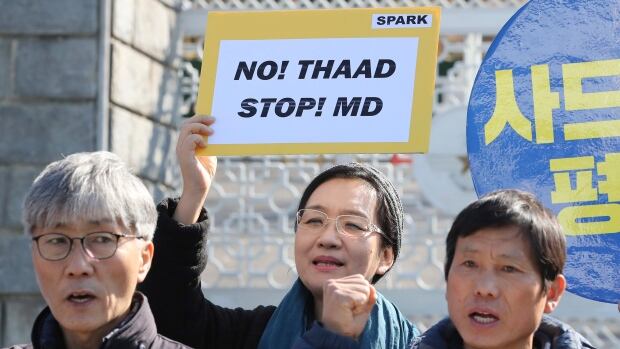
Protesters in Seoul shout slogans during a rally to oppose the plan to deploy the Terminal High-Altitude Area Defense system, or THAAD, in front of the Defense Ministry on Tuesday.

Protesters in Seoul shout slogans during a rally to oppose the plan to deploy the Terminal High-Altitude Area Defense system, or THAAD, in front of the Defense Ministry on Tuesday. (Lee Jin-man/The Associated Press)

China on Wednesday proposed that North Korea could suspend its nuclear and missile activities in exchange for a halt in joint military drills conducted by the U.S. and South Korea.

Foreign Minister Wang Yi likened escalating tensions between the North and Washington and Seoul to “two accelerating trains, coming toward each other with neither side willing to give way.”

“The question is: Are the two sides really ready for a head-on collision?” Wang told reporters. “Our priority now is to flash the red light and apply the brakes on both trains.

Wang said China proposes that as a first step to defusing the looming crisis, the North might suspend its nuclear and missile activities if the U.S. and South Korea halted their military exercises.

“This suspension-for-suspension can help us break out of the security dilemma and bring the parties back to the negotiating table,” Wang said, describing the approach as trying to address all parties’ concerns in a “synchronized and reciprocal” manner.

CHINA-MONGOLIA/

China’s Foreign Minister Wang Yi likened North Korea and those supporting South Korea as ‘two accelerating trains’ on Wednesday. (Jason Lee/Reuters)

China has also rejected accusations from U.S. President Donald Trump that Beijing could be doing more, saying the problem was ultimately between Washington and Pyongyang.

China has been stepping up pressure on North Korea, its once-close…

Complete Story

North Korea warns of ‘actual war’, says it would pursue nuclear deterrent

Continued…

Germany completes return of 300 tons of reserve gold from US

Geir Moulson, Associated Press
Germany completes return of 300 tons of reserve gold from US

Various gold bars, are displayed in the German central bank’s headquarters in Frankfurt, Germany, Thursday, Feb. 9, 2017. Germany’s central bank has completed an effort to bring home 300 tons of gold stashed in the United States, part of a plan to repatriate gold bars kept abroad during the Cold War. (AP Photo/Michael Probst)

BERLIN (AP) — Germany has completed an effort to bring home 300 metric tons (330.7 tons) of gold stashed in the United States, part of a plan to repatriate gold bars kept abroad during the Cold War.

The German central bank said it brought 111 tons of gold back from the Federal Reserve in New York last year, concluding in September — the last of 300 tons slated for return.

“The transfers were carried out without any disruptions or irregularities,” said Carl-Ludwig Thiele, board member of the central bank, called Bundesbank.

Continue reading Germany completes return of 300 tons of reserve gold from US